Secret Chute

House hunting with my enthusiastic contingent, us adults stood in a dim basement yesterday, so cold we kept swaying from one foot to the other, trying to stay warm. Outside, the children tromped in the snowy yard, warmer in the sunlight than we were in the house.

In the basement, someone discovered a wooden chute, carefully nailed shut from the cement floor to the under boards of the dining room above. Intently curious, my friend pried off a board, and I peered up through the darkness where I saw a gleam of daylight through an ornate floor grate.

What the heck?

It made no sense to any of us, running through our logical possibilities.

In the end, blowing on my hands, I said, But it must have made sense to whoever built it. Look at the labor.

Upstairs, the children were laughing and throwing snowballs at each other, busy in their own meaningful kids’ work.

Whether I buy the house or not, we’ve spent serious time already, running palms over pipes, fingering up loose linoleum, rapping on old plaster, getting to know just a few mysteries of this old house.

When the old way of seeing was displaced, a hollowness came into architecture. Our buildings show a constant effort to fill that void, to recapture that sense of life which was once to be found in any house or shed. Yet the sense of place is not to be recovered through any attitude, device, or style, but through the principles of pattern, spirit, and context.

Jonathan Hale, The Old Way of Seeing: How Architecture Lost Its Magic – and How to Get It Back

FullSizeRender.jpg

West Woodbury, Vermont

Lost and Found

Yesterday I found myself in a blinding snowstorm at the Barre courthouse, asking for copies of papers I had lost.

The woman behind the counter asked with disbelief, You lost them? I answered her, Yes, thinking, Lady, if you knew my carelessness…

Those papers have joined the trail of lost keys, cats, single earrings, half pairs of socks, a useful serving spoon, my original marriage license.

The woman disappeared into the building’s depths while I waited in the hall. Then, by chance, I met a friend I hadn’t seen since my early twenties, long ago. In those moments, I had that odd sense of finding my youthful self, as we traded stories about where we are now, in what I hope is merely the middle of long lives.

The woman returned with my papers, my friend headed upstairs, and I went back out into the snowstorm.

…we will lose everything we love in the end. But why should that matter so much? By definition, we do not live in the end: we live all along the way. The smitten lovers who marvel every day at the miracle of having met each other are right; it is finding that is astonishing. You meet a stranger passing through your town and know within days you will marry her. You lose your job at fifty-five and shock yourself by finding a new calling ten years later. You have a thought and find the words. You face a crisis and find your courage.

Kathryn Schulz, “When Things Go Missing”

IMG_0158.JPG


Voting

Less than a hundred years ago, the 19th amendment to the US constitution was ratified on August 18, 1920.

Yesterday, my newly-turned 18-year-old daughter registered to vote for the first time. Not that long ago, on town meeting day, this girl played under long tables in the back of the town hall, burrowing beneath a giant pile of winter coats. This year, she’ll weigh in for herself on numerous votes that day, on town business ranging from electing select and school board members to setting the year’s tax rate.

Like her first day of kindergarten, I couldn’t resist snapping a photo. She politely acquiesced before heading off on her busy way.

The amendment reads simply:

The right of citizens of the United States to vote shall not be denied or abridged by the United States or by any state on account of sex.

Congress shall have power to enforce this article by appropriate legislation.

fullsizerender

Town Clerk’s Office, Woodbury, Vermont

Lying

I laughed at the utter aptness of the Oxford Dictionary word of the year for 2016 – post-truth – but the word (and this time) reminds me of Ernest Hemingway’s famous iceberg theory of writing, his “theory of omission.”

Years ago, when I began writing fiction, I also began reading differently, too, wondering what made terrific dialogue snap, but I also began listening in a very different way, too, and gradually realized our everyday speech often contains variations of lies, intentional or not. Lying by omission slides around in our speech, a somewhat slippery critter.

What’s the story? I sometimes ask my daughters. What’s happening under the surface of our language? Maybe there’s two, three, four stories winding together? Think complexly. Don’t assume.

Perhaps because our political world is so intensely polarized these days, the stories of greed and bigotry and outright desire for power push toward the surface. My suspicion is that this post-truth is apter than I realize, this nearly maniacal intent to create chaos and confusion, to obscure the real threads of the story beneath non sequiturs and outright blaring nonsense. History is one long story of the success of dominance, over and over. Why not chose confusion of speech as the weapon du jour?

Now I will tell you the answer to my question. It is this. The Party seeks power entirely for its own sake. We are not interested in the good of others; we are interested solely in power, pure power. What pure power means you will understand presently. We are different from the oligarchies of the past in that we know what we are doing. All the others, even those who resembled ourselves, were cowards and hypocrites. The German Nazis and the Russian Communists came very close to us in their methods, but they never had the courage to recognize their own motives. They pretended, perhaps they even believed, that they had seized power unwillingly and for a limited time, and that just around the corner there lay a paradise where human beings would be free and equal. We are not like that. We know that no one ever seizes power with the intention of relinquishing it. Power is not a means; it is an end. One does not establish a dictatorship in order to safeguard a revolution; one makes the revolution in order to establish the dictatorship. The object of persecution is persecution. The object of torture is torture. The object of power is power. Now you begin to understand me.

– George Orwell, 1984FullSizeRender.jpg


Slouching out of the Teen Years

This morning the February light shone with that clear and pure quality, as if it might endlessly extend, as far cry from December’s cramped miserliness.

Three nights running now, I found myself after midnight slouching on the couch with my daughter, talking, talking. If there’s any theme to my life and my writing these days, it should include both conversation and crackling woodstove. Domesticity.

I realized last night this young woman and I have entirely emerged from her teenage years. That’s it. All that angst folded up, as if in a fist. Our conversation is sometimes deep running, and sometimes merely about the daily pieces of our lives – who’s picking up the little sister, forward me that email, what do you think about tacos for dinner tomorrow – the day-to-day stuff that comprises our lives. Breathe deep.

Here’s a line from early morning novel reading, one of Obama’s recommendations.

He told her that every one of her enemies, all the masters and overseers of her suffering, would be punished, if not in this world then the next, for justice may be slow and invisible, but it always renders its true verdict in the end.

– Colson Whitehead, The Underground Railroad

fullsizerender

Loon Recovery Project


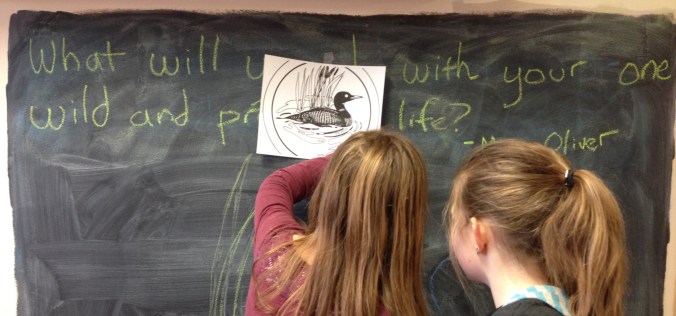
Late last night, while my daughter ate a grilled cheese sandwich before the wood stove, we talked about a slideshow about Vermont loons we’d attended at our library and, with the cold deepening around our house, reminisced about summer nights camping at Ricker Pond in Groton, when we lay awake in our tent and listened to the loons’ wildly beautiful tremolo – a call so bizarre it hovers between our world and the mystery of the unknown.

Remember? she asked. Remember?

Perhaps for no other reason than it’s the last day of January, and winter’s teeth are easing sufficiently I know spring isn’t far in the offing, here’s a Mary Oliver poem.

Lead

Here is a story
to break your heart.
Are you willing?
This winter
the loons came to our harbor
and died, one by one,
of nothing we could see.
A friend told me
of one on the shore
that lifted its head and opened
the elegant beak and cried out
in the long, sweet savoring of its life
which, if you have heard it,
you know is a sacred thing.,
and for which, if you have not heard it,
you had better hurry to where
they still sing.
And, believe me, tell no one
just where that is.
The next morning
this loon, speckled
and iridescent and with a plan
to fly home
to some hidden lake,
was dead on the shore.
I tell you this
to break your heart,
by which I mean only
that it break open and never close again
to the rest of the world.

fullsizerender