School Rules

My teenager, tackling chemistry, doesn’t follow my advice to get some assistance with all those equations. Instead, she cheerfully informs me her teacher did some of her homework. I just asked, she said, and he just went ahead and did them. To say the least, I’m stunned by her happy willingness to make do and glide through a class. The truth is, she cares little (well, possibly nothing) for chemistry, and while I may not either, my own student approach was decidedly more rule-bound – or dull.

Here it is again – this really interesting thing about parenting – seeing my daughter’s skill, from a fairly young age, at navigating the world with a deftness I lack. I’d describe it as Hemingway’s “shock-proof bullshit detector,” an uncanny way of slipping around what appears unimportant to her, with a self-regulating impunity. Nonetheless, I’m pleased to see her immersed in biology….

There’s another trouble with meaning. We’ve been taught to believe it comes near the end. As if the job of all those sentences were to ferry us along to the place where meaning is enacted… Why not begin where you already are?

– Verlyn Klinkenborg, Several Short Sentences About Writing

“This Infuriatingly Intricate Web”

A well-known local author mentioned at the most recent of his readings I attended that he’s writing a book about koans – a book I can’t wait to read, because isn’t life just a series of unfolding koans? Have I ever actually solved one? Some days, it seems to me, not likely.

My daughter spied a V of geese winging south yesterday, the first we’ve seen of this season, but one among countless Vs we’ve watched since she was a tiny girl, her arm crooked around my neck. Fall is familiar, graciously beautiful, infinitely sad, followed by the brilliant beauty of sparse winter: the same Vermont story, year after year, and yet I’m always surprised by the September mornings’ cool mist, the cucumber vines shriveling, all done with this life.

Cooking dinner yesterday, I read an article in the New Yorker about that terrible disease, cancer. Innocuously enough, the article begins with mollusks in Lake Michigan, journeys through seed and soil, and ends with a koan:

… as ambitious cancer researchers study soil as well as seed, one sees the beginnings of a new approach. It would return us to the true meaning of “holistic”: to take the body, the organism, its anatomy, its physiology—this infuriatingly intricate web—as a whole. Such an approach would help us understand the phenomenon in all its vexing diversity; it would help us understand when you have cancer and when cancer has you. It would encourage doctors to ask not just what you have but what you are.

– Siddhartha Mukherjee

FullSizeRender


Hot Goods

One fine Friday afternoon, walking to my daughter’s soccer game, my friends pulled me into their woodworking shop and asked me to take… a sign from an old telephone booth.

Really?  I mean, really?

Your girls will love it, they insisted. I asked, since they were giving away things, could I take a quart of motor oil instead. They said I could have their parrot, and if I really didn’t want the parrot, how did I feel about kittens?

So I took the sign, carrying what was doubtlessly stolen goods from intercity Boston decades ago, and went back to the high school.

My daughter said, You’re kidding me? Her friend remarked it wasn’t particularly attractive. These comments made me point out that, years ago, this stuff was well-made, and the sign was darn heavy. As an additional plus, it doesn’t talk back to me, unlike a parrot.

….a huge percentage of the stuff that I tend to be automatically certain of is, it turns out, totally wrong and deluded. I have learned this the hard way….

– David Foster Wallace

FullSizeRender

(I don’t make up all this stuff.)


Rain This Way

Cricket songs and screeching starlings. In little flashes, the world around us brightens in bits of red, preparing for autumn.

My daughter, busy with middle school and soccer all day, leaves her hula hoop as a calling card for any stray visitors. Reading the lines below, I think they may apply equally to parents of young children. In theory, we might believe our babies will one distant day shoulder a backpack and venture into their own journeys, but in practicality lies the rub….

We typically take the world of our day-to-day lives far too much for granted, assuming without much thought and despite all evidence to the contrary that what we see before us is just the way things are – and presumably always were. This is, I think, especially true of many young people….

From William Cronon’s Changes in the Land: Indians, Colonists, and the Ecology of New England

FullSizeRender

Romance into the Grave?

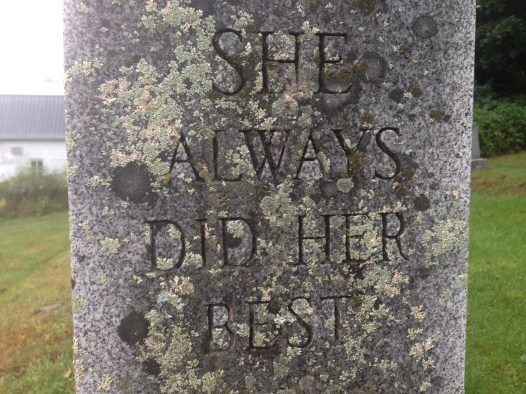
Just on the other side of my garden lies a town cemetery, wisely placed far above Hardwick’s flood plain, with a rooftop view of the village, built on a sandy hillside and along a river. Interestingly, the villagers frequently use the cemetery as a public green space, and older women with little dogs or couples holding hands frequently pass by my elderberries.

New to this house, my daughters and I leap the fence and are beginning to know these stones – names and dates and what little local lore we’ve garnered.

Our favorite is the couple with a pithy phrase on one side – She always did her best – and on the other end – He did not. Our visitors usually pause, blinking, and then laugh out loud.

By the dates, I notice he died twenty years before his wife.

Revenge or love? It must be love. My daughters and I – we’re sticking with that theory.

We could have some arrangement
By which I’d bind myself to keep hands off
Anything special you’re a-mind to name.
Though I don’t like such things ’twixt those that love.
Two that don’t love can’t live together without them.
But two that do can’t live together with them.
From Robert Frost’s “Home Burial”
IMG_1875

Hardwick, Vermont

A Single, Superlative Sentence

Like this cold September (what? covering gardens already?), reading Knausgaard is both exasperating and mesmerizing. Does he really live in a house with small children and can write about minutiae?

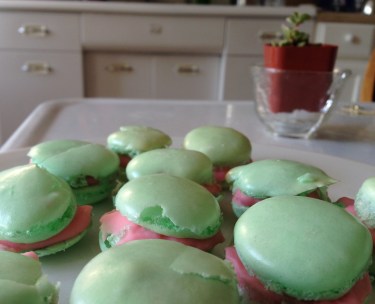
Reading at the kitchen table, my bare toes rub over the sugary effluvia of lime-green macaroon making on the floor. I keep reading.

The children wander in for more macaroons, my daughter’s afternoon vision yielding these quarter-sized airy sandwiches with a pink sweet filling.  While I was in the other room, trying not to listen while tediously working on a paid project, the girls, left to themselves, experimented with baking whipped egg whites (Wow, that’s weird), periodically carrying in a baking sheet of baked samples, the hot sugar still bubbling from the oven, asking my unskilled opinion. In the end, they assembled two dozen uneven tiny cakes, dripping filling. Extremely satisfied, they stand back. Look.

Writing this, I realize (again) our life is all minutiae. Maybe that’s the gem of having children – tiny things mixed in with cosmologically-sized love – Blake’s world in a grain of sand.

Check out this sentence about ancient triceratops and reading to children at bedtime.

That petrol (in a puddle) was extracted from crude oil, which was brought up from reservoirs deep under the ground and consisted of transformed organic matter from a time when human beings didn’t exist, only dinosaurs, those gigantic but simple creatures, and when trees and plants too were larger and simpler, and that it was the prehistoric force of that zoological and biological matter which now unfolded around us, all this made sense – the kinship between the bulldozer and the dinosaur was obvious to any child – but not the connection between the power of petrol and the mysterious beauty of the small trembling rainbow swirls in the many puddles of the 1970s.

Karl Ove Knausgaard, Autumn

FullSizeRender