Gliding

10º below zero this eve of 2018. Like an oddly magical gift, I woke from a dream of visiting a woman with whom I’d had conflict, conflict, and I lay as the day’s light slowly trickled into the room, rubbing a happy cat and thinking I could release that piece of worrying.

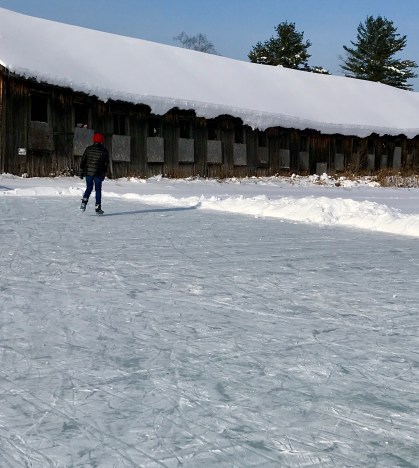
One more year slipped by, my younger daughter officially leaving the terrain of babydolls for the mountainous terrain of adolescence. Here’s a good thing I fostered: ice skating.

If it is written and read with serious attention, a novel, like a myth or any great work of art, can become an initiation that helps us to make a painful rite of passage from one phase of life, one state of mind, to another. A novel, like a myth, teaches us to see the world differently; it shows us how to look into our own hearts and to see the world from a perspective that goes beyond our own self-interest.

— Karen Armstrong, A Short History of Myth

IMG_0750.jpg

Cold Snap!

Our neighbors borrow my teenager’s hair dryer to thaw their pipes. It’s 14º below zero, and they’re confident their situation is minor. Gossip winds around town of whose pipes have frozen. This morning, I woke in the dark with a cat purring beside my shoulder. My daughter, 19, gets up with me in this predawn and says she doesn’t know what she should do with her life.

Aim to do something you’ll be proud of, I suggest.

Deeper than 20º below is when the bitter cold really sets in. The lowest I’ve seen the thermometer is 40º below, in farm fields along the Lamoille River. A ghostly mist ambled around, as if we were in an otherworldly dream.

This is the season of library books, board games, knitting — one year ebbing into the next.

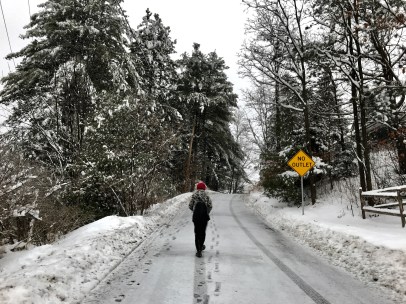
Although there is the road,
The child walks
In the snow.

— Murakami Kijo

IMG_0654.jpg

Main Street, Hardwick, Vermont

Levity

My daughters and I drove north over snowy roads to have dinner with friends who were staying for a few days at a house built by a ship captain in the 1800s. The house is on exquisitely beautiful Lake Willoughby, deep into what I consider “way out there” in Vermont — but that’s all in one’s perspective, isn’t it?

I would have walked around that three-story house for a day and a half, just looking at room upon room, like an enormous treasure or jewel box. Fortunately, my friends know me and were nonplussed when I rubbed my hands over the peacock tails in the downstairs wallpaper. My teenager sprawled before the fireplace and said, We’re not leaving.

An oak table spanned the length of a long room that must have originally been a veranda. At dinner, the kids filled their plates and sat in a row on one side. I walked around the table and sat with my back to the wall of windows. It’s December and darn cold, and the kids, being kids, had likely sized up the draft on that side and chosen the warmer one. Or maybe they just wanted to be closer to the berry pies…

My friend’s elderly father sat beside me, and, after precisely cutting his meat, said very pleasantly, A bit of air conditioning tonight, isn’t there?

Driving home in the dark, around Runaway Pond, through the Bend, past dairy farms hazily illuminated by the moon darting in and out of scudding clouds, I thought of all the stories that house must contain, how all our lives are clumsily packed sieves of so much jumbled living — radiant happiness, crushing misery, sometimes dullness, aching and unmet desire — and then the levity of that sweet sentence rose again into my thinking.

One terrible thing about divorce is losing the person who holds the other half of your shared secrets. That highway north was studded with memories from the very earliest days of my marriage. Driving north, I passed those places and said nothing, knowing the only way to continue is to create.

So when my daughters asked why I was laughing as I drove those final miles home, I told them I aspire to have that gentleman’s light grace when I’m a little old lady, with — God willing — many more miles traveled.

I have one of those very loud, stupid laughs. I mean if I ever sat behind myself in a movie or something, I’d probably lean over and tell myself to please shut up.

— Holden Caulfield

IMG_0727.JPG

Daughter at work, home, Hardwick, Vermont
Hardwick Postcard #9 1/2: General & Particular

On this eve, two photos: one of generalness of American life, the sludge of hurrying here and there, fueled by the genericness of roadside gas and plastic-wrapped convenience food.

Within all this, the utter uniqueness of my older neighbor opening her storm door for a long-haired feral cat, the loud boys across the street pummeling each other with snowballs, my daughter walking home, eggnog and a gift for her friend on her back.

I do not understand the mystery of grace — only that it meets us where we are and does not leave us where it found us.

— Anne Lamott

IMG_0668.jpg

Hardwick, Vermont

IMG_0665.jpg

Hardwick, Vermont

Hardwick Postcard #9: The Close and Holy Snow

I’ve never lived in the tropics, but my friend has, and she’s remarked on the suddenness of nightfall in that region of the globe. A crepuscular walk in autumn’s lengthy twilight is a boon of Vermont living. The first solid snowfall of the year is another.

Now just a few days before Christmas, the other night my daughter and I were in Montpelier, in the frantic traffic, the rush of after-work shopping, and so this morning, when the snow began falling, one silent flake after another, the dawning day seemed filled with a particularly brilliant kind of light.

Whether we want the snow or not, it will come, and a snowstorm always sheds a certain silent grace. When my children were very small, more than anything, I wanted Christmas to be full of joy. Like so much else in my life, I’ve half succeeded and half utterly failed. We’ve had plenty of joy and lavish laughter, but the older I get, the more I understand joy travels hand-in-hand with sadness and grief, too — that the exquisite beauty of that snow carries a killing cold as well.

I think it’s taken me all these Christmases to understand the spirit of this season is so perfectly illustrated by Dylan Thomas’s “close and holy darkness,” and that the most miraculous aspects of this season are the profound mysteries upon mysteries unfolding despite (and perhaps in spite of) my own blind ignorance.

Today, watching the snow fall, my face upturned to the clouds, I remembered being ten-years-old and speculating with my sister about the origin of all those millions of snowflakes, drifting and twirling down. What did it look like, so high above our heads in those clouds?

Awesome.

And when the firemen turned off the hose and were standing in the wet, smoky room, Jim’s Aunt, Miss Prothero, came downstairs and peered in at them. Jim and I waited, very quietly, to hear what she would say to them. She said the right thing, always. She looked at the three tall firemen in their shining helmets, standing among the smoke and cinders and dissolving snowballs, and she said, “Would you like anything to read?”

— Dylan Thomas, “A Child’s Christmas in Wales”

IMG_0644.jpg

Jeudevine Library, Hardwick, Vermont

Hardwick Postcard #8: Talk, Talk

There’s not a bland way to write this: gossip is part of the human condition. Gossip in a small town? Can be funny. Or scorching.

Arriving at a library meeting, someone walks in and says, I’ve been to the post office. I’ve got gossip.

I come out from the stacks where I’ve been shelving books and say, Do tell….

I spend a lot of time at the post office, and I frequently have the odd sense the post office folks know me intimately. While my email inbox may have more details, a whole landscape of my life channels through that slender box. Like gossip, sometimes the mail’s good, sometimes bad, and sometimes rather dull.

From the post office gossip unravels laughter, but then much seriousness, too. The story is about one person, one family, but really about our community. In a multifaceted way, it’s a variation of the contemporary disfunction of our greater society, about emptiness and loneliness, and the natural lust to fill those caverns in our souls, and how badly awry human nature can go.

Then we stop talking for a moment. We just stop.

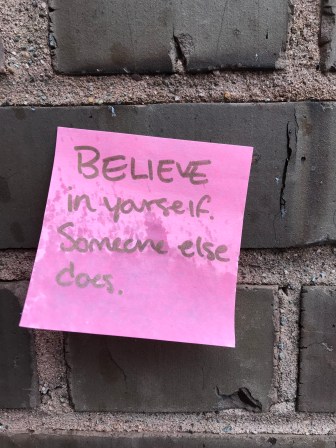
Later, my daughter sends me a photo of a post-it she found on a classroom building at Johnson State. She snapped the photo and left the note for another passerby to read.

Reading fiction not only develops our imagination and creativity, it gives us the skills to be alone. It gives us the ability to feel empathy for people we’ve never met, living lives we couldn’t possibly experience for ourselves, because the book puts us inside the character’s skin.

– Ann Patchett

IMG_1900.jpg