Laughter, Light

Standing in mud and slush in the dark last night, we watched women spinning cords with knots of flames. Their faces concealed in the darkness, I listened to the women talking and laughing, each of their laughs remarkably distinct.

Later that night, walking down Montpelier’s State Street, with hardly anyone around, we admired the mighty Christmas tree at the State House. On the capital’s shiny dome, Ceres — goddess of agriculture, grain, and motherly love for children — reigned.

Vermont — realm of wild blackberries, chittering sparrows, lush forests, and the deep, dark winter. There’s no denying this state holds its portion of troubles, but also the willingness to lift fire, spin it around in the darkness, and laugh.

Take bread away from me, if you wish,
take air away, but
do not take from me your laughter….

— Pablo Neruda
IMG_4106.jpg

The Physical Good

My 13-year-old’s wild to travel. I see in her eyes, in her schemes, as she wonders where her life will go, which way she can push her boundaries. I understand this sentiment. At 22, I gave little thought to a 9,000 mile cross country trek, save swapping a gas-fueled Toyota for a diesel Rabbit. This was during the first Gulf War, when the price of gas soared.

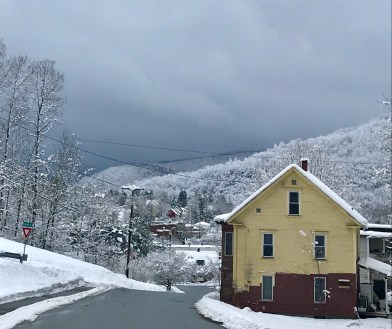
But now? Maybe it’s the early onset of snow that’s choked so much of Vermont’s roads or — more likely — simply that I’m at the place in life where I think, heck, remain rooted. Figure out this one particular place.

Walking after dark — darkness falls so early, early these days, before I pull out my cutting board to begin preparing supper — I think of Chris Hedges’ line: faith is the belief that the good draws to it the good. I read this good as a verb and not a noun. What a notion — that goodness is a physical force in the universe. I know violence begets violence, that using drugs leads to more drug use, that civility in a house tempers anger, knocks down the edges, and bends dialogue towards decency — and that the inverse of this is true, too.

On our back porch, the wind chimes call in a scatting of cold breeze this morning. Later, in the rising light, cardinals will appear, flashy red against all this white.

IMG_4065

13-year-olds

Returning home just after five yesterday, darkness enveloped our house — deep, whole, profound. Through the windows, I saw my girls had turned on the strings of tiny white twinkling lights.

The winter solstice is weeks away, and three times I’ve driven through snowstorms. Wet snow, crashing from our roof to the back porch, frightens our quivering cats.

Meanwhile, in our house, life swirls on. Each of us goes our own way — to school and to work — separating and returning. At night, brushing our teeth together, we look in the mirror — three different heights, three different females. At 13, the younger daughter looks to her older sister as she always done — mimicking clothes, language, habit — yet different, too. Year 13 marks the chrysalis age, between childhood and womanhood.

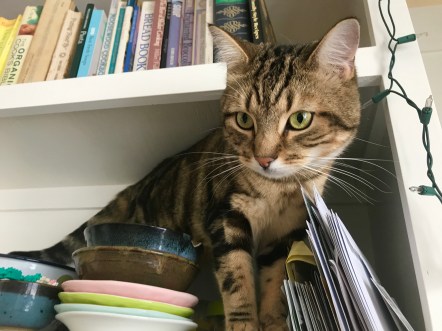
This daughter tends her two beloved cats with silliness and seriousness — making them wait patiently for their meals and also carrying them like furry purring babies around the house. Watching her, I take note.

What good is the warmth of summer, without the cold of winter to give it sweetness.

John Steinbeck, Travels with Charley: In Search of America

IMG_4056

Our kitchen life….

Sparkles

The phone rings early this morning with news of the third snow day in November. Complex math and prediction skills aren’t needed to guesstimate that school for my 8th grader will drag far into June — sweet, rose-scented June. In late June, we’ll be camping on the shores of Lake Champlain in our annual, always filled with laughter camping trip.

I close the Chris Hedges book I’m reading — the book jammed with history and intimate detail — tug on my boots and go out to shovel. It’s so warm, I don’t need a hat or mittens, don’t even really need a coat. As I shovel, I think of Hedges. How right he is the political ramrods my own private family life, too, that the tangle of economics and autonomy and gender weren’t created within my four walls.

Snow falls very lightly, nearly imperceptibly in the light from my house. A whole day stretches ahead, but it’s beginning here, in this pristine beauty.

America was founded on an imagined moral superiority and purity. The fact that dominance of others came, and still comes, from unrestrained acts of violence is washed out of the national narrative. The steadfast failure to face the truth, Baldwin warned, perpetuates a kind of collective psychosis. Unable to face the truth, white Americans stunt and destroy their capacity for self-reflection and self-criticism. They construct a world of self-serving fantasy.

Chris Hedges, America: The Farewell Tour

IMG_4028

Where We Are Now

Winter socked us in early this year, the old sheet I used for covering the remaining mesclun greens still draped over the garden fence, nailed down to the earth by snow.

Preparing to read Mary Azarian’s Snowflake Bentley book to the elementary kids, I request Bentley’s own book from interlibrary loan. As I open the cover of an old copy, I remember when my father first showed my siblings and I this book, so many years ago — the glossy pages and pages of winter’s crystalline beauty.

My older teen — in her high heel boots — complains of cold. Then, invited to sled at night, she packs her bulky winter clothes. Returning in the deep dark, her eyes glisten.

 … though the beauty of the snow is evanescent, like the beauties of the autumn, as of the evening sky, it fades but to come again.
Wilson A. Bentley

Unknown

Library Afternoon Snapshot

A woman stops in my library — new to town and looking for basic info about an internet connection and where to buy food. She’s getting the lay of this corner of Vermont’s territory. Early afternoon, the school kids are paired up around the library, working on projects — some seriously, some intently goofing off.

It’s drab November, and the woman stays for a long while, using the library’s internet connection. Her friend calls the library and arranges to meet in the parking lot, exchanging a microwave. School morphs into after school by then, and the kids merge back into the library. A parent takes three crying girls aside and demands the drama to cease. A little boy chats with the woman in the library who pauses in her work and answers his questions. The kids pull out their newest craze — the chess sets.

Through all this, I keep introducing the woman to anyone who comes in the door.

When I leave at 5 p.m., darkness folds around the library. The woman has left with an armful of books; the children have all gone home. A few adults are picking up yet.

I turn down the heat in this library — a kind of living room lined with books. Then I head home myself.

The library might have been the first place I was ever given autonomy. Even when I was maybe four or five years old, I was allowed to head off on my own.

— Susan Orlean, The Library Book

IMG_3992.jpg