“Like a definition of love…”

Eight summers ago when my daughters and I first moved into this house, we swam in a nearby pond, usually with friends who lived nearby. In those eight summers, the kids grew up and are now swimming in other lakes, other ponds. I kept on. The swimming and conversation was a peaceful way to end jammed and often chaotic working days.

Late last fall, as part of extensive testing after I was diagnosed with lymphoma, I realized I had Giardia, too, proverberial small potatoes compared to cancer and easily treated. This year, I never started swimming. In May, I’d endured a painful surgery with a lengthy incision that needed to heal. That nearby pond was the most likely source of the Giardia.

This August, a friend convinced me to swim at #10 Pond, familiar territory between our two houses, another place where my daughters and I swam and kayaked and picnicked. I arrived a few minutes early, opened my book, and the loons cued. This pond has always been one of my favorites: clear water, friendly fellow swimmers, scant motorized boats, little development. The water was cool. Kicking my legs, I felt my incision tug, but it was a sensation, nothing more. Afterwards, we lingered, drying and warming in the sun.

Yesterday, I was in sultry Barre and drove by the pharmacy where I had the go-around with the pharmacist and sharply insisted he fill my dilaudid prescription. I was on my way home from yet another lengthy stay at Dartmouth. We had to wait for the prescription, so my brother and I walked around Barre. It was early spring, hot, and the trees hadn’t yet leafed out. He’d parked on a hill and worried I couldn’t walk back up. I’d been on blood thinners, and the bandage around my IV site was soaked with blood. Don’t open it up! he warned me. It was so dusty and hot, and I was exuberant to be in the world where daffodils were blooming.

So yesterday, on my way home, I stopped at #10 Pond again, swam and read and listened to a nearby conversation between two men who were fishing — and the loons, of course, the loons.

We’ve now crested beyond the high summer. Each August day offers its own potential, for swimming or heartbreak or simply eating ripe peaches. Reader, wherever you are, love at least slices of your lives and places.

I’m about to send off a third novel manuscript to an interested party. In the dark this morning, I woke and began the book I’ll write about cancer and motherhood. Sure, cancer changed my life in small and great ways, but a year later it’s still the same me, rowing my life against the common current, compelled to write something that seems impossible.

And, for historical and record-keeping notes, I’ll add that the full moon, the Sturgeon Moon, rose smoky and red, ineffably beautiful over the cricket chorus.

“Green Apples” by Ruth Stone

In August we carried the old horsehair mattress
To the back porch
And slept with our children in a row.
The wind came up the mountain into the orchard
Telling me something:
Saying something urgent.
I was happy.
The green apples fell on the sloping roof
And rattled down.
The wind was shaking me all night long;
Shaking me in my sleep
Like a definition of love,
Saying, this is the moment,
Here, now.

Wildfire Smoke.

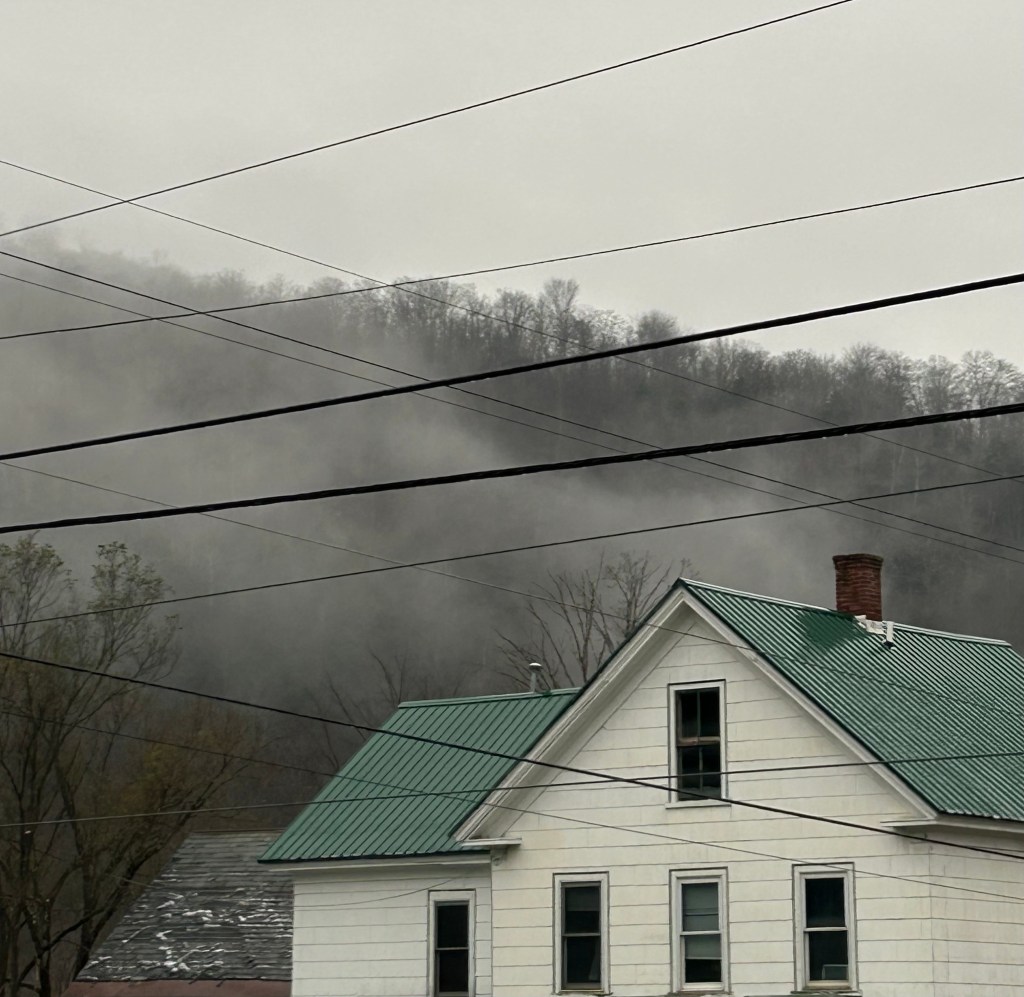
Are these days hot or chilly? All afternoon, working on my back porch, I put on and take off my sweatshirt, step into the sun to make phone calls, lean against the cool clapboards with my laptop. For days now, the air has been smoky with wildfires far away in the north. In the mornings, I wake coughing, wondering how people are breathing, so much nearer these fires.

August, and the raucous summer abruptly quiets. Walking in the woods with a friend, she notes a bird singing — wood or hermit thrush? — but all else is quiet save for our conversation. I’ve been here before, the pause between high summer and early autumn, when the swimming’s still good and the sunset lingers long after supper, but the mornings are filled with cool mist, and the shadows are not warm.

In past years, the faintest shadow of Long Winter has filled me with dread. Again, I will lose my tan, carry my laptop to the kitchen table, maybe go mad talking to my cats. Or not. Twice a day, I water the nasturtiums hanging in baskets on my back porch, listen to the neighbor boys biking. These days are yet long.

From Sunday poetry readings at the local arts center…

Wavering

What makes you think you’re so different? 
That was my weaker self hanging around outside the door. 
The voices over the telephone were accusing, too. 
“Must you always be you?” (They had the advantage, 
More bold without faces. They swirled a few ice cubes 
With a suggestive pause.) For a moment 
I took my heart out and held it in my hands. 
Then I put it back. This is how it is in a competitive world. 
But, I will not eat my own heart. I will not.

~ Ruth Stone

The Might of Flowers.

My daughter suggests I get coffee before driving home. It’s midnight, balmy. Sprinklers water the grass outside the airport. After the New Mexican desert, the air is redolent with growth. Thinking gas station coffee will be sour, I pass, and buy lemonade instead.

In Burlington, the streetlights blink red, and I drive quickly through town. My daughter lives in a neighborhood where gardens and yards spread into the sidewalks. Hollyhocks lean out from the neighbors’ front porch. I’m reminded of my graduate school days in Bellingham, Washington, when the world seemed chockfull of flowers whose names I had yet to learn.

Then, it’s a long drive home through the darkness, with no traffic and the Daily podcast about The Great Gatsby. In this week, my garden has grown wildly, the hydrangeas pale globes in the dark. For a moment, I stand in the driveway, suitcase in my hand, staring up at the sky and breathing in the wet air. There’s that line in Gatsby about the impossibility of repeating the past — or Gatsby’s wager that, indeed, the past can be salvaged. Returning from New Mexico is always this complicated mixture of past and present. My birthplace, Northern New Mexico holds my earliest memories, of listening to the wind and squeezing red mud between my bare toes. Northern Vermont, where I’ve lived for decades now, is suffused with my bad past of a marriage gone awry, a story I can’t shake.

Yesterday afternoon, talking with a friend, I felt myself slipping into the past again, that sinkhole. But don’t we all have that? Heading into this summer, I believed that nurturing the flower gardens around my house would sweeten my life, balm the ravages of the cancer world. A few years back, I planted compass flowers, the six-foot high plants I wrote into the ending of my last book. The plants are now blooming their sunshiny joy. This morning, goldfinches layered in the leaves and petals. I crouched on the dewy grass, in the here and now, nowhere else.

“The need is not really for more brains, the need is now for a gentler, a more tolerant people than those who won for us against the ice, the tiger and the bear. The hand that hefted the ax, out of some old blind allegiance to the past fondles the machine gun as lovingly. It is a habit man will have to break to survive, but the roots go very deep.”
― Loren Eiseley

Our World for this Moment.

In the Heidi book that I read over and over as a girl, Heidi’s invalid friend Clara visits the Swiss Mountains and becomes healed. These days, hiking in the New Mexico mountains, I keep thinking of this child’s book. In the high desert country, hiking through an aspen forest, I forget I’m in recovery, forget that scar on my abdomen, forget everything but the breeze against my cheeks, the desert sand and stone beneath my soles.

This is a family trip to see my aging father, with all the sweet and bittersweetness of family. Here’s hoping all of you are enjoying July wherever you might be. For me, too, these trips make the journey home happy.

“If you take a flower in your hand and really look at it, it’s your world for a moment.”
― Georgia O’Keefe

Keeping Company. Neighbors.

A friend mentions her mother has an art opening that evening in the sprawling building that was once the village inn. We’ve just returned from a walk and stand in a field where, 25 years ago, she sold homemade pies and I sold maple syrup. We each held a nursing baby, in those years.

Her mother lives beside me, so about eight o’clock, the time I’m usually brushing teeth or walking around the house putting water glasses and cat bowls in the kitchen sink, I pull on a sweater (hello, Vermont July) and walk downtown. Monday, hardly anyone is out this evening, as the sunset does its peach-and-rose watercolor magic along the mountains.

I’m amazed, again, at my neighbor’s talent, her unique vision a mixture of O’Keeffe and Cézanne. I stand holding her hand and talking, this woman who lived plenty of lives before I met her. When I weed my front yard garden, she’ll sometimes lean out of her door and holler, “Hello, neighbor!” her hair in plastic curlers.

I walk the long way home through neighborhoods where the children have been called in for the night. Stray teenagers are out; no one else. There’s no glimmer of moon, but the stars are winking into their nightly places. I take an extra loop, and the darkness folds around me.

I’m in this odd place where people I hardly know touch my shoulders, rub my growing-back hair, as if to confirm that, yes, I’m alive. Or I’m looked at silently, uncertainly. The cancer’s made me rougher and gentler. Disinterested in cattiness, willing to visit a neighbor when my body aches to lie down.

At home, I linger on the house steps, the tree frogs serenading. These summer days are long, long, with some hours of work. More than anything, I’m determined to finish a draft of this third novel, determined to sell this book, too. Stubborn my mother would tell me. You’re so stubborn. By now it’s dark, the scattered village lights cupped in the town’s narrow valley, the Milky Way a silent celestial river. My mother despised my stubbornness, this trait that mirrored her. Or maybe I’m completely wrong about that.

I water the hanging plants, and yet I’m not willing to go in for the night, lie down and read, sleep. Last November, I was sitting on these steps in the darkness, the news of having cancer fresh and raw. A different neighbor appeared and sat with me. We talked about opioids and THC. She told me about her husband’s death. In the chilly November, we sat in our coats, a quiet between us, she keeping me company.

“The purpose of poetry is to remind us
how difficult it is to remain just one person,
for our house is open, there are no keys in the doors, 
and invisible guests come in and out at will.”
― Czesław Miłosz

Blue Dress, Loving the Liminal.

I stopped by a friend’s house where I’d not been in over a year. A friend who visited on my worst days, the first hours after chemo when, drugged and miserable, I could barely voice a request, Please, pick up my library books to get me through these days. I leave with my heart full as a flower bouquet, thinking of her mixture of domestic gardens and where the wild slips in…

Now, midsummer, the days as long as anyone could wish for. The cats and I are up with the sun spilling over the horizon, for kibble and coffee and more coffee. My daughters and I meet to do humdrum things, buy cat food and toothpaste. Walking on Vermont Land Trust property where we’d never been, we discover a children’s garden and wander through tunnels of grapevines to a toddler-sized table where we kneel, surrounded by walls of mammoth sunflowers.

It’s an ordinary day. We eat lunch, and my oldest buys chocolate cake, and we keep talking about the things that are unique to Family Us and the things that aren’t, like the news of Stephen Colbert’s imminence disappearance and the mad mad world.

In the sunlight, moving neither quickly nor slowly, we wander into a thrift store. As we wander around, I remember that this is a place where, last fall, I thought I would never return, that these ordinary days that seem so inconsequential would cease with my life.

I buy a summer dress for six one-dollar bills and nod a thank you to the young clerk who wishes me Enjoy!

I hug my daughters, hug them again, and in my own town again I pick up my library books and lie on the couch reading Jane Hirshfield’s words about liminality and poetry. Liminal, liminal, echoes in my mind. I close the book and walk my four-mile route along the river, the water murky and yet sparkling with sunlight shards as the current bends through curves and around rocks. I keep pondering liminal, that threshold between two realms, how I’d been in that thrift store numberless times, sometimes cheery, others frustrated with how the world wears you down, through parenting and worrying and hardship.

Today, I left that store with a folded piece of blue and white cotton, my body and soul electrified as if I had quaffed sunlight. Liminal. My daughter reminded me recently of that long April day that I broke, the day I cried all day long in the Dartmouth emergency room, and she kept going outside to call her sister. In a windowless room, I was desperate for spring sunlight. Hirshfield writes, “The threshold brings its riches, but its barrenness contributes as well.” Liminal.

“On Climbing the Sierra Mountains again after 31 years”

Range after range of mountains
Year after year after year.
I am still in love.

~ Gary Synder