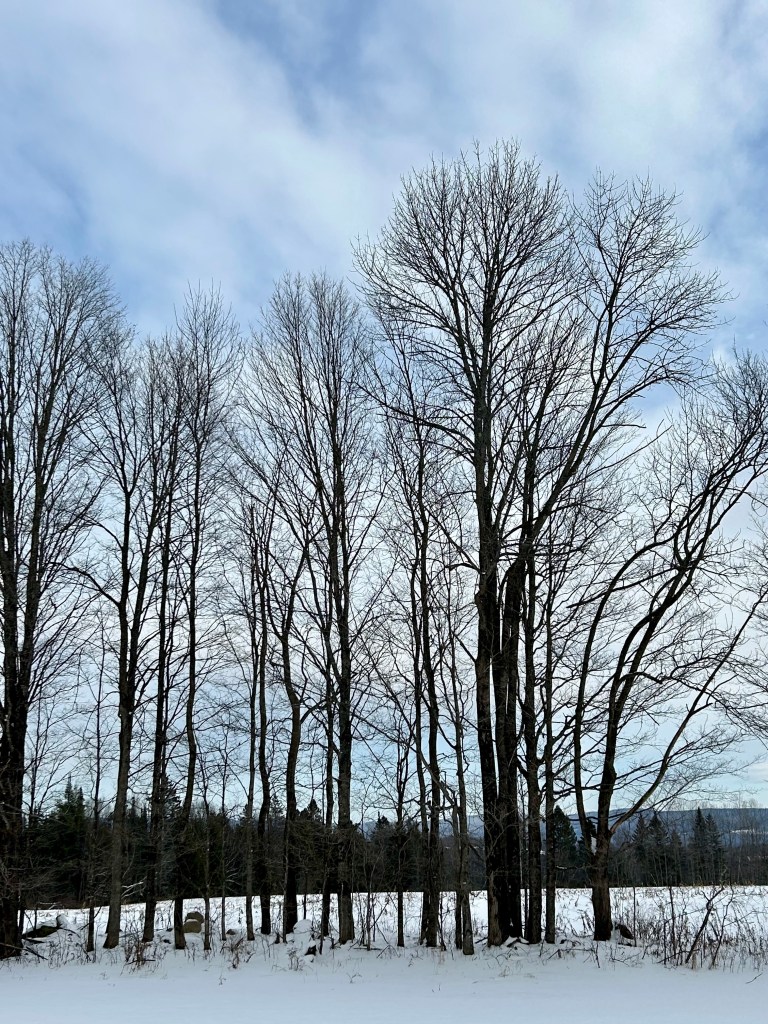
Crossroads.

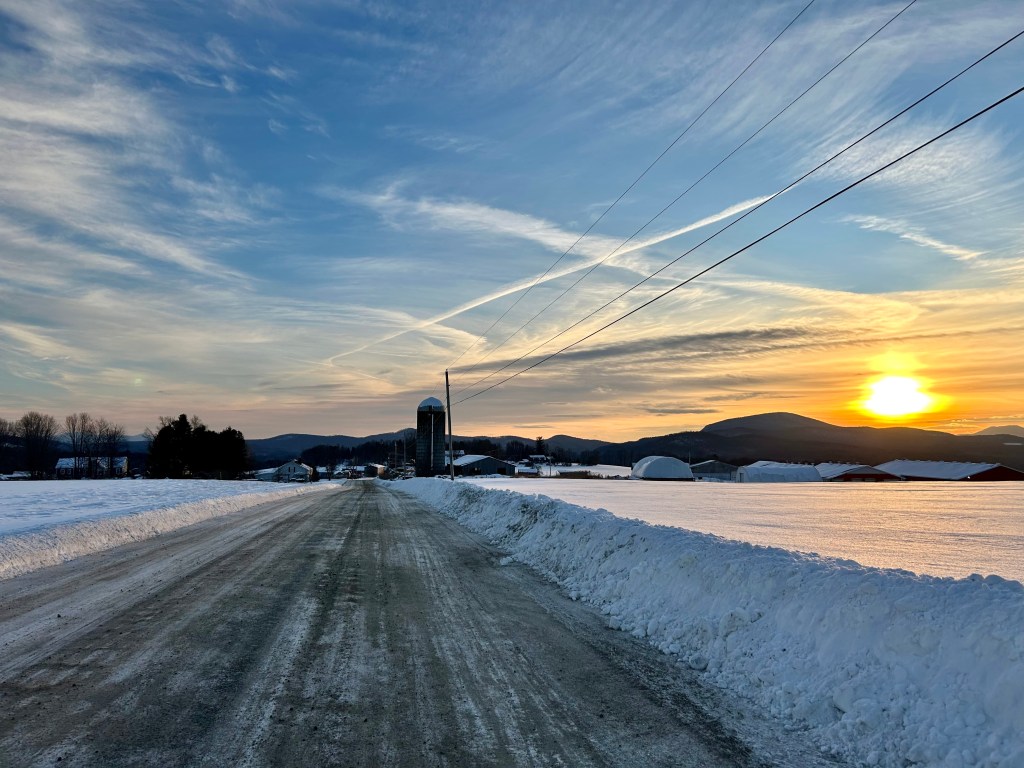
I park at a dirt crossroads this weekend beside a former tavern and walk up the hill to the Old West Church. The sunny afternoon speckles through the roadside maples, and I meet others doing what I am, in pairs or singly, and we greet each other, cheerily. At the Old West Church, I hear two terrific poets, but on my walk back to the tavern the line that runs through my head is from a Franz Wright poem, There is but one heart in my body, have mercy/on me, an incantation.

I keep thinking of my dead mother on this radiant Sunday, my mother who pulled her last breath a year and a half ago, hardly a hopscotch jump ago. In my mind, I’m building the architecture of what I’ve tagged as this Cancer Atlas I’m writing, scaffolding this book’s bones. The book is about the here-and-now, about living (at least for now) through a terrible disease, about walking along Vermont’s autumn-gold back roads, about pulling up this summer’s frost-killed pepper plants that produced so bountifully this summer. And my mother? As I work, I think so often of her, this woman both generous and mercurial, the double blade I harbor in my own heart. Gracious, how much she’d enjoy this picturesque walk. She was a woman who loved old churches, was fascinated by adjacent cemeteries, who would have relished the art in the tavern.

At the tavern, I linger in an open doorway, talking with a curator, drinking iced tea from a half-pint jar. My mother would have drunk the wine, feasted on the cured meat and seeded crackers. Dust kicks up in the road. Old friends appear, and we joke about winter’s ferocity. It’s always a crossroads, isn’t it?

“We are created by being destroyed.”
― Franz Wright

Touching the Earth.

Right at the solstice, frost.

My garden planting this spring was a combination of friends who appeared and weeded and planted, of the sunflower seeds I sowed and the woodchucks ate and I replanted and the woodchucks devoured again, of volunteer calendula and love-lies-bleeding and towering gold sneezeweed, and the pepper plants from a friend that produced in enthusiastic abundance.

Hurray for the garden. These evenings when I light the first wood stove fires of the autumn, my cats chew shreds of birchbark, sprawl before the warm stove. Hurray, they purr in their cat way.

Season’s change again, so familiar and yet different, each day fresh and welcome. Season’s change for me, too, some days filled with friends and colleagues, other days I hole up and get my work done. Writing now about cancer, I imagine holding this keen awareness of my mortality, of the perishable world, in my hands: a tender-eared rabbit, a vicious rat, or maybe simply a handful of sunlight.

In the deep fall
don’t you imagine the leaves think how
comfortable it will be to touch
the earth instead of the
nothingness of air and the endless
freshets of wind? And don’t you think
the trees themselves, especially those with mossy,
warm caves, begin to think
of the birds that will come – six, a dozen – to sleep
inside their bodies? ~ Mary Oliver

Habits of the Heart.

A radiantly sunny September afternoon, I’m at the northern edge of Caspian Lake, an afternoon with the slightest of breezes so the water shimmers and ripples. The summer people have all returned to other places, the local families at work or school, so it’s just me. For the longest time, I stand at the edge of the long dock and watch a bald eagle fly low over the water, then circle back and disappear into the woods.

Where do you find succor?

For years, with little girls, I spent hours with my friends at the public beach on the other side of the lake. Our worlds dispersed now, I haven’t walked there this summer. In no rush on a day that’s already been crammed with people and my to-do list, I take the longer trail back to the road. The usually wet forest is so parched the boardwalk bridges span over dry soil.

As the afternoon folds down, I take a walk along the river, the path I’ve been following all summer, watching the trout lilies give way to soapwort to the persistent asters. A pickup truck idles across the trail. A woman I knew years ago from a library kids’ group waits for me to pass, then ropes off the trail so she can move her cows from one pasture to another.

On my way home, I stop at the co-op for vinegar and coffee beans and cashews. A stranger says hello in the bulk aisle and reminds me he’d passed me on the trail, he on a bike and me walking in sandals. We talk about the moon and a star named Arcturus. When we part, he says, “See you on the trail — a metaphor for life.” Slow I am these days, as if I’m floating on my back in a warm pond, my eyes open to this flawless blue sky, the undulating water gulping in my ears. Autumn, this heartbeat of beauty, its own true metaphor.

… From this week’s New Yorker:

… what made America great—were “habits of the heart”: the everyday engagement of citizens that sustains institutions by holding leaders to account. Habits fade, but they can also be revived.

Moonrise, More.

Barn door view.

An old friend unexpectedly appears at my door one evening as I’m folding laundry. We sit on my back porch and drink hot honeyed tea and watch the just-beyond-full moon slowly rise. September, the night’s chill creeps in around us. I grab my hat and coat and brew more tea.

All this fall, I’ll be thinking of a year ago, when I was getting sicker and sicker, with no real understanding why until that terrible night in the ER when a scan revealed cancer, so much cancer. Heading towards a year later, I’m admiring the moon sail over the mountain ridge and up through the trees. We keep talking and talking. It’s not so much the words that stitch us together but our chuffing breath that hangs in clouds between us, a howling neighborhood dog, a rustle in the ravine of a wild creature.

After my friend leaves, I wander around the moonlit garden, hands in my coat pockets, the tall amaranth a shadowy forest beside the closed four o’clocks. Frost is not far in the offing.

Inside, a daughter has texted me….. where are you?… Outside, breathing in the moonlight. Still here.

Instructions on Not Giving Up

More than the fuchsia funnels breaking out
of the crabapple tree, more than the neighbor’s
almost obscene display of cherry limbs shoving
their cotton candy-colored blossoms to the slate
sky of Spring rains, it’s the greening of the trees
that really gets to me. When all the shock of white
and taffy, the world’s baubles and trinkets, leave
the pavement strewn with the confetti of aftermath,
the leaves come. Patient, plodding, a green skin
growing over whatever winter did to us, a return
to the strange idea of continuous living despite
the mess of us, the hurt, the empty. Fine then,
I’ll take it, the tree seems to say, a new slick leaf
unfurling like a fist to an open palm, I’ll take it all.

~ Ada Limón

Autumn’s Radiance, Fine Medicine.

Before dawn, rain patters, a splatter through the open windows. The singing frogs are still at this hour. The rain moves through lightly. All summer: drought, drought, not likely to be relieved any time soon. In the town forest, beneath the soaring pines, the scent of the hot soil reminds me of the desert, a strange thing in northern Vermont. In the garden, the peppers, the sneezeweed, the Love Lies Bleeding relish the dry weather. By September, the garden will do whatever it’s going to do this year. Early autumn, colors burst. The hydrangea, so pink the large blossoms appear overly dyed, the coreopsis and compass flowers great bursts of little-kid-yellow, swaying with feasting bees.

Autumn, and I’m reliving last year’s descent into illness. A year ago, I was in a clinic’s office, asking what was wrong with me. I was sent away, and I went back to my toiling work, my sleepless nights. A month later, I returned again, thinner and weaker. Again, I was sent away. Shortly afterwards, I was in the ER and dosed with opioids. A scan revealed “unexpected severe neoplastic disease,” nothing that I’d conjured.

This fall, my novel heading towards an ARC for next summer’s publication, I reread my journal and the hospital notes and began writing a book about cancer. I’ve relied on my memory, that fickle creature, so rereading the notes from two hospitals is a vocabulary builder (so many medical words brand-new to me) and illuminating. This and then this happened. Our bodies and the world are known through numbers, like this drought, the inches of rain we need and the inches of rain to cure, a climatology record. Likewise, the hospital notes are records of lesions in centimeters and pulse in numbers and drugs in millimeters — my story’s elements. But, so, too, are the pears on our trees, plumper and sweeter than I’ve tasted in the eight years I’ve lived here. I pluck a weighty fruit from its branch, stand in the dusky-night yard, and watch the nearly full moon rise.

This week, driving to a friend’s house, I spy #10 Pond shimmering through the trees. The sheer unbidden beauty of the pond pulls me to a stop. I get out and stand on the dusty roadside, the crickets sizzling. A day like any other random day, a slip of a few afternoon hours. But here I am, still stitched into this evolving story.

“When I realized the storm
was inevitable, I made it
my medicine.” ~ Andrea Gibson

“Listen, no one signed up for this lullaby…”

Incantation of the First Order 

Listen, no one signed up for this lullaby.  
No bleeped sheep or rosebuds or twitching stars  
will diminish the fear or save you from waking  

into the same day you dreamed of leaving—
mockingbird on back order, morning bells 
stuck on snooze—so you might as well  

get up and at it, pestilence be damned.  
Peril and risk having become relative, 
I’ll try to couch this in positive terms: 

Never! is the word of last resorts, 
Always! the fanatic’s rallying cry.  
To those inclined toward kindness, I say 

Come out of your houses drumming. All others,  
beware: I have discarded my smile but not my teeth.

~ Rita Dove