Sun. Rain Moving In.

These April days, suddenly full with light rushing back. I’m up early, getting things done, putting order into the messiness of my life. Does it make a difference? Who knows? Still, we need to eat. We wash up. Teen does homework. The songbirds and turkey vultures return in force. Now, blue herons fly over my house every day, from the reservoir to the pond near my friend’s house. I think, what if a heron dropped a note or a homemade donut? How cool would that be? But the herons fly on, way cooler than our little human minds.

Here’s a cool poem, though:

Over the Weather – Naomi Shihab Nye, 

We forget about the spaciousness
above the clouds

but it’s up there.The sun’s up there too.

When words we hear don’t fit the day,
when we worry
what we did or didn’t do,
what if we close our eyes,
say any word we love
that makes us feel calm,
slip it into the atmosphere
and rise?

Creamy miles of quiet.
Giant swoop of blue.
Promise.

Hurray! A whole day (Covid card and mask required) devoted to a workshop at Jenna’s Promise. I haven’t been to a full gathering in, well, about two years. The workshop was about the future of recovery in the Green Mountain State.

One of the key speakers lifted a blue vase. Her daughter, now passed away from an overdose, had brought home the vase from India. The vase had broken in her luggage on the return flight, and it had sat on a shelf in pieces. The speaker raised the vase and explained how her grandson had suggested they repair the vase with super glue. Together, they mended the beautiful vessel.

The thing about this audience — the recovery crowd — is that the rose-colored glasses have long since shattered for everyone in the room. Any wet eyes are likely to be from tears — from sorrow or laughter — either is likely. Hardly any rational human would disagree that the pandemic broke our world where it was already ailing. While I’ve long since relinquished any belief in magic, I do know the power of super glue. And I do know what’s broken can sometimes be repaired.

(And, I heard the inimitable Johann Hari read….)

April. Spring. Robins mudding those fat-walled nests.

“It isn’t the drug that causes the harmful behavior—it’s the environment. An isolated rat will almost always become a junkie. A rat with a good life almost never will, no matter how many drugs you make available to him…. Addiction is an adaptation. It’s not you—it’s the cage you live in.” 

— Johann Hari, Chasing the Scream

Rivers’ Roar.

Caspian Lake, Greensboro, Vermont

The rivers are running again. I pause on a Sunday morning run, on a large bridge state money funded for the rail trail project. The river roars in spring lust. People can — and do — drown in April. This season is as fierce as winter.

The countdown has begun, the green steadily eroding the brown.

A year ago, my family was quarantined with my daughter’s positive Covid test. Yet unvaccinated, I lay awake at night, wondering why I hadn’t yet written a will, why I hadn’t added my oldest to my skimpy bank account. During the day, I painted the inside of our porch windows a brilliant blue and listened to Derek Chauvin’s trial for the murder of George Floyd.

When the jury verdict was read, our quarantine had ended. My youngest and I were sitting my car, listening to the radio, waiting for her soccer practice to begin on a cold evening. A V of geese flew over the wet field.

Years fly by. Sure. But that year doesn’t seem like yesterday. It was one full year. While my daughter played soccer, I walked among the cedars along the river, watching the remaining pieces of ice dislodge and wash into water.

…. In other news, grateful for two lovely review of Unstitched in Montpelier’s The Bridge by Tom McKone and for Tyler Orion Glauz-Todrank’s review in Lucky Cloud Books.

Green and Brown.

Greensboro Grange, Vermont

A flock of singing red-winged blackbirds kept me company yesterday on my short walk from the village along the frozen lake. Summers, sprawling houses fill with people from other places, more urban areas, but in this nether zone of late winter/early spring — the mud realm — it’s just me and the rain and the birds.

Of all the seasons in Vermont, this odd one seems the most miraculous to me. Out of dull brown, last year’s frost-killed season, tiny nubs of green appear. So much promise. Every year, this surprises me.


Some springs, apples bloom too soon.

The trees have grown here for a hundred years, and are still quick

to trust that the frost has finished…

You could say, I have been foolish. You could say, I have been fooled.

You could say, Some years, there are apples.

~ “Gather” by Rose McLarney

Mixing Memory and Desire.

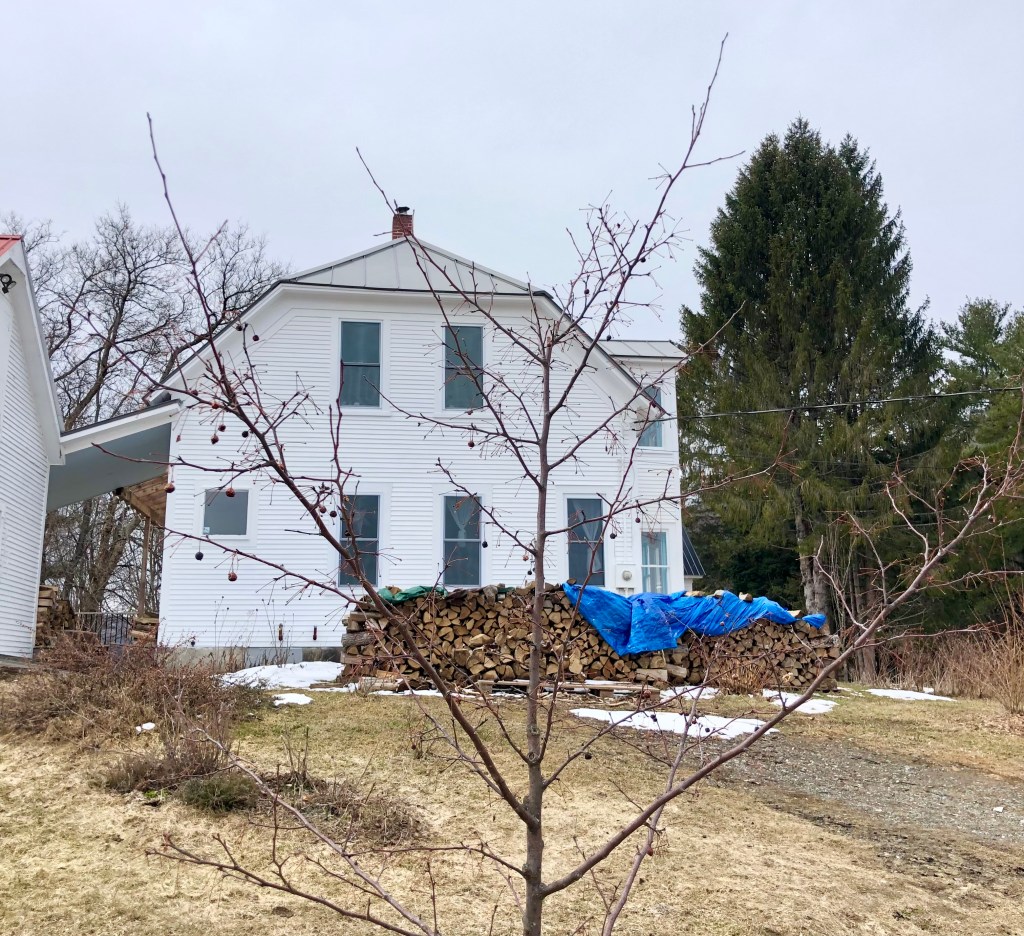
Note the wood smoke from our chimney….

Note this photo was taken yesterday afternoon, when I walked outside and nearly froze the soles of my feet. Note snow surrounded our house this morning….

Note that spring comes hard, hard, in Vermont. Jumping the starting block a few days, I keep thinking of T.S. Eliot’s lines:

“April is the cruelest month, breeding

lilacs out of the dead land, mixing

memory and desire, stirring

dull roots with spring rain.”

The first time I read these lines was in high school, digging into the poetry stacks in the school library, mesmerized by lines like Let us go then, you and I, when the evening is spread out against the sky….

Later, later, spring will bloom in all its tender-petal beauty. But for now…. T.S. Eliot knows the score in Vermont.

Somewhere in March.

Hardwick, Vermont

Mud season is fierce this year. The school busses cease running on some roads. Families share photos of kids waist deep in mud ruts. Time, more than all the gravel in the state, is more likely to true up the roads than anything else.

Mud season is the odd shoulder season in Vermont. The skiing winds down. There’s no good biking. The tourists are all in sunnier southern locations, and Vermonters muddle along.

All day long, the prettiest and lightest snow falls — nothing serious, nothing much at all — just a scattering of the purest white and enough of a chill that the wood stove is welcoming when I come in with cold cheeks and armfuls of wood. I put a quiche in the oven and head out for a walk. The snow has (mostly) melted here now, and so my paths through the fields and woods have opened up again. Behind the elementary school, the turkey vultures circle over my head. They’ve just returned from their winter sojourn, to their long-time nest in a stand of white pines. I know what they want; there’s no secret here.

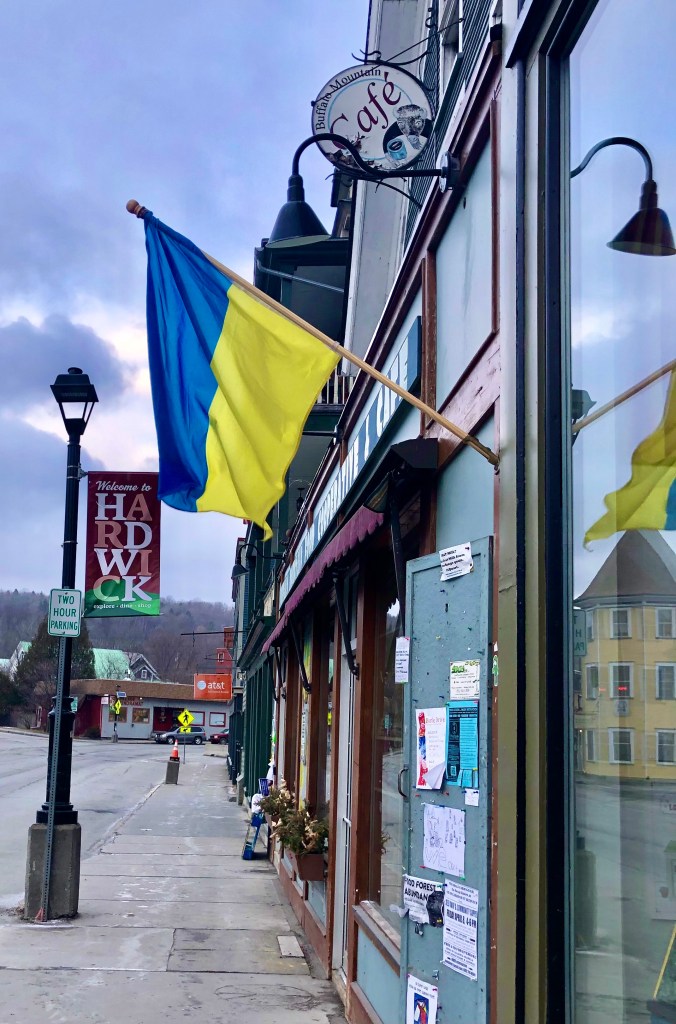
I hurry down the hill and along Main Street. A woman stands outside the laundromat, hands in overall pockets, staring up at the drifting snow. She raises one hand to me. I do the same, round the corner, and head home.