Still on the Installment Plan.

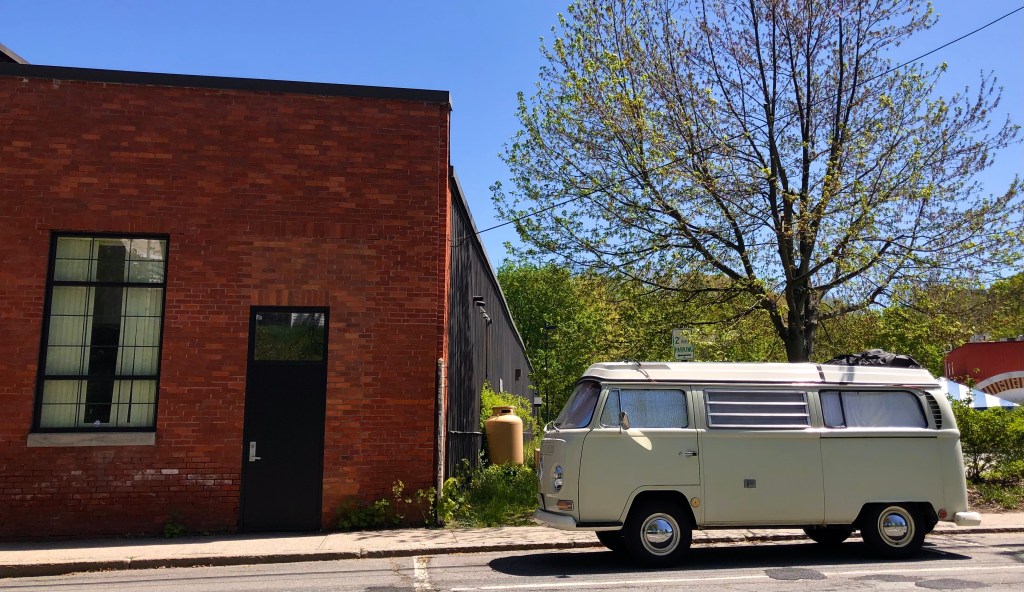
A woman I’ve never met starts speaking to me on a street corner in Brattleboro. I’d been staring across the street staring at windows on the second floor above the Shin La Restaurant where I lived when I was 20. On my 21st birthday, I walked down the street, drunk, to visit two friends. They lived in a house just a few blocks away. I was sleeping with one friend, in love with the other. The man I loved has long since died. His housemate has disappeared back into his moneyed world of investment banking and whatever that might mean. He was a decent guy, and I hope his life has gone well.

The woman says she sees a break in the traffic, and we should cross together. I tell her I’m a confirmed jaywalker. She tells me that she is, too, but not alone. “I like to cross with someone.” She’s about my height, which is in the Land of the Little People at around five feet.

On the other side, she heads one way and I go the other. It’s brilliant May, and hallejulah for this. Birds sing in the many trees. Lilacs and fruit trees bloom. For a moment, my body feels light — as if I leaped across a stream. Thirty years have passed since I lived in those rooms. Here I am again, in all this sunlight, remembering with what I joy I read Céline for the first time in that apartment. I was a philosophy, not a literature student; I was reading Heidegger and Kant and furiously writing. The apartment’s previous student was a lit student drop-out, and he had left shelves of books in the closet. Death on the Installment Plan? Good lord — no one has ever written a better book title. I read the book in a few long gasps.

“In the whole of your absurd past you discover so much that’s absurd, so much deceit and credulity, that it might be a good idea to stop being young this minute, to wait for youth to break away from you and pass you by, to watch it going away, receding in the distance, to see all its vanity, run your hand through the empty space it has left behind, take a last look at it, and then start moving, make sure your youth has really gone, and then calmly, all by yourself, cross to the other side of Time to see what people and things really look like.” 

― Louis-Ferdinand Céline
May Ramblings.

I’m home after eight. My daughter is on our front porch, eating ice cream and talking with the cats about all the interesting cat things we talk about at the end of the day. They never mouth back. One is utterly loving. The other tends to stalk around with the tip of his tail at a distinctive angle, a little indignant at the foolishness of his humans.

I’m deep in the thick of parenting and adolescence. The thing that’s so hard about adolescence is that it’s just so right. The world is profusely unfair. We live in a jumbled-up time. Yes, the kids have been handed a planet immensely beautiful and terribly ailing. It’s all true. Frankly, there’s no reason to argue about any of of that.

And yet, somehow lives must be made. At one point, in that rough 2020 year, I bought a box of ice cream cones and a carton of ice cream so we could make ice cream cones at home. I had no idea when an ice cream shop might open again.

In May, in Vermont, the world is beautiful. Now in the mid-80s, dry, dry, this isn’t our usual wet and damp spring. I pause in the parking lot on my way into work and talk with a young deputy. We swap garden tips. He tells me about his apple trees. He muses aloud about the weather — what will July bring? A freak snowstorm? A frost in August? Or maybe more of the same, beautiful day after beautiful day unfolding. We wave away the black flies. There’s not much point to go further.

Flying at Night

Above us, stars. Beneath us, constellations.
Five billion miles away, a galaxy dies
like a snowflake falling on water. Below us, 
some farmer, feeling the chill of that distant death, 
snaps on his yard light, drawing his sheds and barn
back into the little system of his care.
All night, the cities, like shimmering novas, 
tug with bright streets at lonely lights like his.

Ted Kooser
Published in “Flying at Night”

Where We Are.

Mackville Pond, Vermont

My daughter and I drive around in the evenings. It’s a teen/parent compromise I suppose — a walk in the town forest where I gush over blooming trout lilies and spring beauties and trilliums as if ephemerals have never done this amazing show before. My daughter is cool and tough, utterly on that rugged cusp of childhood and womanhood. It makes my heart ache. It makes my heart swell.

We drive around in what might appear to anyone else as aimless nothingness, checking out geese and listening to the peepers. In our driveway again, I slip off my sandals and lean back in the carseat. Goddamn, I could sleep in her car, that the slip of moon would rise over us, and then we’d just begin again in the morning. Maybe we’d drive to Nebraska. Maybe to her high school. Maybe we’d just keep sitting here, talking, or not.

Meanwhile — spring goes on. Leaves unfurl.

My wrists and eyes and heart are baggy with wrinkles. That is how old I am. Meanwhile, I keep thinking of a line about doubt by Søren Kierkegaard. As a young woman, I thought this doubt thing was for the weak and the foolish. I believed in striking out, holding firm, sucking up the consequences of my actions. Now, it’s a koan that keeps rattling around in my late night, my early morning, my stray driving thoughts: “Doubt is conquered by faith….” I think, take heart from from that. Then, when I look up the line, I realize I’d forgotten the second half: “… just as it is faith which has brought doubt into the world.”

I think, Go listen to the peepers again.

Small, Good Things.

A friend and I drive to a nursery on a back road in Plainfield, VT, through fields that seem impossibly green. The trees have barely begun to bud. I buy a snowdrift crabapple tree there. The tree is so tall that my friend and I spend some time carefully nudging it into the back of my Subaru.

I’ve met the staff on my annual pilgrimage there. They all speak quietly, as if our words might disturb the rows of potted currents and grapes. I ask again for planting advice. As I listen, I suddenly realize I’ve gone at this tree planting and cultivating thing all wrong. Beneath my trees, I should create a forest garden of duff and broken up straw and that humus-y compost that plants must love like chocolate. Daffodils bloom in the gardens beneath their trees.

I expect the staff has told me this before, but for whatever I reason I didn’t listen, or their advice drifted the way of so many words.

All the way home and all afternoon, I keep thinking about these woodland gardens and about a Raymond Carver story, “A Small Good Thing.” Two years plus into the pandemic, in this jumbled world, a small good thing….

That night, my teenager comes home and suggests we get a creemee. Friday night, and there’s no one out. We stand under the moon, licking ice cream cones, the peeper screeching in the swamp behind the pizza joint. A small good thing.

Daffodils: Verb?

I’ve been a patient at numerous Planned Parenthoods, in three different states, since I was a young woman. These days, I keep remembering a nurse practitioner I met in Bellingham’s Planned Parenthood. I had waited a long time. It was a very hot afternoon. Dust blew in through the open window. She apologized as she washed her hands and simply said it had been a busy day.

I was in my early twenties, had brought a book to read, and I didn’t care.

The staff at Planned Parenthood gave me information I needed when no one else did. This was information and advice that shaped my entire adult life. I was never turned away — even when I had nothing to offer as payment — never denigrated, never treated coldly. My oldest daughter is now the age I was that afternoon. In those young optimistic days, I believed inherently in progression. I didn’t see then that history repeats itself, turns back and bites the same wounds.

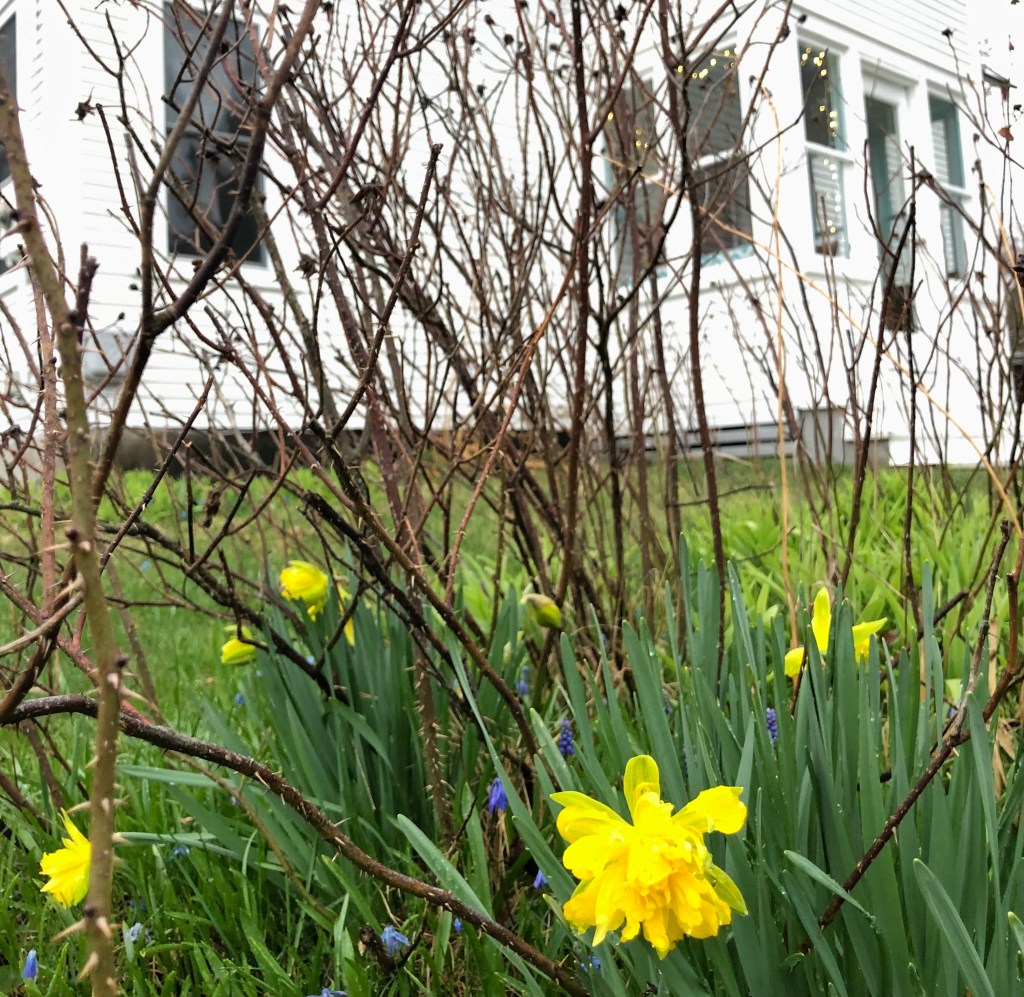
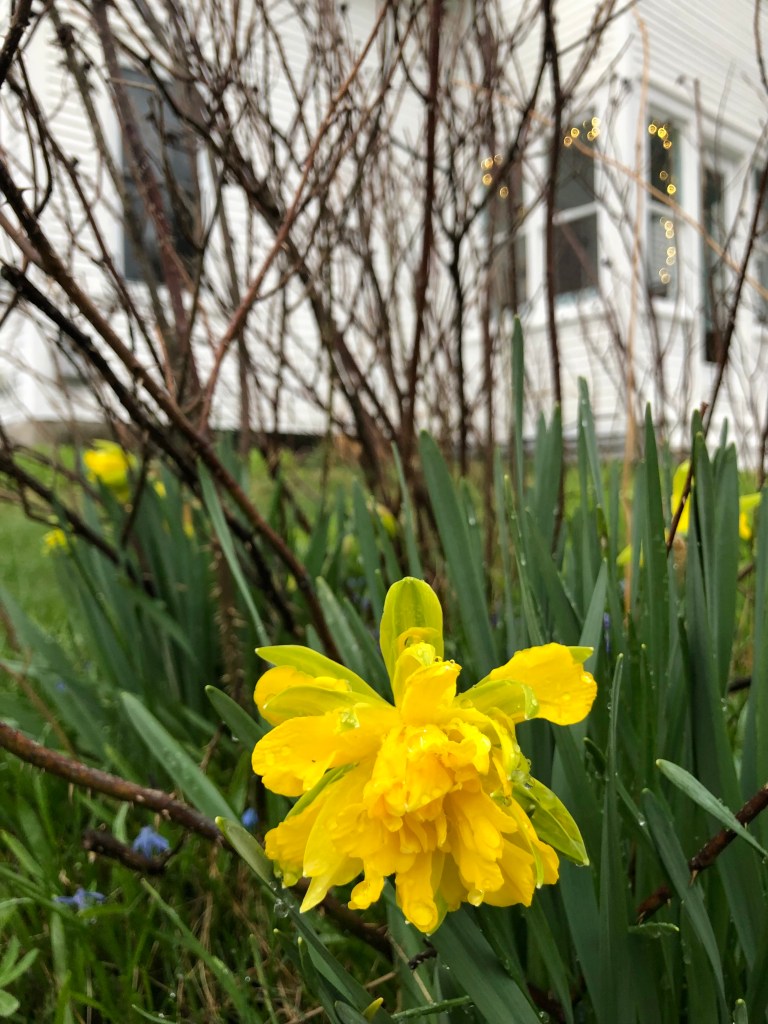
In this sunny, hopeful month of May — daffodils. Maybe I’ll think of this as a verb, not a noun: daffodilling.

Remember Joy.

The May I was pregnant with my second child, rain fell every day. I remember this keenly because my husband wasn’t working that month. I was about to have a baby, and I wanted very much to be finished with pregnancy. I had been so ill for eight months, and I just wanted to move on.

As it turned out, a gorgeous healthy baby girl was born on May 31. The summer was long and hot, just perfect weather in Vermont.

This year, I didn’t realize until today that we had passed over into the month of May. I’m writing this, as I’ve been in the same kind of dissatisfied funk that I was seventeen years ago. It seems silly to admit this — at the time, perhaps, I was in a funk only because of my own dissatisfied soul. I had — and have — plenty. I was talking to new acquaintance yesterday about the general dissatisfaction and irritability that blossoms up everywhere these days. It’s complicated — it’s always complicated — and by no means do I want to diminish that. I don’t want to diminish where I was in those days, either. Now, I can look back at those days and marvel, at least a little, that I did manage to survive intact, more or less.

That summer, though, I knew it would be the last summer I would ever have an infant. Almost right away, I was lucky enough to know that. I remember thinking, let the laundry go unwashed if need be.

This afternoon, walking around my house in a gently falling cold rain, I remembered those days. My daughter has one year of childhood left. Already I’ve begun to recriminate myself for what I should have done, how, given another shot, I’d be such a better mother. In the rain I came back to that same thinking I reminded myself of years ago, Be here now. Remember: drink joy, too.