A Thousand Things. Summer Moments.

On my way home from work, I stop in to visit a small building just recently finished. Inside, the room smells of freshly cut cedar. The visit is a pleasure, with a building well-designed and completed. Its owners will take joy here, that’s nearly certain.

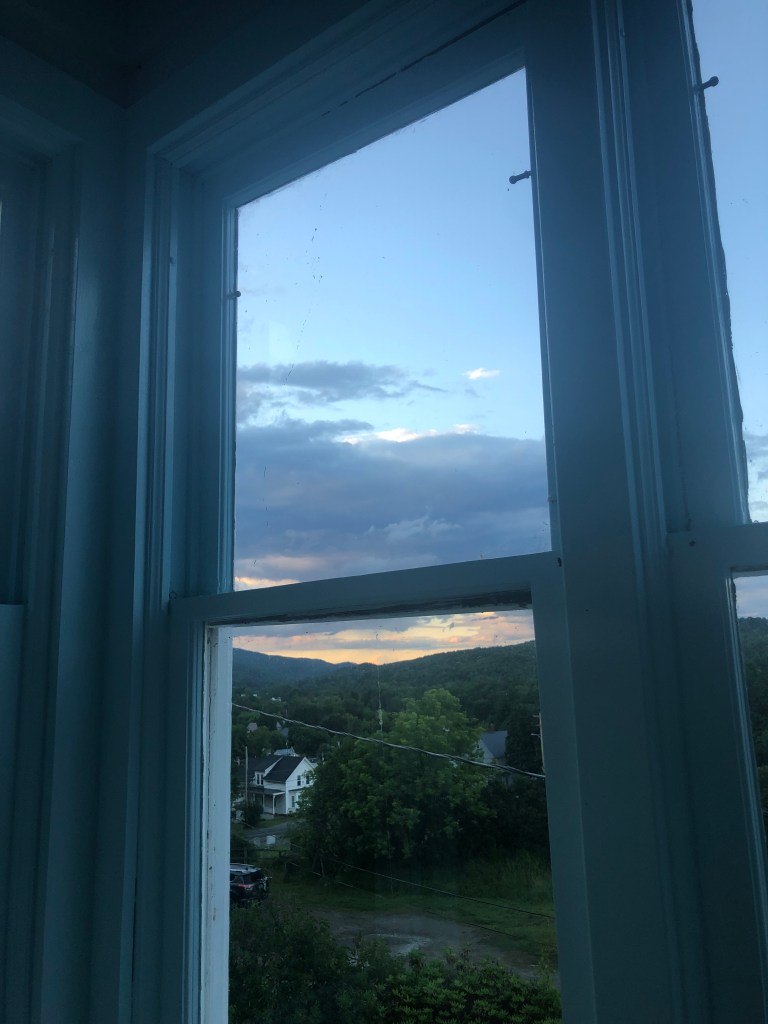
I’m at the far end of the lake, and so I take the long way home over dirt roads. I make one more stop, where someone I knew years ago has finally begun building a long-planned retirement house. Building is both fast and slow these days — a craze to build and a shortage of materials. There’s no one at this site, and I stand for bit, admiring the view of the Black River valley. I hope this place gives the owners their share of joy, too.

Where I work now is the town where I spent so much of my daughters’ childhood summer days, swimming and hiking. There was plenty of joy in all those things, too. The afternoon is redolent with humidity, exactly as I remember in my childhood.

In this steamy afternoon, I have a little pocket of time before an evening meeting. In my garden, I pick two zucchini, some lettuce that’s gone to sour, and a red coin onion. My garden grows as tall as my shoulders, more wild than not. A light rain patters down. I weed a little.

A thousand things I’ve done today. Or nearly a thousand. In this little moment, I let my own racing mind go. The snails have gotten into the lettuce. I lift one and then, gently, set it back down again.

Let it eat on, I think. I’ve plenty to spare. Don’t be greedy, I admonish myself.
Water. Sky. Lilies.

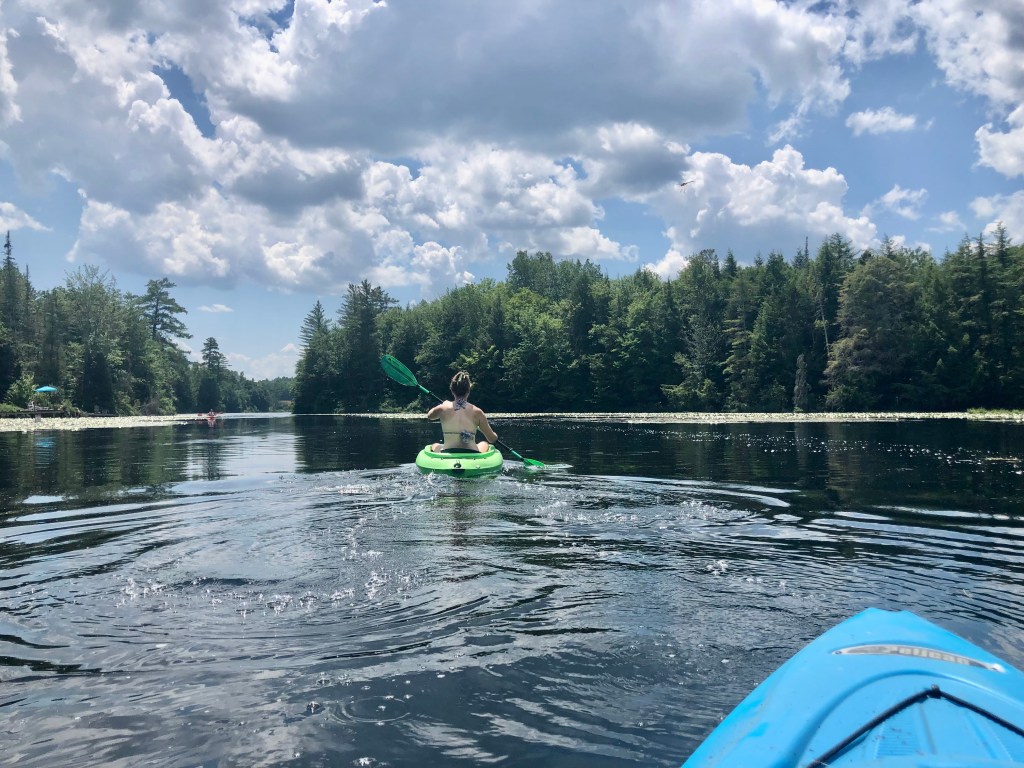
Sunday morning begins hot and out-of-sorts in our house. As antidote, we load the kayaks on the car. We paddle through a passage between floes of waterlilies in a breathtaking landscape — clouds reflected in water and all those perfect flowers. We’re not far from home, but the kayakers and canoeists we pass are all strangers who raise hands in quiet hellos.

In no rush at all, we paddle to the pond’s far end, where we drift for a long while, talking and handing a box of crackers between us. A loon and a single chick bob nearby. The other loon parent appears with a string of lunch in her or his mouth.

Later, we pull our kayaks on a shore and swim out to a raft where we lie in the sun and talk about where we might be five years, ten years, down the line. A man swims out with his two daughters, and we talk a little with him about the raft and the sun and the waterlilies that cover the pond.

I’m reminded of William Blake’s line about seeing the world in a grain of sand as we slowly paddle back to where we began. I’ve walked across sections of this pond in the midwinter around ice fishing holes. A number of years ago, a teenager drowned here, a boy I knew as a baby. His parents were vendors in the same farmers market where my husband and I sold maple syrup and ice cream. We all had little ones in those days. On those hot afternoons, we shared stories while swaying with babies on our backs.

The pond this July day reflects only sweetness and beauty. At the shore, my daughters load our kayaks back on our car. I rinse off my bare feet at the water’s edge. A little boy runs to the end of the dock. His father stands waist deep in the water. He raises his arms and says, Jump. I’ll catch you.

Saturday. Stories.

In the classic scenario of Saturday plans waylaid, I end up driving here and there this morning, for errands that may or may not make any difference at all. That seems to be where we are these days — maybe, maybe not.

July has warmed, and I work on the back deck, in the shade of our table umbrella, drinking cold coffee.

An acquaintance I haven’t seen in a while stops by. We stand in the shade of my house, talking. He found my book in a yard shade and bought it. Then he tells me his own story of drinking and how he rose up against it. I’d known a few strands of this story, little bits, here and there, that he’d freely given me before. But his telling and my listening slips me back into that sacred space of stories. The telling. The listening. Nothing maybe about that at all.

“A story has no beginning or end: arbitrarily one chooses that moment of experience from which to look back or from which to look ahead.”

— Graham Greene

Mid-July.

Rain falls again this morning, in this summer of such growth. Yesterday afternoon, between work and evening Selectboard meeting, I wandered in my garden, discovering calendula blooming in the zucchini. This morning, drinking coffee before I head off again, I add to my list. Oh, the list, and how it pales against this fragrant rain and those rose blossoms battling the Japanese beetles.

I’ve lived in New England for nearly all my life, and July is the month that renews my love of this place. Orange tiger lilies, pink cosmos, crimson currents.

All around me, the world stretches and tugs. My daughter grows up. The cats age. I work and spend. The planet spins inexorably on a course all of its own. But July is the month that reminds me the world is far, far larger than my own tiny house and acreage, my own dear family, that the world around me teems with life and thwarted longing and sometimes fulfillment, too.

The neighbors’ boys pedal up and down our dead-end street for hours, learning to ride their bikes, persistent as heck. Determined to master this skill.

Zen pretty much comes down to three things — everything changes; everything is connected; pay attention. 

― Jane Hirshfield

Travels and Home Again.

Portland, Maine

In the bit of time my brother and I drove through Portland recently, we talked about a few things — where to find a good cup of coffee and that my family grew up in the pandemic. Like that — and somehow, not like that. The next morning, with real regret, I sweep up the few things we’ve left around the apartment I’ve rented for a few days, gathering cherries from the refrigerator and sandy towels from the entryway.

At home later that evening, I wander through my garden. The hydrangeas and blueberry bushes I planted five years ago have now begun to thrive — or some of them. With my fingers, I slip off Japanese beetles.

July in Vermont is the season of utter growth, the one shot to rocket forward to the sun. Each day dawns with possibility — swim or don’t swim. Work long hours with an aim of working less on sunnier days. This is summer’s calculus. Slow down, slow down.

“To me, poetry is somebody standing up, so to speak, and saying, with as little concealment as possible, what it is for him or her to be on earth at this moment.” 

— Galway Kinnell

Interlude.

It’s been a long time since my little family and I went anywhere just for fun, to explore coastline or trails. Friday morning finds us sitting beneath an enormous oak tree eating donuts, admiring a salt marsh, and then chatting with a woman about delphiniums in a community garden.

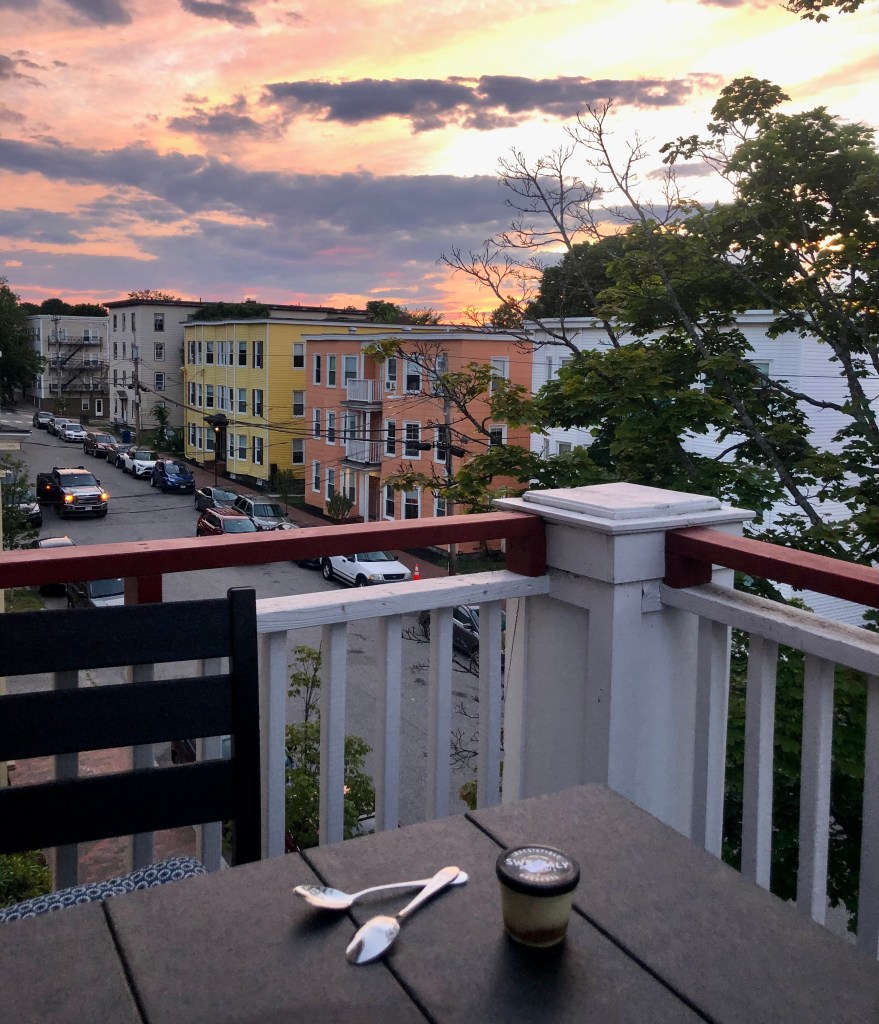
Two years and some into the pandemic, my little family has grown up. We are years past the summer where I took my daughter and a friend canoe camping with a giant teddy bear. Once upon a time, I believed I could keep the chaos of the world distant from my family — impossible, impossible. For these few days, the chaos of the world reigns on while we’ve carved out a small space of Uno and dumplings, rock and sand and ocean, the silliness of leaning over a balcony railing and watching how city folks prize parking spaces.

We’re in a sea of songbirds in these tall maples surrounding our temporary home. As for that chaos — how clearly I remember my own young womanhood and how hungrily I dove into my own share of life, how I embraced the chaos that came my way. I underestimated how hard it would be to shape chaos into creativity; maybe we all misjudges the depths of life. No longer in the Age of Sippy Cups, my daughters beat me at cards. I still win at trivia.