Storywalk.

I often read other blogs filled with all kinds of interesting things and wonder. Where on the planet are you writing? So often, I begin a post with “The weather turns foul or cheers up, the leaves unfurl or fall off and die….” Weather is ever-present around here. And yes, we’re still swimming, but the days are already dimming.

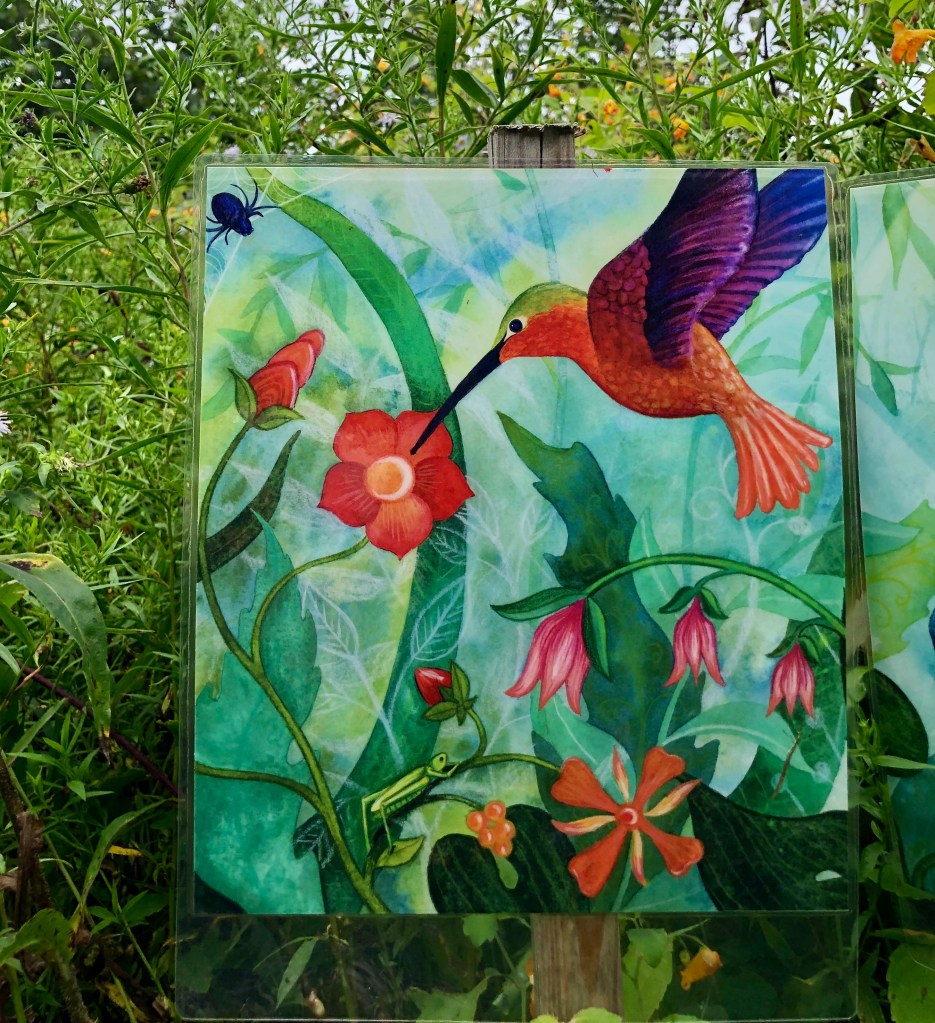
I found this lovely page from a children’s storybook along a path. The local children’s librarian put these on posts on a short path from the library to the lake. On my way into work this morning, I stopped at the lake and opened my lap. I worked intently for an hour, just me and three loons, and some woman who appeared with her two golden retrievers. The water lay flat and smooth, about as perfect as anything gets in this world.

Recently, I read over a few of Shirley Jackson’s terrific essays about writing. She writes, “The essence of the story is motion.” So, too, I wish we better understood this about life. That endless monologue running through my head… well, the walk through the woods is the essence of me.

Poem for Monday Morning.

Across the Street

By Austin Segrest

I ran across the street, I didn’t know any better.
Ran out in the street, I didn’t know no better.
I just knew a woman was there, though I’d never met her.

She sat me in her parlor, distracted me with trinkets,
milky glass birds and fish, distracting trinkets.
She said my mother would be fine, but did she think it?

The world was a blur of crystal wings and fins.
My tears were casked in crystal, wings and fins.
She was the first of many lady-friends.

The tree shadows shortened, she brought me a drink of water.
Morning matured, she brought me a glass of water.
I drank it so fast, she went and brought another.

I kept looking out the window, she didn’t ask me what for.
I watched out that window, she didn’t ask what for.
The seconds broke off and lay there on the floor.

I imagined my mother’s route, as far as I could.
Her long morning walk, followed as far as I could.
Nothing I could do would do any good.

Suffer the little children, and forbid them not.
Christ said suffer the little children, and forbid them not.
Said love thy neighbor, sometimes she’s all you got.

Washing Up.

Greensboro, Vermont

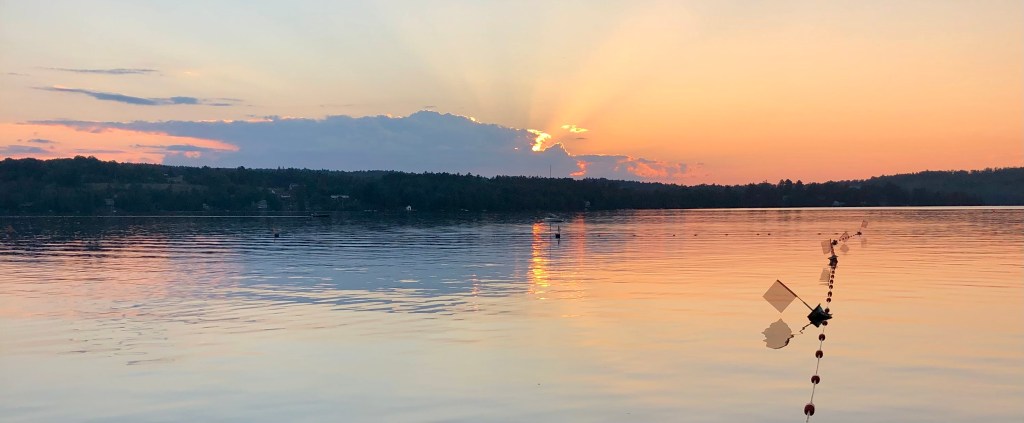
Late Friday afternoon, I swing by work for a few things and bring a friend. The day has cooled, and the evening is perfect in an August storybook way. Afterward, we stop by the beach where a few families are lingering with kids. The parents are clearly ready to head home. The children reluctantly leave the warm lake.

My friend and I sit on enormous pieces of donated granite that function as benches, admiring the spill of sunset over the serene lake, when an acquaintance drives up. He’s there for his daily swim. We kick around a few random exchanges, and somehow the conversation bends around to money. He tells us that his brother was a golf caddy in high school. Every night, he washed his tips in the sink and then ironed the bills.

We laugh and then swim. But later, driving home, I think about the teenage boy, decades ago, scrubbing up his tips, making them new. What was he thinking? And where did that take him?

Home again, the crickets sing mightily around my house. A moon hangs in the sky, and the constellations emerge. All that shadowy summer night, so much infinity.

A few lines from Brad Kessler’s novel North:

The Noonday Demon was invented at the monastery. You had to plumb the depths to reach the heights… Depression [at the monastery] is impossible to avoid; it’s where God enters — through the wound.

— Brad Kessler

Keep Walking.

The summer people are still summering it up around the lake. In a few more weeks, these noontime walks will be me and the goldenrod. The kids will be back in school, the adults back in the adult world.

Walking, I can’t help but take stock of the summer. In a quiet way, this has been a summer of learning for me. Perhaps more than anything else, I’ve started to let go of how hard I hold onto time. I stop and talk to the gardener who often seems to be mowing under a wooden split rail fence. I see him just as he’s turned off the motor, and we talk for a while about phlox and coreopsis, milkweed and butterflies. He’s been gardening around this lake for over forty years, and he’s in no particular rush for anything.

The day has warmed since the cool of the early morning when I left my house. I’ve had plenty of coffee and there’s a long stretch of day ahead. With the toe of his boot, he brushes grass clippings from the mower. He asks how far I intend to walk.

Not far, I answer.

He says he’ll offer me a piece of advice: go further than my plan. Walk around the next curve in the path.

In his mirrored sunglasses I see myself, a small woman in a blue dress. I agree, All right.

He nods and starts the mower again.

Sunflowers.

I began planting mammoth sunflowers years ago because I wanted flowers in my garden to tower over my children. There’s an old photo I have of my toddler walking barefoot among enormous stalks. I planted a veritable swath of sunflowers this spring. Late summer is the pay-off season, when the first of these blossoms open. The first head is so enormous it can’t really do its follow-the-sun heliotrope deal — but its flower siblings shift all day.

One fall, a number of years back, I had just two of these beauties, so much taller than myself. After the snow fell and the birds cleaned every scrap of seed, I cut off the dried blossom and propped it on a ceiling beam. The sunflower remained there all winter.

The bud
stands for all things,
even for those things that don’t flower…

Galway Kinnell

Solo.

Every summer for years now, my daughters and I have gone camping on Burton Island in Lake Champlain. We always bring the same friend of my youngest daughter. Sometimes another friend and sometimes my oldest hasn’t come. This year for all kinds of reasons, I went alone for a night.

I stopped first to visit a friend and meet his friendly sheep. Then I raced to the ferry. Rain and clouds had moved out. The island has no cars, so the atmosphere is particularly sweet. Little kids bike everywhere. A group of teenage boys had set up a small army of tents, bikes, and fishing poles.

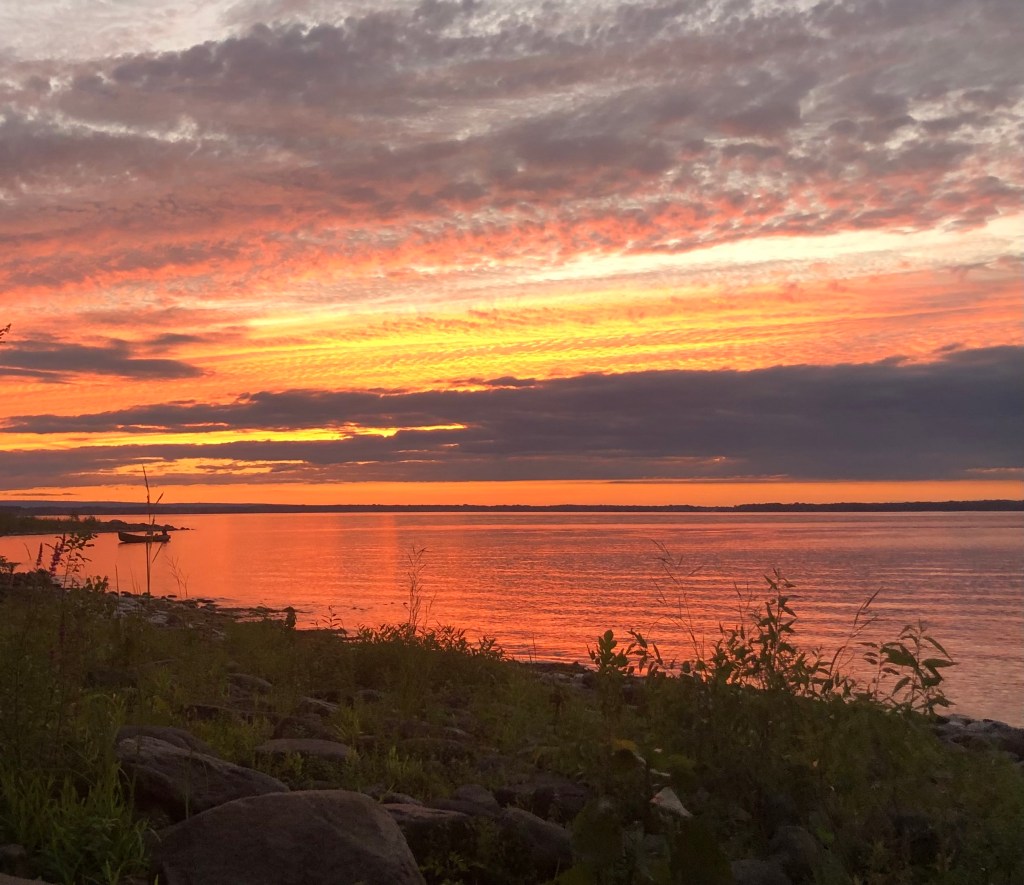
I had brought what I needed for the night: a novel, my knitting, a winter hat, the recently printed out version of my manuscript, and a good pair of walking shoes. If there’s one thing I’ve learned as a single mother, it’s make friends with strangers. Much to my daughters’ annoyance, I often find someone to chat with at soccer games, the co-op, the post office. A kind of survival skill on many levels. But I wasn’t there to chat. I walked around the island on its slate-pebbled shores in the daylight, during the enchanting sunset, and in the dark. As the night fell dark, the tree frogs sang melodiously. I slept dreamlessly under the rising moon. In the morning, I drank coffee and read and read until I packed up my few things and headed back to the ferry.

The island, a state park, is mostly staffed by college kids, who are polite and enthusiastic. The young man on the ferry folded up the wildflower guide he was reading to roll a few bikes on the ferry.

On my way home, I realized next summer I could take my kayak and stay a few nights on Champlain’s islands. I can’t swim to save my life but surely that’s something I could learn.

A few lines from Dan Chaon’s Sleepwalk:

“No doubt, a day of reckoning for mankind is coming, yet even for those of us who accept the inevitability of mass human death, there’s still a cautious hope; we’re waiting to see how Armageddon plays out, keeping an eye open for ways it might turn to our advantage… I’m no evolutionary biologist, but I have faith in our species’ stick-to-it-iveness.”

— Dan Chaon