At 86.

I grew up in a family nearly devoid of grown men. No grandfathers, no uncles save one uncle by marriage I met once in California and never saw again. Like any kid, how I grew up seemed just the way of the world.

Every summer, we saw my grandmother and wacky and wonderful aunts and female cousins. In those weeks, the ordinary rules were suspended. We kids lived in our realm, quite happily, while the adults did their endless talking and laughing. In all this, my father headed our rambling crew, whether we were swimming in Maine’s icy Atlantic or visiting a Shaker village. My father taught his three kids to love E. B. White and Shakespeare, to fly a kite and cross country ski. The original YouTuber before YouTube was a thing, my father is a lifelong library aficionado. He taught himself — and so taught us — to paint a house and repair a leaking washing machine, to write a clear sentence, play Hearts, understand mathematics is exquisite, and lean into the happiness of lying on your back under the summer constellations. The list is eternal: use a sharp pencil to solve algebra; chop garlic fine; Plato is sublime; be polite to cashiers; work hard; pay your bills; hike.

If you couldn’t figure out an answer, keep thinking. My god, that’s useful.

I inherited his nose and his utterly irreverent sense of humor. He never indulged his children in the illusion that the world is easy or kind. The summer I was ten, we drove from New Hampshire to Wyoming to Colorado to New Mexico, living out of our green Comanche Jeep and careening back into New England two days before school started. By that time, my sister and I had read his copy of Huck Finn at least twice over and thoroughly kicked around Huck’s aversion to civilization. 86 today, my father is still modeling Thoreau’s behavior of sucking the life’s marrow, grit and all, while savoring espresso.

Sundays too my father got up early
and put his clothes on in the blueblack cold,
then with cracked hands that ached
from labor in the weekday weather made
banked fires blaze. No one ever thanked him.

I’d wake and hear the cold splintering, breaking.
When the rooms were warm, he’d call,
and slowly I would rise and dress,
fearing the chronic angers of that house,

Speaking indifferently to him,
who had driven out the cold
and polished my good shoes as well.
What did I know, what did I know
of love’s austere and lonely offices?
— Robert Hayden, “Those Winter Sundays”

Go Without Sight…

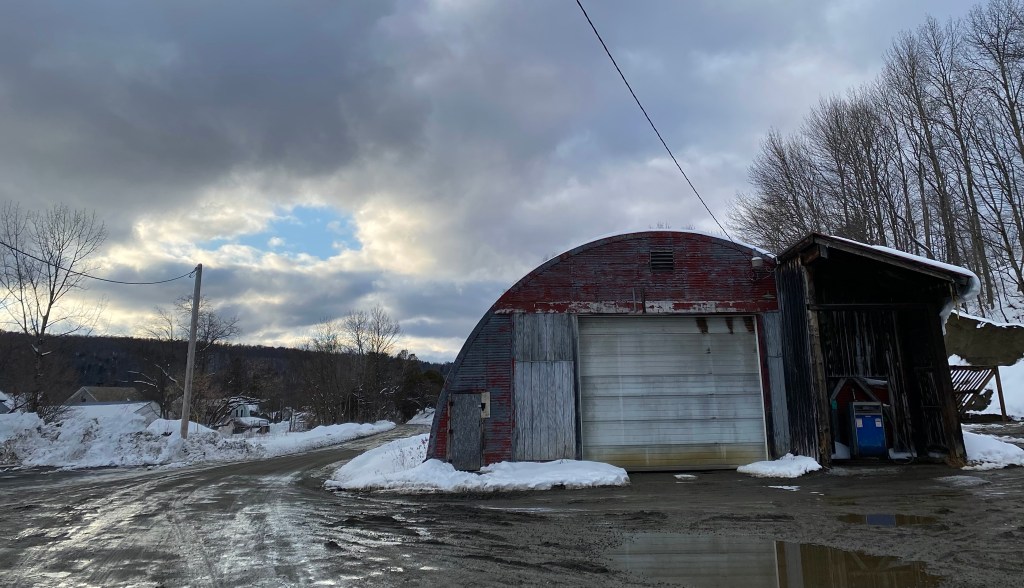
On this day of sunlight and chores, I end the afternoon walking through the back areas of town, behind the town garage and around this year’s dwindling sand pit. I turn around in the neighborhood with the scary unleashed dog, backing up slowly and doing, perhaps, exactly what should not be done.

Out of sheer carelessness, I never got the wood stove heated up to temp this morning, early at my desk, so intent, that I carelessly let the stove smolder low. In the day’s heat, I’ve let the stove dwindle further. That chore awaits me. My carelessness annoys my daughter, who’s afraid of burning the house down (what sane Vermonter isn’t at least slightly afraid of that?) and in love with the stove’s fierce heat. Two things at once. Which sums up March. Winter and spring. Breezy clean and ponderous with the thawing earth’s muck.

I pass hardly a soul on my walk and wonder if I should have made friends, or at least a kind of peace, with that snarling dog. As I walk, the air cools. The puddles are luminous with what remains of the day. I remember that beloved line from Wendell Berry — To know the dark, go dark — the line that’s driven so much of life. When I get home, I look it up.

To go in the dark with a light is to know the light.
To know the dark, go dark. Go without sight,
and find that the dark, too, blooms and sings,
and is traveled by dark feet and dark wings.

Cars, Coffee, Conversation.

My daughter drives the interstate towards Burlington in the valley that folds along the Winooski River. I’ve driven this stretch of interstate countless times, in all kinds of weather, alone or with children in the backseat eating snacks and talking about something like various shades of blue.

We pass the town where, a few years back, I fiercely negotiated down the price of a Matrix. While my older daughter test drove the car, the owner and I stood on the sidewalk in front of his suburban split-level. He sold restaurant equipment and wasn’t in the least interested in sharing stories about that job. He couldn’t get the Matrix’s hood open, which made me ask how often he checked the oil. My question irritated him. That — and the cash I brought — tipped the price in our favor.

As it turned out, that Matrix never burned a drop of oil. My daughter drove the car for years. Well beyond 200k miles, we sold the car to a man who called himself Saffron Bob. Saffron Bob appeared in a snowstorm, also with cash.

My daughters found his story about growing saffron along Lake Champlain utterly believable. I did not, but I was wrong about that, too.

We stop for coffee. My daughter steps forward and pays. We keep driving and talking, another strand of our story.

Flattening the Road.

I drive home in a pouring snow, remembering when we bought a Toyota pickup years ago, and I drove with four-wheel drive, how the road suddenly flattened out. I’m driving my daughter’s car. In Hardwick, I stop at the auto parts store. Her right wiper is torn. I’ve known the person my daughters call The Auto Parts Man for years. He opens the wiper packages on the counter and then puts on his coat and heads out in the snow and replaces my wipers, too.

It’s the last day of February, and he says he’d rather winter just quit. He laughs and shrugs.

Nonetheless, for the moment, my windshield is clear.

This hill
crossed with broken pines and maples
lumpy with the burial mounds of
uprooted hemlocks (hurricane
of ’38) out of their 
rotting hearts generations rise
trying once more to become
the forest

just beyond them  
tall enough to be called trees  
in their youth like aspen a bouquet  
of young beech is gathered

they still wear last summer’s leaves   
the lightest brown almost translucent  
how their stubbornness has decorated   
the winter woods

— Grace Paley

Interlude.

Checking out at the co-op, an acquaintance says she has a question for me. I follow her outside, and we stand in the falling snow, she with her bags full and me with the tomato and yogurt my youngest requested.

Through the snow, the mural across the street glows its brilliant rainbow of colors. Across Vermont, murals have appeared in the past few years, not just in the usual suspect cities — Burlington and Brattleboro — but in places where art seems least expected: a parking lot, or the roadside field in Jeffersonville where cement silos are beautifully painted with an old man sowing seeds, a red clover blossom. Half a decade ago, driving with four young teenagers, I pulled over and we walked around and into the empty cement tubes. Springtime, we splashed through standing water in the hayfield.

Now, snow swirls around us, my favorite kind of drifting snow, magical and full of possibilities. We talk for maybe ten minutes, while I hold that tomato and a paper bag of granola, shivering, while people trudge through the snow around us, buying baguettes and greens and bottles of wine. We’ll find no answers in our brief conversation that picks up those knots of privilege and power, of pretense and betrayal. This far along in our lives, there’s nothing textbook here. The questions shape our lives, the little world where we live.

I suggest a sliver of a solution, a tiny change, a minuscule movement, a small slice of good. By then, I’m shivering fiercely. The night’s falling down, and my small household will be hungry.

The painter’s vision is not a lens,

it trembles to caress the light.

— Robert Lowell, “Epilogue”

Order.

Dreaming, I untangle my knitting conundrums: rip out one half-finished cardigan and use the yarn for a cabled pullover. Nothing earth-alternating, planet-changing, simply my need for order and creation. Some small measure of satisfaction.

Which is why I understand the volunteer in the Giving Closet, the room in the old school building where I work these days. The Giving Closet holds the community’s castoffs and giveaways, an endless motion of clothes and toys and dishes and not enough artwork that swaps around from household to household.

Late afternoon, low clouds pressing around the wide windows as a storm moves in, I wander into her space and offer hot water for tea. She’s endeavored to straighten and tidy the concatenation of stuff that invariably slides into chaos. Two women are looking for scrubs, holding up shirts and asking each other, This? or This?

Through the windows, snow drifts down. The roads part and V around this old schoolhouse, empty. Across the way, the Ukrainian flag hangs down from the church’s sign.

….. and here’s a few lines from a recent review of Unstitched by Joanna Theiss.

While Unstitched is a valuable and important book for its discussion of opioid addiction, the writing is quietly beautiful, every word appreciative of the Vermont landscape and its seasons, on mothering girls while grieving with a mother who lost her own daughter, on the stark class divides that hinder our efforts to grow past this crisis, and the joy of community, no matter how much mending it requires.