Vermont’s Foundation: Freedom and Bread

A possum circles in the highway, no doubt startled by my headlights. It’s past midnight, and no soul’s around. I drift into the other lane and let the possum do what it wants to do.

I’m listening to the radio playing the Rolling Stones and thinking of a David Budbill poem I read that afternoon, about Vermont’s colonists and centuries of following folks, seeking freedom and bread. The possum is definitely seeking her or his own version of possum bread, but freedom…? The question looms large. I haven’t far to drive this night, but the words stick with me — bread and freedom — surely two of the main drivers in my life, likely in yours, too.

The peepers are lusty along the Lamoille. The air reeks of wet mud, of that sweet fecundity of spring.

At home again, we lie down with the windows open. I hear the teenagers talking and laughing before they slip into the thickness of young sleep. To ward off the night’s gloom and cold, I’d started a small fire in the wood stove. Through the open window now drifts smoke. In these May days — both hot and chilly — I’ve moved my wood piles, again, as I tend to do, raking the bark and broken bits to dry in the sun. Foolish, perhaps, to keep a fire smoldering while the bedroom windows are open. Or maybe simply a kind of freedom.

What Is June Anyway?

After three weeks of hot weather and drought,

           we’ve had a week of cold and rain,

just the way it ought to be here in the north,

            in June, a fire going in the woodstove

all day long, so you can go outside in the cold

            and rain anytime and smell

the wood smoke in the air.

This is the way I love it. This is why

           I came here almost

fifty years ago. What is June anyway

          without cold and rain

and a fire going in the stove all day?

— David Budbill

Our Moon Shone on Helen of Troy, Too.

Rain falls in the night, a pattering through the open window on the mock orange bush. The rain winds through my half-asleep dreams of different places I’ve lived with open windows and falling rain. I’ve often thought of the moon as my constant, my anchor in the arc of the universe. Moonbeams fell on Helen of Troy’s face, too. But spring’s gentle rainfall? Such a sweet sound.

A rouge frost browned pieces of our May world, and the rain promises deeper green. The morning after the frost, a man in line at the post office told me he’d lived in Vermont all his 63 years and had seen frost in July. I detailed the frost damage to my daffodils; he shared his apple blossom woes.

July? I asked, are you sure?

He laughed, quite sure indeed.

As I lay listening, the morning songbirds began, a snippet, then a rising thread of song, pushing away the night.

Random Spring Scrawlings.

Back about a hundred years ago when I started to read, my elementary school had these large books with colored pages. I read only on the right-hand pages, then flipped the book upside down, and read on the other side. The net effect was a perpetual mystery: I was reading forward, but there was always this tantalizing upside down text on the left-hand side. Could I dart my eyes there and jump ahead in the storyline?

The storyline had castles and princesses. I think of these books every spring, because Vermont spring colors are so darn brilliant — just like those colored pictures.

I’ve never seen those books again, although I searched for them for my own daughters.

May. Let’s never sugarcoat anything, never cheapen our world into an Instagram I’ve got more than you post. Snowflakes fell yesterday, even midday, swirling flakes. My daffodil petals were gnawed around the edges this morning. But it’s May. Spring alone: reason to live.

May, Fire, Frost.

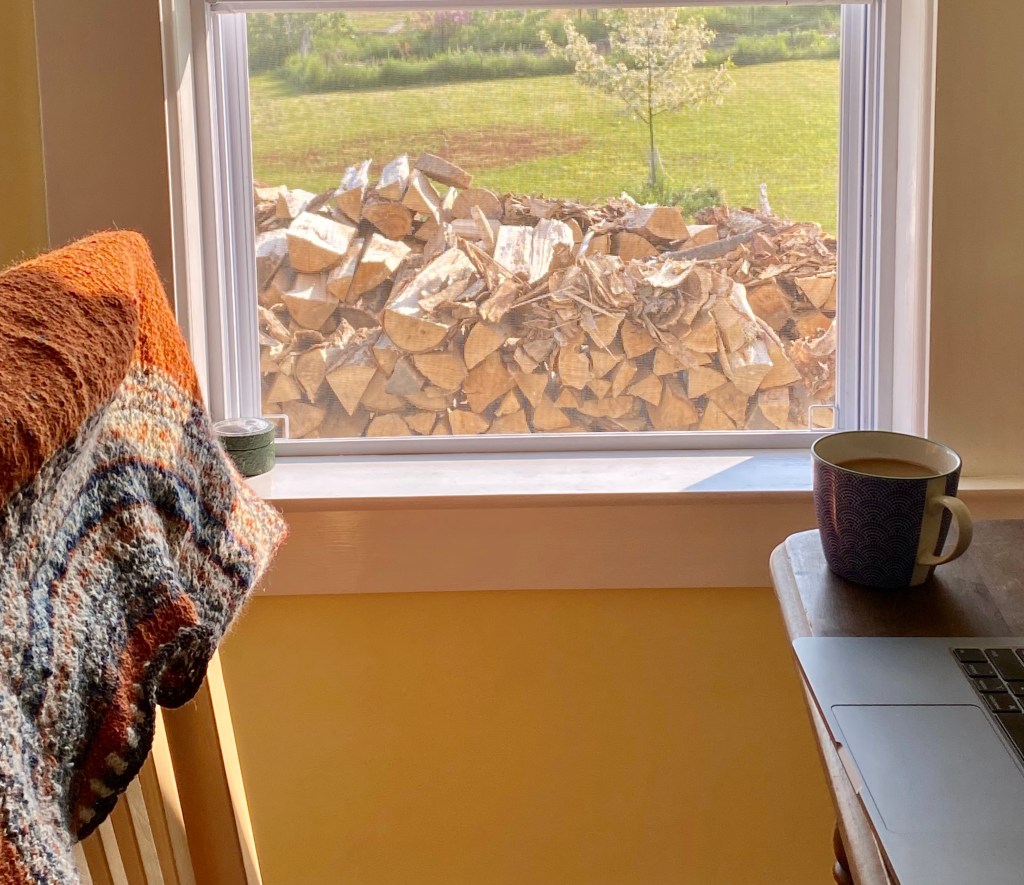
May, and I’m kicking a few pieces of firewood in my wood stove, pleasing the cats on the red rug, luxuriating in keeping the door to our glassed-in porch open, the heat pushing into this three-season (but really one-season) tiny room.

We are in the days of lengthening light, spring exuberance. The sun rises crimson. A young woodchuck grazes on the lawn, then wanders into our fire pit, curious perhaps about us humans, or simply searching.

I am a gardener; we are outright foes. But this morning, my cat Acer and I watch the woodchuck through the window beside my desk, the morning’s cool pushing in through the screen. Acer steps on my keyboard, rubs his head against my elbow, reminds me that I left him for a few weeks.

I’m still thinking of that window in the apartment where we stayed in Florence. On the tile floor, the tall window open, I watched dawn flow over the red roof tiles, the pigeons sweeping over the roofs. I live in the world of the hermit thrush, mewling catbirds, carmine cardinals. A friend tells me she plans to cover her apple tree with a bedsheet tonight, to ward off the frost. Huh, I think. May.

Consider your origin.

— Dante

The First Green of Spring

Oh sure, the May sunlight, the way the steady breeze tosses the growing grass all day, tugging new leaves open — the robins and sparrows chittering and nesting, singing as they fatten their nests, get their bird family going — even the woodchuck grazing beneath the apple tree, feasting on violets and fattening its sleek being — all beloved, all dear — but really, it’s the tree blossoms, the spring beauties, the dutchmen’s breeches, the Johny jump-ups scattered in whatever way and whatever place they need to emerge. What a world this is, our Vermont May season. Flowers.

Here’s a poem from David Budbill.

“The First Green of Spring”

Out walking in the swamp picking cowslip, marsh marigold,
this sweet first green of spring. Now sautéed in a pan melting
to a deeper green than ever they were alive, this green, this life,

harbinger of things to come. Now we sit at the table munching
on this message from the dawn which says we and the world
are alive again today, and this is the world’s birthday. And

even though we know we are growing old, we are dying, we
will never be young again, we also know we’re still right here
now, today, and, my oh my! don’t these greens taste good.

Revision.

On the most perfect spring morning, I’m driving along route 107, a stretch of highway I’ve always loved that curves along the river. I’m listening to a This American Life story about two boys (and if you listen, listen all the way to the end, please), when the revision path for my novel abruptly unfolds before me, like a Jacob’s Ladder toy.

I’m in somewhat familiar territory, and so I pull over and scrawl down a few sentences. The day is suffused with dandelions and violets. I get a little lost to where I’m going, but not too lost. Later, I take a different road home, up route 100 along the White River Valley. Last year’s corn stubble patterns black fields that stretch to mountains where leaves freshen the gray with new green. The fruit trees are blossoming. I stop and finish the remains of my sandwich —pickles and sprouts and a coarse sharp mustard — keeping company with pink petals and pollinators.

My lunch companion remarked how a forest will do what a forest will. As I eat, I remember how poet David Budbill railed against writers taking themselves too seriously. He wrote, wrote hard, wrote productively, and revered the mystery of the imagination, the murkiness of creativity. His advice to writers, “Don’t think. Listen.”

On my way home, I listen to another This American Life story about a bird who sang to itself. I’m not making this up.