In High Waters & Broken Roads, Temporarily Put Up.

A stranger tells me about her flood experience. She and her grown son had been camping beside a lake when the water began to rise. Unable to drive south to the town where they lived, they drove north to high ground and slept in their car in Craftsbury Common. The next morning, seeking road intel, they walked over to Sterling College. The college staff offered them breakfast. The roads had been damaged all around the town, and no one was getting in or out. The college put the family up for three nights in empty staff housing and offering gratis meals in the dining hall. “The food,” the woman told me, “was so good. Everything fresh from their farm.”

In the scheme of things — a problem: two people, marooned, sleeping in their car. The solution: empty rooms, plenty of food. Practicality and kindness.

…. And in this end-of-summer rainy-but-possibly-to-clear morning, a few favored lines from E. B. White:

“The crickets felt it was their duty to warn everybody that summertime cannot last for ever. Even on the most beautiful days in the whole year – the days when summer is changing into autumn – the crickets spread the rumour of sadness and change.” 

— E. B. White

August Gloaming.

The foxes that denned behind our house did not return this year. A neighbor who lives around our hillside shares that she saw a kit earlier this summer, and we speculate that the fox family set up summer quarters nearer her. It’s all speculation, neither here nor there.

Who has returned are the turkey vultures, roosting in the pines between our houses, reliable as the rain this summer.

Mid-August, and the kids are trickling back to school. A friend texts me that her son is headed into his senior college year. I remember when this kid was born. He used to come to our house and stand on a kitchen chair and bake cookies. In this soggiest of summers, still time unspools inexorably. In the evenings, we sit outside and watch the sunset sprawl crimson, the mosquitoes drawing drops of our blood.

The pollinators suck at my small garden’s calendula, gold and orange. A few years back, I sowed a few seeds. Gone wild, the calendula reseeded rampantly, nestling against tomatoes, among cucumber vines. I haven’t the heart or will to pluck a single flower.

It rained for three days straight, a relentless steady rain that kept up its monotonous rhythm day and night, there being no periods of waxing and waning or moments of imperceptible brightening…

— Mary Hays, Learning to Drive

Field of Sunflowers.

In a former garden I tended, I planted elecampane whose yellow blossoms bloomed over my head. The plant spread along the garden’s back edge, a natural fence between the bed where I planted greens and tomatoes and the field where I sowed potatoes. We had reclaimed that stretch of field from the forest, and the sparse soil was hungry for manure and the cover crops we rotated.

Now, in search of elecampane to transplant, I find this flower, the long ragged-edge leaves already fading from this year’s growth, the greenery not particularly lovely. I plant this strange flower before our house.

Flowers have the undeserved rap of girlyness, of flimsy decoration, of false medicine. Not so, not so.

how quiet
the light-blue morning glory —
such good manners

— Issa

Go on and wonder.

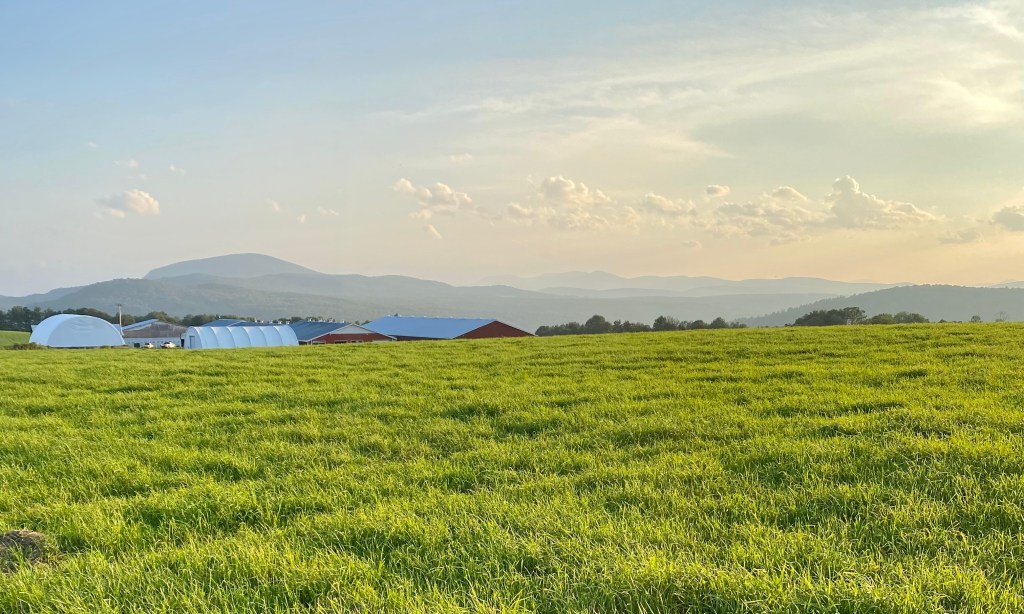
I skip out halfway through a Selectboard meeting and take a backroad home. Since the floods, I haven’t driven these dirt roads. The roads are back together mostly, with rocky channels on either side of the steepest places. At the road’s highest place, I pull over.

August light.

I’d started that morning in jeans and a sweater, working on my back deck while rain splattered down, the morning large with a cold damp breeze that made me wish for socks in my sandals. This evening, I’m wearing a sundress again.

All summer long, we’ve been collecting complaining about the summer in Vermont. First, no rain. Then, too much rain. I have plenty of firewood left from the tepid winter, and then burned fires into the summer.

The evening spreads out radiantly. For this moment, I’m in no rush to head anywhere, so I park and walk down the road a short ways, crickets sizzling in the hayfields. A pickup rolls slowly down the road. The driver, an acquaintance, stops, and we chat for just a moment, about the particular green and blue surrounding us, then he glides away.

Light in August. My father bought me a used copy of Faulkner’s novel for a dime in a used bookstore. I was a teenager, a fanatic of Tolstoy and Dostoyevsky, those immense Penguin paperbacks that were so gratifyingly fat. I kept that copy with me for so many moves, thousands of miles, and I’m guessing I have that version yet, crammed on my bookshelves.

Faulkner’s world is the complexity of past and present, the world jammed against our faces right now, floods and fires. This morning, again, a crimson dawn, curls of fog in the blue valley. My east windows need washing. Get on this, I think, get on this…

“Wonder. Go on and wonder.” 

— Faulkner

Post-Flood, the Chaos.

I keep writing about this flood, because the flood’s marked our summer: before and after. I’ve written that our house was spared (thank goodness, thank goodness), but the pieces are all around us. Immediately post-flood, such an outpouring of generosity, and then, the predictable, the wearing down, the exhaustion, a growing sense of uncertainty. Rain falls and falls. We can no longer ignore that the summer has been wet and cold. And yet, how selfish it feels to complain, when we are in the Shire of Vermont.

My own saga unfurls publicly in the wake the flood. The property my ex-husband owns is posted for a tax sale; it’s been six years since he paid more than pennies on this bill, sovereign citizen that he is. My name is posted in the tax sale, that the Court removed my name from the deed in our divorce. I’m drawn into his life again, the facts of my life bantered about with people I know and those, I’m sure, I’ve never met.

The property is valuable — 92 acres with a large sugarbush. In the midst of this, someone I know from long ago phones me. The morning is dark, and I haven’t turned on any lights. His words are so kind it’s like sunlight in this gloomy summer. There’s no resolution here, no possible decent outcome. I will likely never speak to my former spouse again. I’ll never own this property. And yet, my life will hopefully go on and on, for decades yet. For these timeless moments, I drink in that unbidden kindness, let it fill me. I feel it within me, the possibility of how my life might turn.

And, because it’s August, one of my favorite Hayden Carruth poems, August First.

Late night on the porch, thinking
of old poems… The sky
is hot dark summer, neither
moon nor stars, air unstirring,
darkness complete; and the brook
sounds low, a discourse fumbling
among obstinate stones….
I wonder what became of
purity. The world is a
complex fatigue. 

“Distrust everything, if you have to…”

As a firm believer in clotheslines and keeping my bills low, we don’t have a clothes dryer.

In past rainy summers, with children in cloth diapers, I spent time in laundromats on Sunday mornings before selling maple syrup at a farmers market.

After a span of rainy days, I eventually break down (again, this no-dryer commitment might be simply stubbornness or gratuitous ego, pushed far beyond rationality) and load two dryers in the Hardwick laundromat. I bring a book and read on the porch of the Inn across the street. Behind the Inn, the Lamoille curves through town. On the river’s other side, a house burned earlier this summer. Now, what remains slides down the bank, piers of a narrow porch first, the back clapboard wall soon to follow.

Unintentionally, I’ve chosen busy Friday afternoon, and the intersection is jammed with traffic and pedestrians. I’m reading about schizophrenia and crime, about madness and civilization, and I keep looking over my shoulder at that empty house and its unanswered question of what’s happening here?

Eventually, I close the book, walk across the street, and fold our clothes warm with the dryer’s heat. Beside me, a little girl and her father study the line of dryers. She’s wearing a dress with bunnies. Seeing me, she pulls out her skirt. “Pink,” she offers.

I nod and answer, “Great-looking rabbit,” and then I head home.

Wait, for now.
Distrust everything, if you have to.
But trust the hours. Haven’t they
carried you everywhere, up to now?

— Galway Kinnell