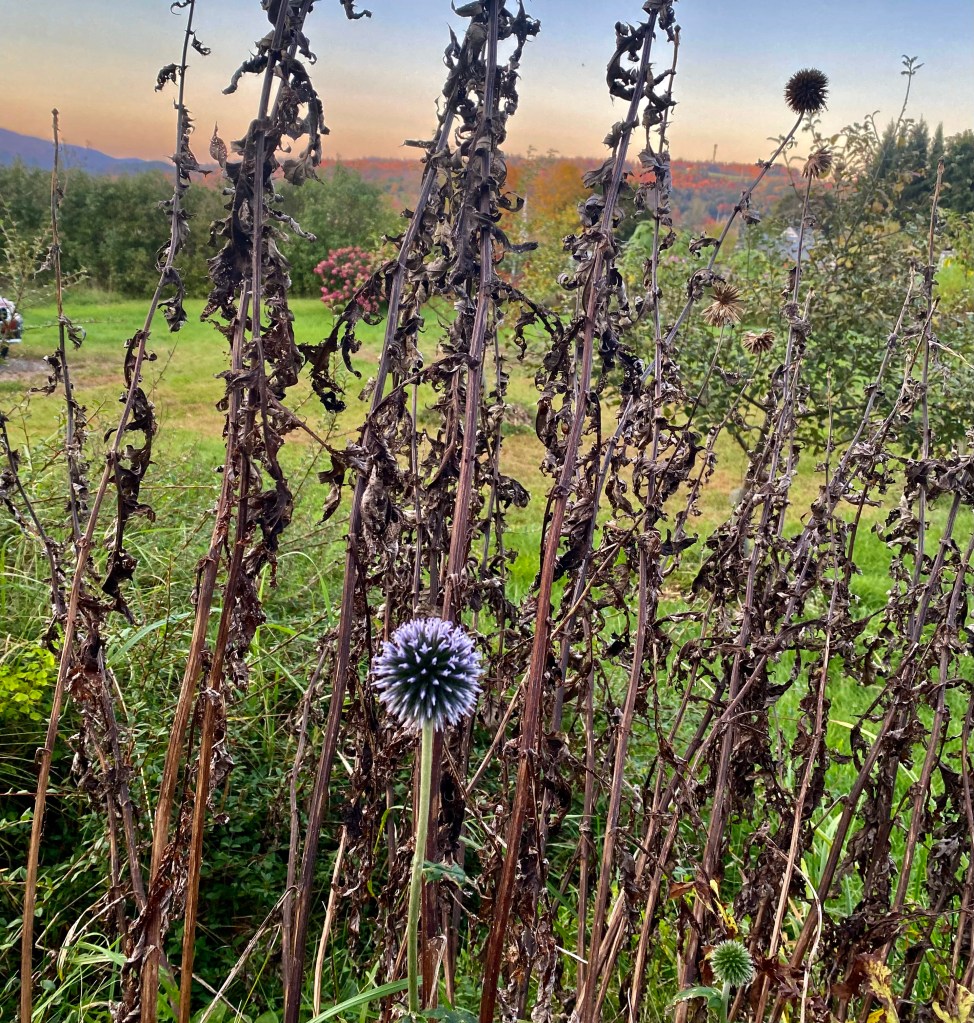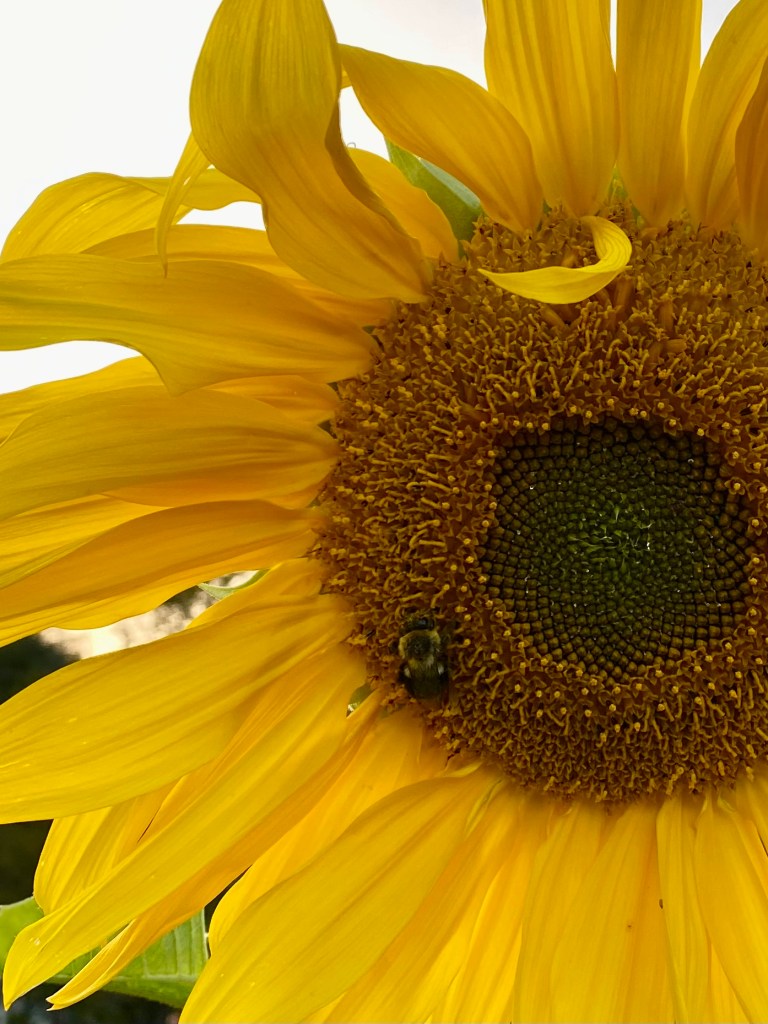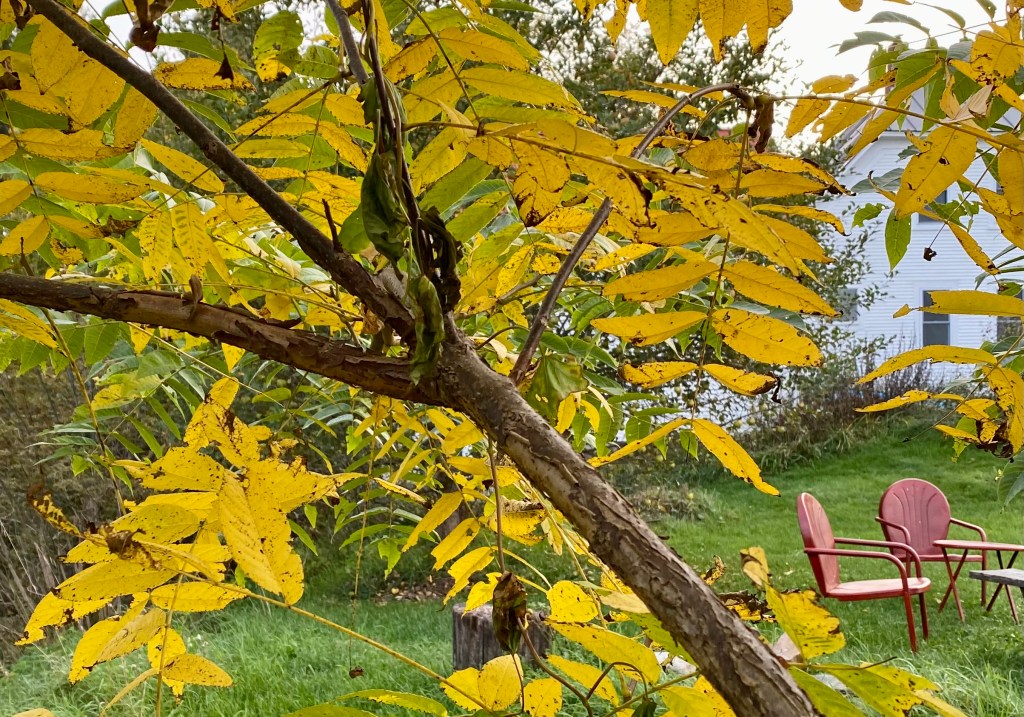
Continuing without a sign.

An inveterate list-writer, at the end of each day, I’m often summing what I’ve done. Somedays, my hands and my hand seem to come up empty. Or my heart has articulated a question.

I pass a few days drinking coffee and talking with my daughters, walking through the woods, along rivers and streams and a rock-throated gorge. They’ve teased me for years about my focus on the gritty and hardscrabble, my fascination with wandering into abandoned cellar holes, my curiosity about abrupt turns in human stories. But when has the world ever not been falling into pieces? There’s this, though: surely at times the world’s misery spins harder and swifter and unbearably more painful.

In those cellar holes, gardens of flowers and sustenance once bloomed at doorsteps, their seeds dormant in the soil. Sunday, nearing dark, I brake for wild turkeys meandering across a dirt road. There’s no one around. I pull over and walk down the road to snap a photo, but the turkeys suddenly rush, hearing my footsteps, and I’ve forgotten my phone in the car anyway. I’m at a driveway that bends up the hillside, the house of out sight. Many years ago, the man who lived there offered me his dead wife’s fur coat. He must be long gone, too. I’ve long since lost any sense of who lives there now.

“Matins”

You want to know how I spend my time?
I walk the front lawn, pretending
to be weeding. You ought to know
I’m never weeding, on my knees, pulling
clumps of clover from the flower beds: in fact
I’m looking for courage, for some evidence
my life will change, though
it takes forever, checking
each clump for the symbolic
leaf, and soon the summer is ending, already
the leaves turning, always the sick trees
going first, the dying turning
brilliant yellow, while a few dark birds perform
their curfew of music. You want to see my hands?
As empty now as at the first note.
Or was the point always
to continue without a sign?
— Louise Glück

Autumn Mysteries.

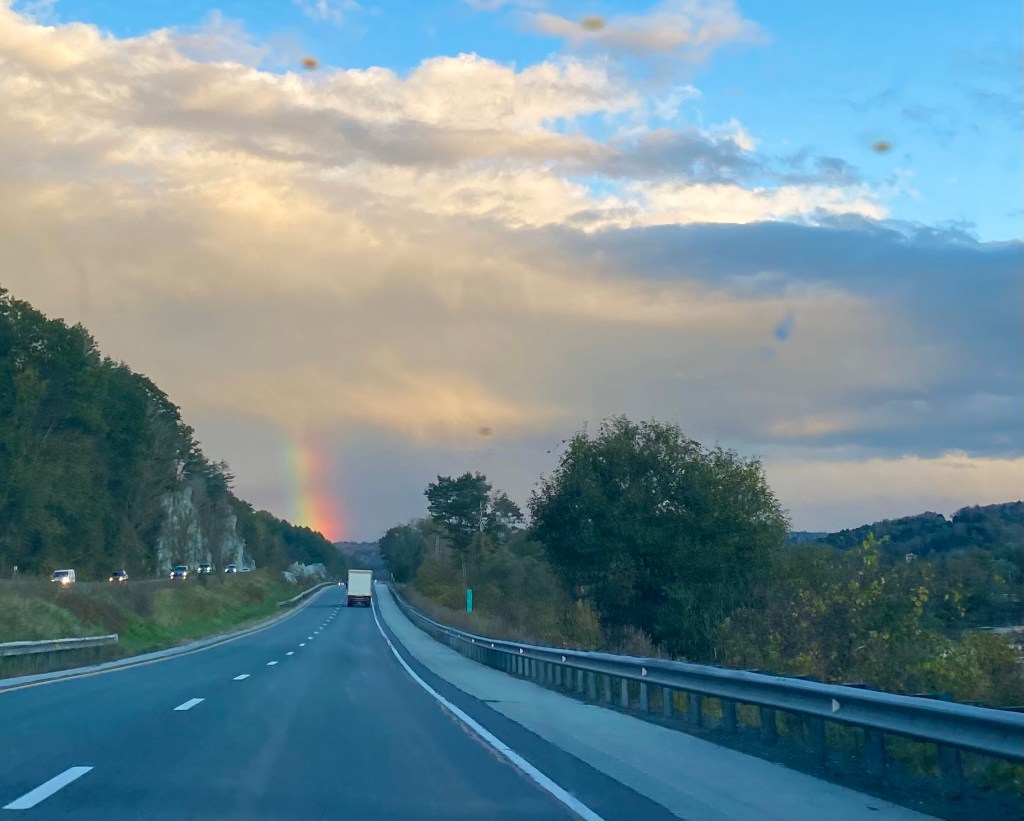
Around a bend in the interstate, a rainbow leg glows. I’ve handed over the keys, and I’m in the passenger seat, knitting forgotten in my lap, as we hurtle along the pavement, rushing over bridges that rise over the Winooski River. Mid-October, dark is not far in the offing. I’m texting my daughter at home who’s feeding the cats and stirring the embers in the wood stove. It’s hopeless to tell my daughters that not so long ago whether someone was home or not was a mystery. Domestic life relied on a vein of faith.

Has the world less mystery now? Surely not. This autumn rainbow beckons us. Around us, an infinity of things we will never understand.

Between us, there’s a bit of discussion about which exit to take, but my driver humors me. There’s those maples before the gold-domed statehouse I want to see, the silver maple beside the library that holds its green longest. By then we’re laughing about a little joke between us — bulk foliage and bulk syrup — tossing those words back and forth for no clear reason at all except for a moment of pleasure.

Autumn: the swinging door between summer’s glory, the myriad folds of winter.

Above the fields,

above the roofs of the village houses,

the brilliance that made all life possible

becomes the cold stars.

Lie still and watch:

they give nothing but ask nothing.

From within the earth’s

bitter disgrace, coldness and barrenness

my friend the moon rises:

she is beautiful tonight, but when is she not beautiful?

— the incomparable Louise Glück, “October”

Post-Flood, Montpelier.

As if overnight, the fall foliage has vanished, swept into gray. The secret of Vermont’s autumn is the long lingering twilights, languorous and violet. Branch by branch, the trees are emerging from their summer splendor. Before frost yet, my garden rages on, orange tithonia, candy-colored cosmos, the morning glories that intrepidly vine through sunflowers and tomatoes and borage.

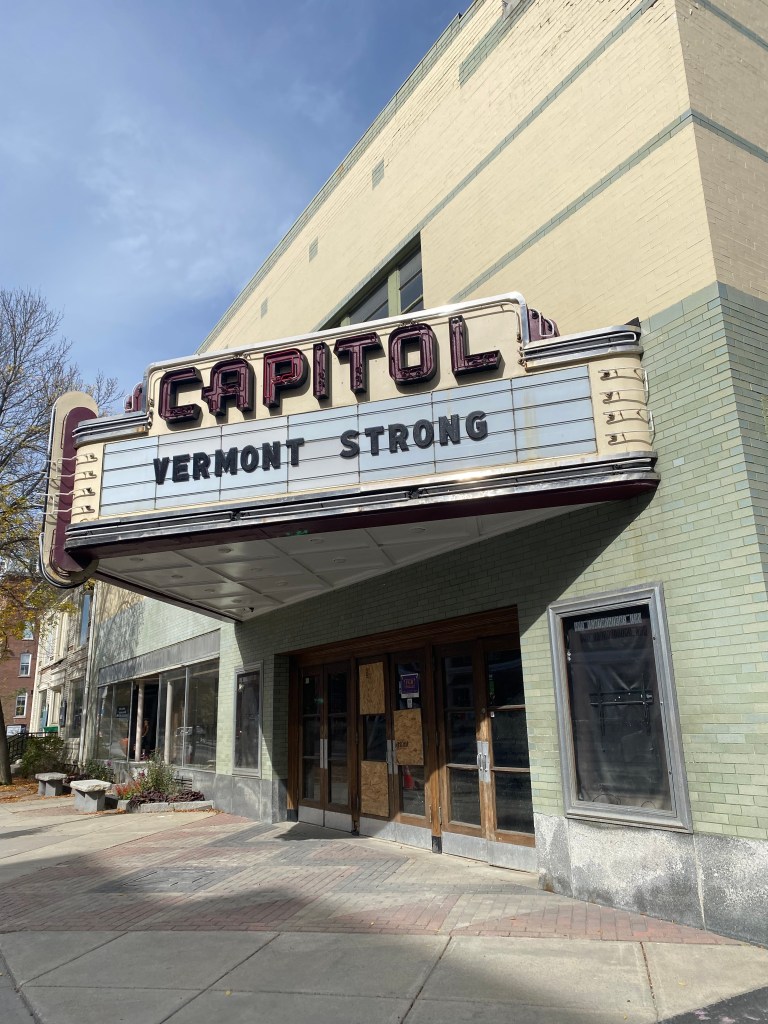
This weekend, I walked through Montpelier. So much of Vermont’s capital remains boarded up after the July flood, in need of money or labor. Other folks have shuttered up and headed elsewhere. It’s impossible to pretend that the world around us isn’t swirling in chaos. Nonetheless, when I come in with my fingers and toes cold, I build a fire. The neighbors string up gold lights. Quickly, quickly, and immensely slowly, the season settles in.

“You must try,
the voice said, to become colder.
I understood at once.
It’s like the bodies of gods: cast in bronze,
braced in stone. Only something heartless
could bear the full weight.” 

— Jane Hirshfield

A Mixed Delight.

All week, we say to each other, This might be the last nice day or Only a few good days left, as if our Shire-ish Vermont realm teeters on the brink of disappearance. Not so, of course.

I leave work early and disappear into the town forest, stepping off the main trails which suddenly seem populated, and hurry down the narrow bike paths, picking up speed and running in my shoes that I’ve meant to replace with their torn toes and worn soles. Add that chore to the list of the mundane: clean the upstairs closet, shake out the living room rug, replace the burned-out lightbulb over the bathroom sink.

October is a hard reckoning month in Vermont, the sizing up of the summer (not enough swimming, surely not enough sunlight) and the letting go of gardening as winter edges in, steadily, inexorably. I rake leaves, mulch the garden, put away my shovel and hoe.

For years, I canned crazily, hundreds of jars of beans and tomatoes and apples. This year, the mainstay of my garden is flowers. Months ago, the flowers gained the upper hand, and I can scarcely pick my way through the tangle of vine and petal: a patch of succor for pollinators, slow moving now, and birds.

My mother asks what’s new, what’s happening: skeins of geese fly over our house. Like the skeins of yarn I unwind and then rewind into fat balls. Sprawled on the windowsill beside my desk, my cat studies a gray squirrel fattening its cheeks with sunflower seeds. Red, gold, green: autumn.

We must risk delight. We can do without pleasure,
but not delight. Not enjoyment. We must have
the stubbornness to accept our gladness in the ruthless
furnace of this world. 

— Jack Gilbert

Starlight Walking, a Pause, a Choice.

Walking back from a library program after dark, I cut through the cemetery. The cemetery is unlit, and I’m walking slowly, staring at the Milky Way sprawled overhead, the enormous immensity of the cosmos. In the dark, I hear a cough. I haven’t been paying attention. At first, I think the cough has come from the person smoking on the balcony not far from me, in the house chopped into apartments at the dead-end road, or the people coughing might be around the gap in the fence surrounding the cemetery. I’m headed that way; the gap leads to the woodsy path that will lead me home. That particular place in the path often has trash – Little Debbie’s wrappers and empty Twisted Tea cans.

So here’s the thing: I’m not at all afraid. Despite the village around me, the night is deep. I’m well-hidden, so concealed I stand there thinking, staring up and seeing a shooting star.

I’ve written a fair amount about being a single mother, a broken half, the jilted family, the rage of abandonment. But it’s equally true that I’ve been single for so long now in a society that seems so devoted to coupleness, that I rarely speak of my solitary life. I know very few single parents, at all, for whatever reason. So this night, I do what I’ve taught myself all these years: I drink in my fill of starlight, that piercing Ursa Major hung over the black horizon of the mountains, let her drench me with her power. I make my choice and retrace a few steps, see my friend and her partner on the street below driving along in the dark, friends who would have happily given me a ride, had I asked. But these nights are still balmy and the bitter cold hasn’t set in yet.

The Pouring Glory of the World.

Saturday, I’m on the bridge in Winooski taking pictures of my daughters, in a strange, almost dreamy smoke-tinged sunset, the kind that’s become more par for the course than not these days. The river snakes through Winooski, a former mill town beside Burlington. Such effort has gone into this town, converting mills to upscale housing, the downtown bustling with restaurants that spread onto the sidewalks. My brother asks me if the town is on the rise. Wrong question, I think.

We’re at the end of a day of walking and sunlight. My brother owns a brewery, and so, while it’s been many years now since my drinking days ended, we’ve gone in and out of bars and breweries, and I’m reminded that the bars I once loved were such good places, full of the people and their stories, their weariness and joy, these things that have always tugged me.

Oh Vermont, my beloved state, in the gem of October. Walking through the woods with friends, golden light falls through the trees. Roads defined my twenties, mountains and rivers my decades after that. I’m well aware that living in Vermont, living in my hillside house with one foot in the village, the other hidden in a wild ravine, is a kind of undeserved luck. Yet the rivers, jammed with debris of broken buildings and busted vehicles, human junk, are a visible siren call of so much and so many things.

Sunday morning, we drink coffee and eat cornbread on my back porch, and solve, as my brother says, not one whit of the world’s problems. October: redolent of wet soil, broken leaf. Yellow and scarlet, a finale of gray. The month when the leaves will fall, the world open up.

From Jessica Hendry Nelson’s Joy Rides Through the Tunnel of Grief:

Wonder is accepting what we cannot control, which is damn near everything. This, the pouring glory of the world. It goes in all directions.