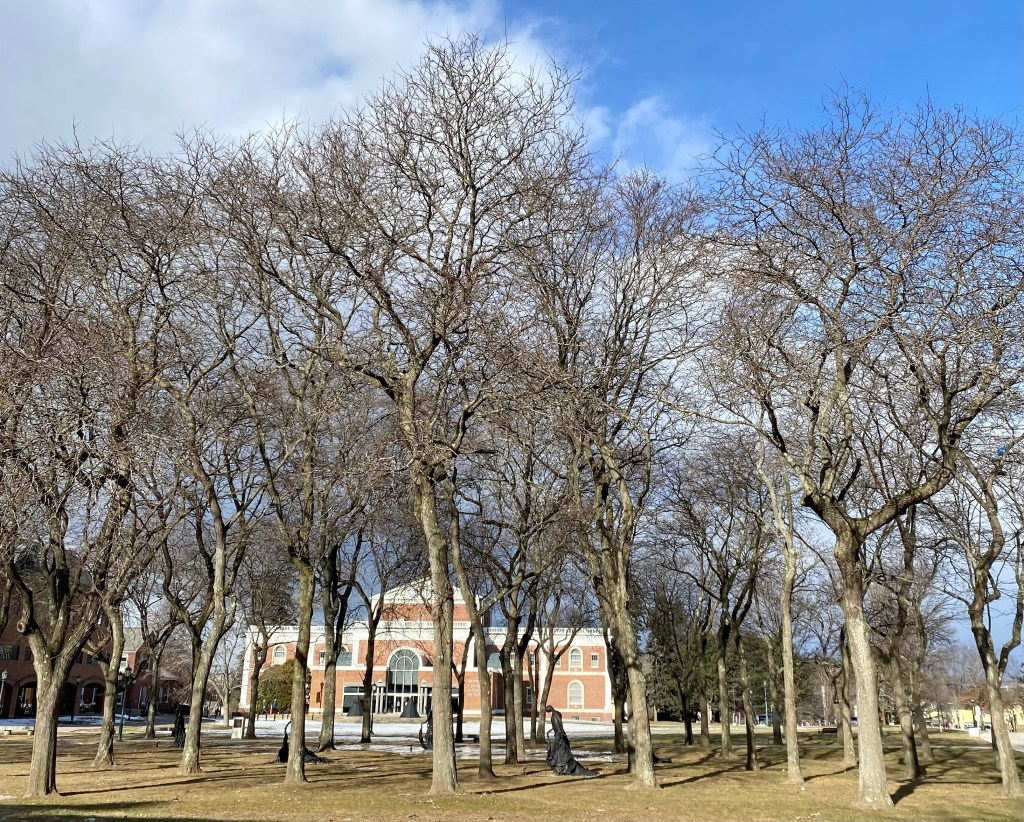
January: wonder & diligence.

Twenty-five years ago, on a frigid January night, I went to a birthday party and ate chocolate cake. I would have my first baby in a week, and I had gone at that pregnancy with wonder and diligence, heavy on kale and broccoli, scant on refined sugar. The cake was marvelous.

In this warm January, a friend lingers with me over coffee. Melting snow drips from the porch roof as we talk about travel, making art and making a living, parenting. I’m reminded of a line from Raymond Carver that the mightiest force in his life was his two children, Carver who wrote brilliantly about laundromat hours. Wonder and diligence. Our conversation winds around to The List, the eternal draft of chores and visions, the crossing off and adding on, the drafting and revising, the diligence that strings our days together, a crude framework of parenting.

End of January: the weather is slushy and icy, sunbeams a rarity, hardly the season of wonder. My firewood holds the month’s damp, as if resistant, too, to the lousy weather. I lay chunks of wood beneath my stove, drying them a little before I chuck them in, burn the wood to ash.

My little cat flicks his tail. A cardinal nestles in the mock orange’s bare branches, crimson feathers in the muted world. I lay my hand on my cat’s silky back, murmuring, “Well, what do you know….”

And a Raymond Carver poem:

“Happiness”

So early it’s still almost dark out.

I’m near the window with coffee,

and the usual early morning stuff

that passes for thought.

When I see the boy and his friend

walking up the road

to deliver the newspaper.

They wear caps and sweaters,

and one boy has a bag over his shoulder.

They are so happy

they aren’t saying anything, these boys.

I think if they could, they would take

each other’s arm.

It’s early in the morning,

and they are doing this thing together.

They come on, slowly.

The sky is taking on light,

though the moon still hangs pale over the water.

Such beauty that for a minute

death and ambition, even love,

doesn’t enter into this.

Happiness. It comes on

unexpectedly. And goes beyond, really,

any early morning talk about it.
Are you for real?!

The other night, I’m leaving a meeting in the high school library devoted, more or less, to hashing out what community means (nothing to be solved in a few hours). In the parking lot, a woman says Goodbye, Brett — and quicksilver, I shout, Are you for real?!

As the other folks empty out of the school into the spitting snow, she and I talk beneath the ghostly streetlamp. Very quickly, it’s clear to me how utterly wrong I am about this woman. What I believed was true was not. I once ate chocolate covered strawberries in her house with my youngest daughter. The woman packed up a bowl of these delicacies for one sister to give to another.

In ten minutes, we are speaking animatedly of matters of our hearts. We’re both shivering by then in the damp snow. We hug and head to our homes.

I don’t know what’s happening in the rest of the country, and I surely can’t speak for anyone else, but how glad I am that I called out in anger. And how much more grateful I am that she took the time to listen to me, to lend me her shoulder, and I could do the same for her. Indeed: real.

A community… is the knowledge that people have of each other, their concern for each other, their trust in each other, the freedom with which they come and go among themselves.

— Wendell Berry

The true religion, the religion of snow…

I stand at my kitchen’s glass door devouring blood oranges and watching the sifting snow. Blood oranges — could I choose a less local delight? I open the door and cast out the peels for the birds.

The cat Acer sits on my feet, listening to the morning radio news, too. Just over the river, my home state New Hampshire revels in the Presidential primary. Meanwhile, Vermont prepares for its March Town Meeting Day, with the calculations and passion of budgets and petitions. Close an elementary school? Pledge to become a pollinator-friendly town? So much of January in my state is devoted to public meetings and discussion/debate, to a reckoning of the way forward, a jostling for who’s running for what seat — and what seats might remain empty.

Meanwhile, snowy winter has finally arrived, spare and elegant. Fearsome and enchanting. As the days deepen in cold, the light hours increase: no stasis in this world.

A fan of local chicken, bacon, milk, my cat stares at my orange-sticky fingers with disdain. I crunch the orange seeds, too, devouring this sunlight sweet.

Here’s Billy Collins’ poem about shoveling snow with the Buddha:

[Shoveling snow] is so much better than a sermon in church,
I say out loud, but Buddha keeps on shoveling.
This is the true religion, the religion of snow,
and sunlight and winter geese barking in the sky,
I say, but he is too busy to hear me.

The sound of one hand clapping, revisited.

This week, I unexpectedly find myself waiting for someone I don’t really know and end up reading a copy of Ken Wilber’s collected writings. Winter has finally come. The purest and loveliest of snowfalls fills up our world. I wait much longer than I had guessed. A woman comes in to sweep the floor, and we talk for a bit. Sunlight pours through enormous windows.

Here’s some Ken Wilber I soaked in:

You know the Zen koan, “What is the sound of one hand clapping?” Usually, of course, we need two hands to clap – and that is the structure of typical experience. We have a sense of ourselves as a subject in here, and the world as an object out there. We have these “two hands” of experience, the subject and the object. And typical experience is a smashing of these two hands together to make a commotion, a sound. The object out there smashes into me as a subject, and I have an experience – the two hands clap together and experience emerges.

And so the typical structure of experience is like a punch in the face. The ordinary self is the battered self – it is utterly battered by the universe “out there.” The ordinary self is a series of bruises, of scars, the results of these two hands of experience smashing together. This bruising is called “dukkha,” suffering. As Krishnamurti used to say, in that gap between the subject and the object lies the entire misery of humankind.

On my way home, I do something I’ve never done in the winter. I park along the edge of an unfamiliar road. I’ve forgotten my hat. The wind is wild, as if I’m on a stormy sea. My hair tangles over my eyes. Oh sun, oh wind, oh endless snow.

Midwinter, here.

Onset of Pre-Cabin Fever.

I shake stunningly beautiful snow from my mittens onto my cats. Mid-January. Winter’s loveliness has just arrived. My house is again the three of us, two fluent in Cat and one marginally fluent in Human. The one who speaks Human gets the deciding vote, so we get up very early. The Cat speakers are wholly in favor of this, as the wood fire is fed and the cat kibble rationed into bowls. Eventually, the dawn finds us, and the rest of the world creeps in.

If this keeps us, the prognosis is mad-as-a-hatter by Honest Abe’s birthday. No fear of that. Any hermiting is constrained around here. Two small excerpts from my novel are accepted by journals. The cats and I nestle into our narrative. I let them lick butter from my fingers. Snow silently fluffs around us, concealing the stars, the sunflower stalks, the ash bucket I left by the step.

A little chaos…

I call the mechanic back about my car who says it’s all good news, a replaced muffler, and the car looks fine.

Finally. Something repaired in the chain of a dying range, a done-in washing machine, my own washed-out and piss-poor attitude.

In one of the few sunny days I’ve seen recently, I’m standing on my back porch, listening to water dripping. We talk a little about the shitstorm of this decade so far, the election roaring up in nearby New Hampshire. He mentions he doesn’t know my political leanings, and I laugh. I’ve been writing him checks for years now, and I’m certain it’s no surprise who I didn’t vote for. But he bends our conversation a little further, kicking the standard gloom-and-doom away and remarks that we might as salvage some happiness in this life.

On this rainy midwinter day, I convince my youngest to drive north to a library in search of a Claire Dederer book. Here’s a few lines from the last chapter of Monsters.

Love is anarchy. Love is chaos. We don’t love the deserving; we love flawed and imperfect human beings, in an emotional logic that belongs to an entirely different weather system than the chilly climate of reason….