The Bardo.

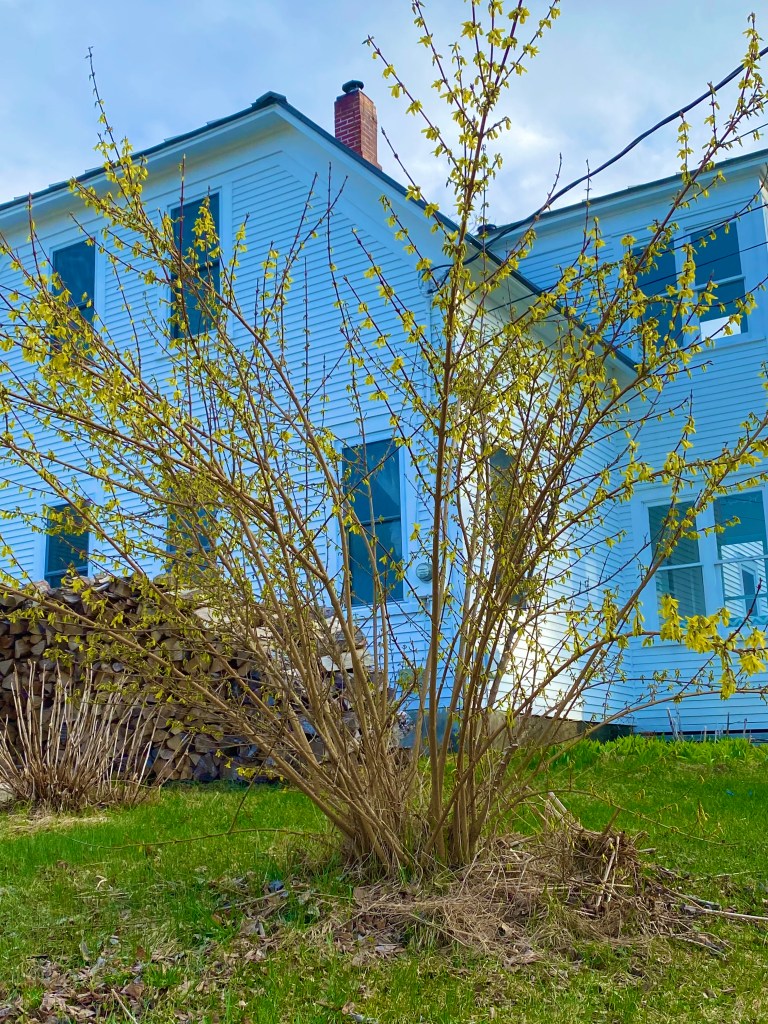
A few years ago, I bought a stick of a forsythia plant. The plant had withered in a nursery which hadn’t cared much for this plant, one of the three or four remaining perennials at the season’s end. For years, I had wanted to plant a forsythia with its cheery early-spring blooms, but I stood there and considered. The plant was about ten dollars. I eventually opened my wallet and took the admittedly meager risk.

The plant thrived. A few years later, I sold that house, dug up the forsythia, and carried the pot in the back of a friend’s pickup to my new house. The plant grew but never thrived, more stick and leaf than bloom.

This year, however, seven years into our life here, the blooms are abundant. I am not a Buddhist, not trained or schooled in any formal education at all, but here’s a thing. For a period of time after each of my daughters was born, I lived in a rarefied space, not of the common everyday world, but exposed and tender, as if the sky had opened up. I had labored to carry a six-pound baby into this mortal world. I had a foot in this world, and a foot still lingering in a gauzy undefined realm. But each day of nursing and crying, of meals of roast chicken and buttered toast, bricked up that entrance, planted me securely in this world again.

So, on the other end of mortality, I see my mother lingering yet with us, in profound and complicated manifestations, in the four of us — her husband and three children — and her four grandchildren as she drifts into her new realm.

In the house where I grew up, my mother and her neighbor bickered over ownership of an enormous forsythia that straddled their property line. As I walk around, planting and watering a lilac tree, stacking firewood, raking, I’m tugged to these delicate gold petals, so brief, such a long struggle, so miraculously splendid.

Darkness overtakes us on our way 

in my lodging the roof leaks 

weeping cherries in flower 

— Buson

The dark blossomings of chaos…

Again, this metaphor lens (how is it possible not to see the world in metaphors?) Paul and John’s Long and Winding Road, Dante’s gloomy forest, Sylvia Plath’s bees and beekeepers…

I lead a friend into a forest, a piece of Nature Conservancy land on a dirt road. We’re talking, talking, my eyes searching the forest floor for ephemerals (the trilliums folded shut, trout lilies still only leafy, no blossoms yet). I take one wrong turn, a second wrong turn. I backtrack, looking for the narrow stone steps. Our walking and talking — and my eventual smartening up to pay attention — takes us to Chickering Bog. In this pristine place, it’s just us and frog eggs, fat tadpoles, crimson pitcher plants — the confluence of ancient and freshly brand-new.

The strange thing is, I’ve walked to this bog half a dozen times, easily. Yet never in April when the sunlight drops down through the trees’ bare branches, when the winter-fall of broken branches strews over the paths. Or maybe I’ve never been here with this conversation about things tiny and great. The glassy water shimmers so clear the bog’s mucky bottom tantalizes, unreachable, so many centuries of so much life.

At the journey’s end, at the dirt road’s edge, the sprinkled gold coins of coltsfoot, a purple sprig of flowering Daphne.

On the reading front…..

“We must therefore be willing to get shaken up, to submit ourselves to the dark blossomings of chaos, in order to reap the blessings of growth.” — Gregg Levoy, Callings

A great fountain of white gossamer…

From New Mexico with its sheer light, I descend back to April Vermont, where miniature daffodils push their yellow faces through last year’s leaf mulch. How well I know Vermont spring — the sunny breezy days where the wind tosses the lake and the water is bluer than blue, the footpath sprinkled with the gold gems of coltsfoot.

After the desert’s sweeping beauty, Vermont is a mossy box, a jumble of the paint peeling from the back of my house, the bin of empty cat food cans in barn (quit kicking that dump run into the next week), the niggling college financial aid forms yet to be corrected, the working hours I string together, making some decent use of my time.

April is a month that goes on too long, lingers brown in northern Vermont, with its tease of green trout lily leaves, the flourish of wild ramps. Paradoxically, April has always seemed the most hopeful of seasons, too, the nesting songbirds sweeping out winter’s silence.

In the evening, my daughter and I walk her dogs across the cemetery to the ballfields. Off leash, the three of them run while I stand in the field’s center, listening to the robins’ chatter in the white pines. Back at my house, we stand by the woodpile, talking about little things — who will take the leftover garlic bread, did the butterfly bush survive the winter. The rising moon illuminates the clouding-up horizon with a glowing shaft. We linger, watching the full moon sail confidently, unstoppably, over the horizon. Later, I linger on the back porch, sipping tea. The moon has removed the lid of shoebox Vermont. The air’s sweet with wet soil.

Springtime, 1998

Our upstate April
        is cold and gray.
                 Nevertheless

yesterday I found
        up in our old
                 woods on the littered

ground dogtooth violets
        standing around
                 and blooming

wisely. And by the edge
        of the Bo’s road at the far
                 side of the meadow

where the limestone ledge
        crops out our wild
                 cherry trees

were making a great fountain
        of white gossamer.
                 Joe-Anne went

and snipped a few small boughs
        and made a beautiful
                 arrangement

in the kitchen window
        where I sit now
                 surrounded.

— Hayden Carruth

Strangers’ sweetness, flying United.

In a sleepwalking haze, I make my way from Albuquerque’s sunny airport to slushy gray Denver (winter, again?!) On the cross-country flight, I make friends with my seatmate, tossing away the nap option for our conversation about camping at Zion National Park. We part ways at Dulles. Walking through the airport’s chaos, I remember that Zion trip in our green Jeep when I was a girl. We tubed down the river all day. I smacked my hip on a rock. That evening, we devoured sausages roasted over a fire, admired the moonrise. Such happy hours.

Later, descending into Burlington, Vermont, the plane cuts down through the brilliant clouds, the underbelly smoky gray, furled with nascent rain or snow. A crimson blush scrims over the mountains, the merest beginnings of tree buds. Dusk hovers. I think of my daughter waiting for me in the nearly empty airport, all grown up now, car keys in her hand. I’m hungry for whatever food she’s brought and, mostly, for the conversation on our drive home.

As the plane brakes on the tarmac, the young couple with the baby beside me remarks that this was their baby’s first plane trip. Around me, the passengers cheer, “What a baby!” but quietly, so the little one isn’t frightened. The parents glow with happiness, the baby coos contentedly, the crowd keeps on, “Great baby! Great baby!” Such a long journey this has been and will be; so happy I am to hear this joyful mantra.

…. Last, a little more about my mother.

What twenty bucks brings.

My father asked me to include the whole W.H. Auden poem I quoted in the previous post. The poem reads:

Stop all the clocks, cut off the telephone, 
Prevent the dog from barking with a juicy bone,
Silence the pianos and with muffled drum
Bring out the coffin, let the mourners come.

Let aeroplanes circle moaning overhead
Scribbling on the sky the message He Is Dead,
Put crepe bows round the white necks of the public doves,
Let the traffic policemen wear black cotton gloves.

He was my North, my South, my East and West,
My working week and my Sunday rest,
My noon, my midnight, my talk, my song;
I thought that love would last for ever: I was wrong.

The stars are not wanted now: put out every one;
Pack up the moon and dismantle the sun;
Pour away the ocean and sweep up the wood;
For nothing now can ever come to any good.

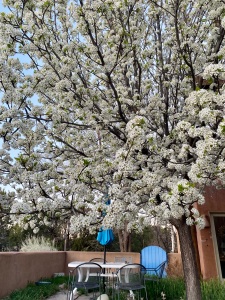
I’ll add this, too: a stunning blossom year for the plum tree my parents planted years ago. They bought the tree for twenty bucks. Would a fruit tree take in the desert, my mother wondered. My father reasoned, Heck, it’s twenty bucks. The tree will grow, or not. The tree thrived.

Stop all the clocks.

Santa Fe, many years ago

In this space, I’ve stepped between the mossy threads of my own life. For many years, my mother who lived far from me kept up with my life through my blog. I’d started writing stonysoilvermont the summer my then-husband and I split up. I was about to publish my first book. Although I’ve considered quitting, I’ve kept on, the disciplined scraps of this writing feeding into my creative life.

So it seems right to acknowledge my mother’s passing over into the next realm. A woman of nearly indomitable strength, she was ill for many years and surmounted multiple surgeries and illnesses. But none of us are mortal. My mother, who was a nurse for decades, knew this more keenly than most people. When I was a girl, she returned every morning at breakfast with stories from the hospital, some funny and some heart-wrenching — a child with leukemia, a cab driver shot point-blank in his head. One July morning, she carried home an orange kitten. We named him Oliver, and he lived a long full cat life.

Same, too, with my mother, a woman whose strength and passion shaped my own. In her later years, disease made her wander back and forth in time, into places where none of us could follow. My mother would have wanted us to grieve the end of her life, but not to fall dramatically on our knees. Raised a Lutheran, she was imminently practical. Nonetheless, I remember when I was 21, and my mother grieved her own mother. She stopped all the clocks.