The Fallow Season

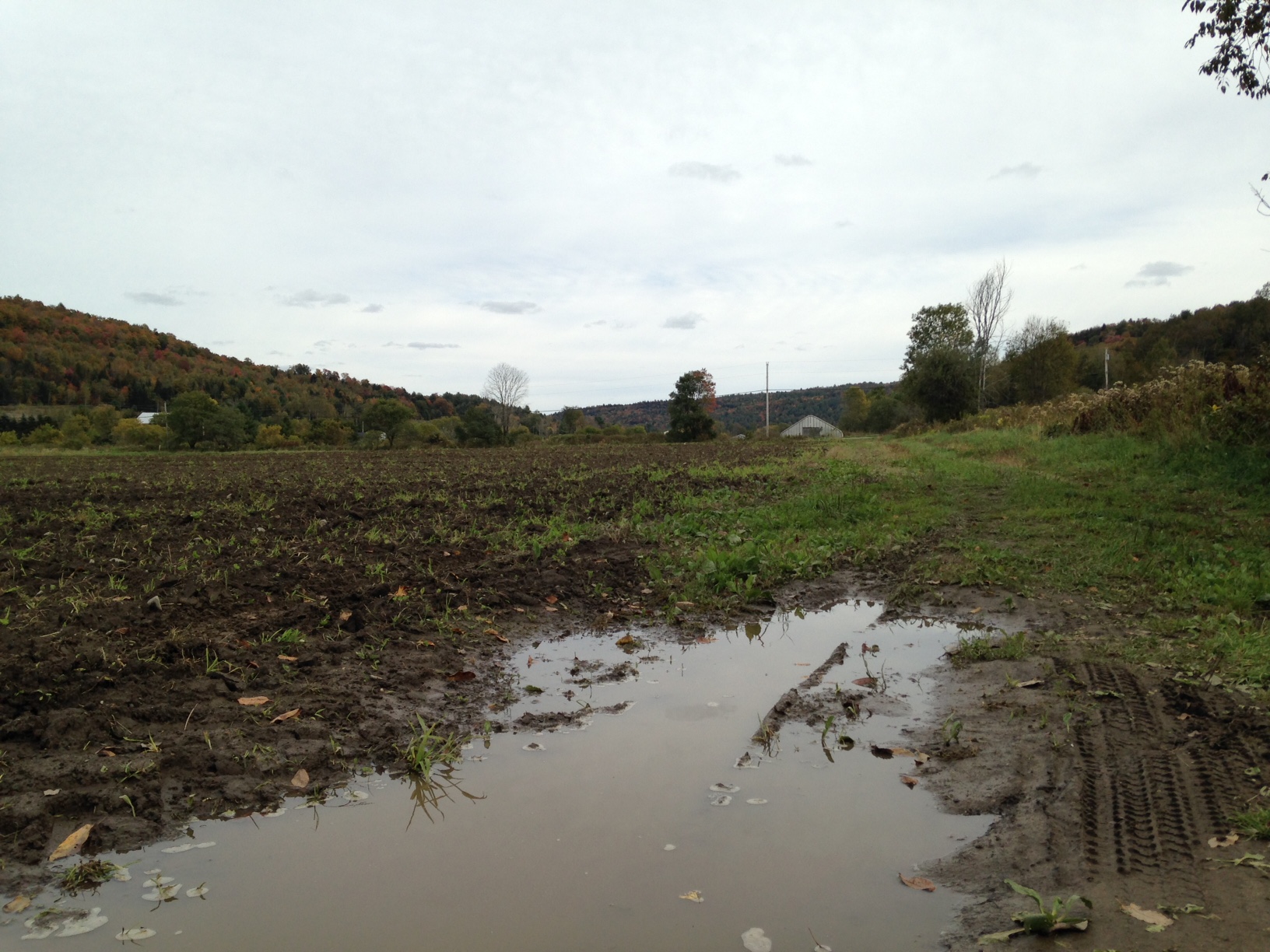
After work today, I walked around the farm fields at the bottom of our road, a carpooling place from years ago. I have a photo of my younger daughter when she was three, running with a friend over enormous white-plastic-wrapped bales of hay, in sheer summertime joy. The field’s fallow now, a great swath of black earth opened up, studded with thistles and stones, emptied of visible life. Even the cartwheeling crows have abandoned these fields. The summer’s radiance has been driven over by the denser hues of gray and black, autumn’s burst of foliage nothing but a splash before winter hammers its solid pins in.

I, for one, welcome in the fallow season, craving a chunk of stillness, wishing the frothy madness of the world (from local gossip to national news) to keep at bay for a bit – or at least a weekend.

Walking with my neighbor this afternoon, we speculated that a brown shape in the dirt road ahead of us was a cluster of fallen leaves, but as we approached, the shape lifted with small wings, and then flew nearby: a wood thrush, quietly keeping us company, swooping nearby and then flickering away into the woods, among the falling leaves.

Wild creatures have the confidence
to realise it’s time for rest.
Nature regards man as a jest,
and doubts his mental competence.
All nature knows it’s for the best
to realise its time for rest.
IMG_0048 copy

Kate Brook Road fields/Hardwick, Vermont

— Ivor Hogg

Early Fall Mornings, Before High School

Early mornings, it’s dark now, the rain hammering on the lid of the LP gas tank outside the bedroom window. My older daughter slumps at the kitchen table and complains about the dark, the cold elbowing in, summer now fully escorted out the door.

As gently as I can, I tell her, It’s nothing personal.

I took that nothing personal line from her, the very line I’m turning back as mirror on her. After one angry tirade at me, she said very genuinely, It’s nothing personal, mom. I’m just telling you. Don’t be upset.

And so, with a real feeling of lightness, I said to her, That’s just the way the world is.

And our day went well.

To have to carry your own corn far–
who likes it?
To follow the black bear through the thicket–
who likes it?
To hunt without profit, to return weary without anything–
who likes it?
You have to carry your own corn far.
You have to follow the black bear.
You have to hunt to no profit…

“Song of Speaks-Fluently,” in Tony Hoagland, Twenty Poems That Could Save America

IMG_0027

The Universe is One Unending Sentence

These early mornings, I’m writing an article about my novel, dissecting how I use language, and explaining the impact of Ernest Fenollosa’s writing about Chinese poetry on my own Vermont book, from the overall arc to the characters’ interior lives. And so on, and so forth…..

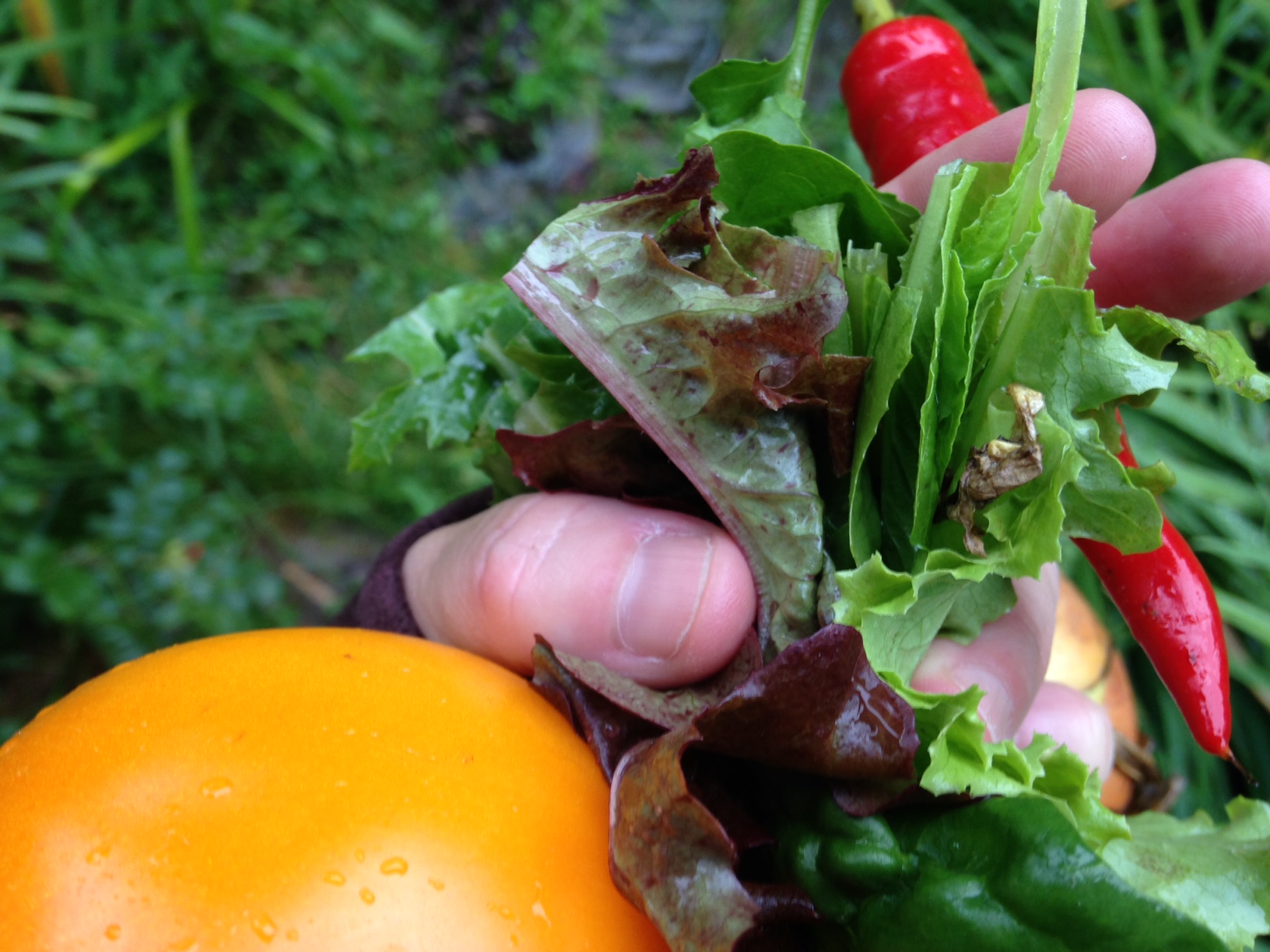
A once-upon-a-time philosophy major, I’m capable of writing up a fury of abstraction, but, really, the gem of Fenollosa’s writing is its concreteness. This afternoon, walking in a foggy rain laced with hues of yellow and red leaves, I picked a cucumber, a brandywine, a crimson red pepper – those jewels of pepper plants keep giving – a handful of mesclun. Separate, discrete things? Or all joined in my arm, in my garden, beneath this misty veil, at this turning place in the season?

The truth is that acts are successive, even continuous; one causes or passes into another…. motion leaks everywhere, like electricity from an exposed wire. All processes in nature are interrelated; and thus there could be no complete sentence …. save one which it would take all time to pronounce.

–– Ernest Fenollosa

IMG_0025

Lady Moon

Small town post office chatter today centered around last night’s eclipse and the remarkably balmy weather. In the quiet night, I had woken my younger daughter from a sound sleep and taken her upstairs to the balcony in my room, where, half asleep yet, she rubbed her eyes and tipped her face up to the heavens. Years from now, I wonder if her memory of this night and the shadow over the rusty moon will be woven in with those strings of her broken dreaming. In the dark that smelled of cut grass and leaves beginning to rot, we stood under the eternally deep sky, the moon so clear her light spilled over our faces. I held my daughter’s warm hand in mine.

…Yet, nothing in nature changes, from that day to this,
(the moon) is still the mother of us all.
I can see the drifting offshore lights,
black posts where the pelicans brood.

And the light that used to shine
at night in my father’s study
now shines as late in mine.

–– Louis Simpson

_MG_2624

This incredibly fantastic photo was taken by Diane Grenkow of Mackville, Vermont, a 19th century mill village.

The Silence Means Something, Too

A few days ago, I inserted Lucille Clifton’s “The Lost Baby Poem.” In graduate school, a professor passed around copies of this poem at the beginning of one workshop. We all sat there, silently, and then a friend of mine began to cry, tears streaming down her face, soundlessly.

My professor cleared his throat and said sadly, Nothing said about this poem is enough said.

My house of females has a lot of talking, but sometimes I remind my daughters that silence can be just as mighty, the absence of words as powerful – for good or ill – as speaking or writing. That sometimes enough is really enough.

To underestimate the appeal of art is to underestimate not only poetry but also human nature. Our hunger for myth, story, and design is very deep…. If we are not in love with poems, the problem may be that we are not teaching the right poems. Yet ignorance of and wariness about art gets passed on virally, from teacher to student. After a few generations of such exile, poetry will come to be viewed as a stuffy neighborhood of large houses with locked doors, where no one wants to spend any time.

–– Tony Hoagland

FullSizeRender

Woodbury, Vermont

Moon Rise

This evening, we finished dinner late, and my older daughter hurried out the door, saying she’d wash the dishes as she tugged on her sweatshirt. The younger daughter rushed, too. Let’s go out, she insisted. Twilight descends rapidly now, and even along our nearly untraveled dirt road it’s too dark for a child to bike in the dark. Independent at ten, she nonetheless walked closely beside me, marveling that her older sister was not afraid. I told her I had been afraid of the dark until I was an adult, and only cured myself by walking back and forth from the sugarhouse to the house in very late nights, in snow and rain and sharp cold. I remember quite clearly how utterly impenetrable I found the dark, and how long it was before my fear lessened, and an even greater time before I welcomed the night as a familiar friend.

I assured my younger daughter she wouldn’t be afraid of the dark forever, either. Walking, we talked about why the songbirds aren’t singing now and about her school monarch butterfly project, and then as we ascended an incline, the moon abruptly appeared from behind the trees, so luminously alive it was like gazing into a pail of fresh milk, luscious with cream. We stopped, shivering a little. As the dusk fattened, my older daughter in her white shirt appeared out of the gloaming, laughing at finding us in the dark.

In all the many things of today, here’s the deepest:  the almost-full moon rising over a mountain, greeting my daughters and me in this cool Vermont night.

O Nietzsche, how wrong can you be, though
I like the way you sublimated your rage
into the colic of apoplectic, apocalyptic prophecy.
I don’t know if the world’s bad enough to deserve you,
or if chaos has miscarried at the birth of your dancing star,
but blessings on your head and house, anyway, wherever you are.

–– Patrick White

Photo by Molly S.

Photo by Molly S.