Winter: the Whale’s Belly

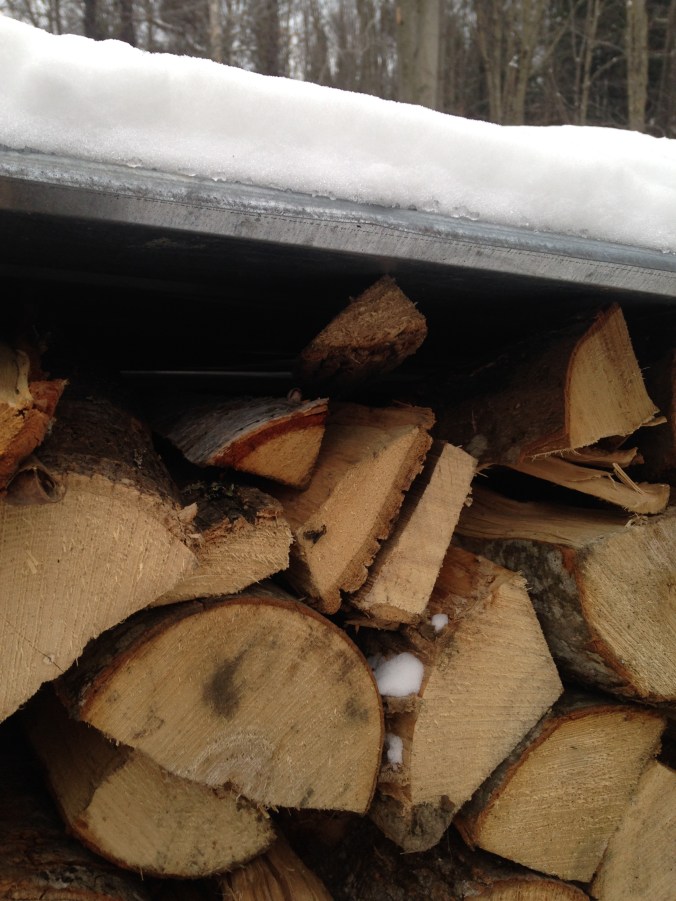
Our kitchen was forty-two degrees this morning. I leaned over the range and chipped a ridge in ice along the bottom of the window, and thought this is getting a little ridiculous. And I forgotten cream for the coffee. Often, in these morning – no Biblical scholar, not even a church-goer – I think of Jonah in the belly of his whale.

But then, home again from a basketball game, the wind blowing snow in our faces, my older daughter sang out, You can tell the light’s coming back! 

Indeed. Through translucent clouds, the day was yet bright, the moon a glowing gem tucked above the bare branches of maple trees. After a frozen day, the end was such a lovely place, with traces of snow falling, the white all around pure and white, and the light familiar and beckoning as that long-off spring.

...Winter is for women ----
The woman, still at her knitting,
At the cradle of Spanis walnut,
Her body a bulb in the cold and too dumb to think.

Will the hive survive, will the gladiolas
Succeed in banking their fires
To enter another year?
What will they taste of, the Christmas roses?
The bees are flying. They taste the spring.

– Sylvia Plath, "Wintering"

IMG_9644

Photo by Molly S./North Bennington, Vermont
Gnomon

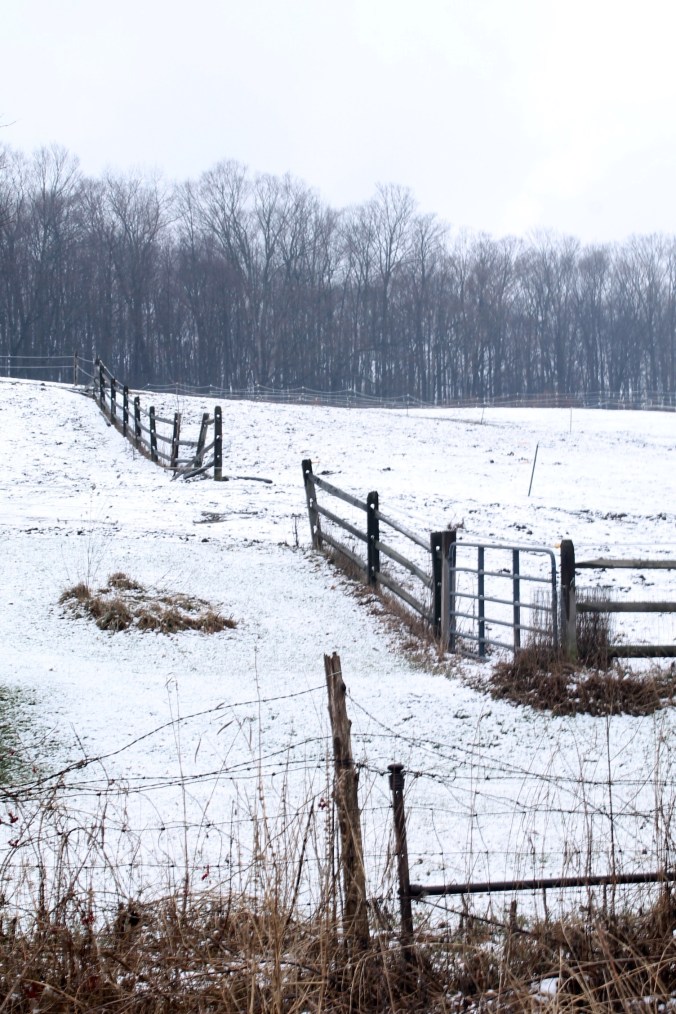
When I was in high school, my father, sister, and I read Joyce’s short story, “The Sisters.” I was thinking of that story again today, in this kind of chilly and drab weather that intimates how I imagine Ireland. The opening paragraph is one of my most favorite in all literature. In the story’s opening lines are three words – paralysis, gnomon, simony – that are keys to understanding the story.

With my daughters today, we were talking about family, and patterns of behavior, and I began to wonder myself, What are the keys to understanding each of us? For one of my daughters, at the age of three, I would have used tricycle and rabbit as her own particular talisman; for my other child, the word sister.

We use language so easily, so freely, that we’re often careless with its power, misunderstanding and underestimating its capability, both for destruction and redemption – or as a key to see into deeper recesses of our inner lives.

THERE was no hope for him this time: it was the third stroke. Night after night I had passed the house (it was vacation time) and studied the lighted square of window: and night after night I had found it lighted in the same way, faintly and evenly. If he was dead, I thought, I would see the reflection of candles on the darkened blind for I knew that two candles must be set at the head of a corpse. He had often said to me: “I am not long for this world,” and I had thought his words idle. Now I knew they were true. Every night as I gazed up at the window I said softly to myself the word paralysis. It had always sounded strangely in my ears, like the word gnomon in the Euclid and the word simony in the Catechism. But now it sounded to me like the name of some maleficent and sinful being. It filled me with fear, and yet I longed to be nearer to it and to look upon its deadly work.

– James Joyce

IMG_9725

Photo by Molly S./North Bennington, Vermont
 

Ides Of January

Halfway through the middle of January, halfway through a school year.

With the bottoms of doors we don’t use in winter dampened shut with rolled rugs to stave out the drafts, and the curtains drawn tight every night against the cold glass, the back entryway filled with firewood, the living room floor strewn with bark chips, the winter (despite the little snow) is hammered solidly against our house. While the children are visiting grandparents this weekend, I’m determined to press through my own inside work piled unevenly on my desk, the couch, a chair beside the wood stove. Much of that is good news – my book is heading towards a second printing – and the winter is a steady time to work.

But yet this is the time of year I lust for those humid summer nights, the windows open, the tree frogs singing. On our dirt road this afternoon, my daughter, driving, nearly stopped the car when a flock of wild turkeys clambered out of the apple trees and surrounded us, running beside us with their skinny legs and awkward bodies. She was frustrated, wanting to hurry home and go for a run.

I unrolled the window and leaned out of the rolling car, my arm outstretched for the nearest bird, the breeze cold and hard in my face.

She started laughing. What are you doing?

Catching dinner. Steer a little to the right, will you? I nearly have this one.

Ides of January. Time to mix it up a little. Lots of winter left.

Black are my steps on silver sod;
Thick blows my frosty breath abroad;
And tree and house, and hill and lake,
Are frosted like a wedding cake.

– Robert Louis Stevenson

FullSizeRender

West Woodbury, Vermont


Fire & Ice

A few inches of loose snow cover the snow all around our house. Beneath this lies rock-hard ice. Maybe someday I’ll live again in a world of shoveled sidewalks, but for now, our footing changes all through the winter and even well into the spring, when mud begins its 10,000 variations. I carried out this morning’s ashes and made a trail to that essential woodpile. A gray dusting of ashes covered a bucket of gleaming coals that hissed, burning down through the ice and snow.

Fire and ice. Why I love Vermont could fill many pages, or simply these three words. The contents of my hearth lie cast out on the frozen ground, dying, while jays cull my compost pile. The girls replenish our woodbox, readying for another night.


Life is, in its very essence and character, a terrible mystery—this whole business of living by killing and eating. But it is a childish attitude to say no to life with all its pain, to say that this is something that should not have been.

– Joseph Campbell

IMG_0558

January, Vermont, 2016


Follow Your Bliss

When I was in graduate school, a popular bumper sticker read Follow Your Bliss. That Joseph Campbell line has followed me for years, and it’s only now, in my forties, that I realize I terribly misunderstood this line. I was hung up on the notion of bliss as a static state, this misguided notion that happiness is something you might be able to square off and define, that happiness might be a finite destination.

Follow Your Bliss seemed to imply a life of milk and honey, where children are always chubby-cheeked and houses never burn down. When I read Campbell, I didn’t stop to realize that doors opening also means there are times when every door appears slammed shut, and the way out impassable. I think now I would rewrite this line to Work hard, have faith, and laugh. Keep your eyes savvy and don’t forget to stretch your hands out for others. All that’s in Campbell, slow learner that I am.

If you follow your bliss, doors will open for you that wouldn’t have opened for anyone else.

A bit of advice
Given to a young Native American
At the time of his initiation:
As you go the way of life,
You will see a great chasm. Jump.
It is not as wide as you think.

– Joseph Campbell

FullSizeRender

Photo by Molly S./Hazen Union parking lot, early morning


January Thaw & Rural Safety

When I carried out the stove ashes this morning, the air was balmy, almost sweet, redolent with that peculiar scent of woodsmoke hanging low, with traces of mud and the wetness of tree bark. The ten-year-old girls played in the hoop house, climbing up the metal arches, while I restocked where the woodpile had fallen down into slushy puddles.

Later, the rain began to fall in earnest, and the little girls and I drank tea and talked about the river ice breaking up. We remembered snowshoeing on a pond last winter, and someone who had broken through the top crust, soaking his boot. He spread himself out on the ice, to even his weight.

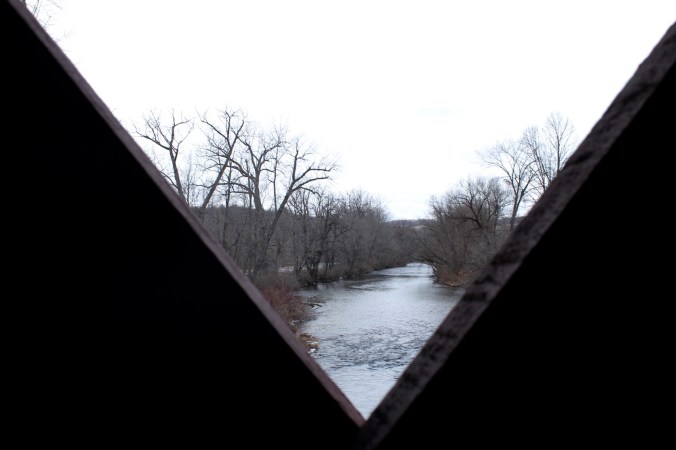
In the cold of winter, we often skate on deep lakes with enormous pleasure. I reiterated how to skate with safety – how to love Vermont’s frozen waters with the bend of the sky overhead.

As we talked on and on this rainy, chatty day, I ended up telling my daughter and her friend about a visit I had made to Detroit when I was their age. My father bought food at a restaurant where money and food revolved through a bullet-proof revolving door. My siblings and I didn’t understand this at all; my father said, “We’re in Detroit, now, kids.”

Rule 1 if you break through the ice: don’t panic.

Crows

It is January, and there are crows
like black flowers on the snow.
While I watch they rise and float toward the frozen pond,
they have seen
Some streak of death on the dark ice.
They gather around it and consume everything, the strings
and the red music of that nameless body. Then they shout,
one hungry, blunt voice echoing another….

– Mary Oliver

FullSizeRender