The Undertow

Deep in the night, I woke thinking of a Raymond Carver story I had been reading, “Will You Please Be Quiet, Please?” My children had found this title infinitely amusing, riffing on it as a joke between the two of them.

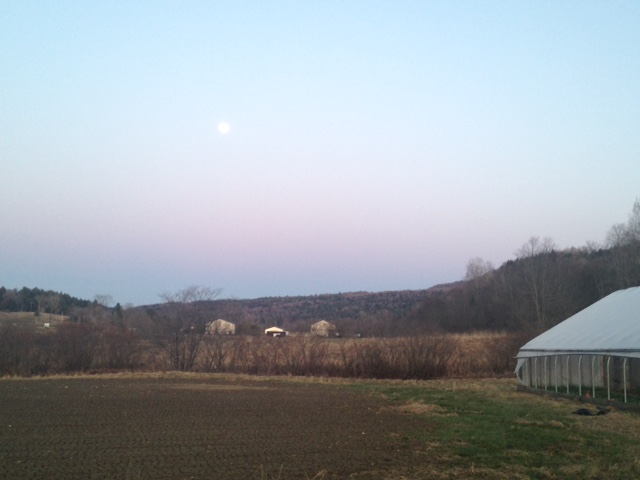
All night long, while the girls and I had been sleeping, cumulus clouds floated over our house, the full moon shining through like a light at the bottom of an ocean turned upside down. I opened the door and stood on the balcony, imaging myself a clipper ship surrounded by this sea of luminescence. In the distant east, just over Woodbury Mountain’s black ridge, shone a single star. In the moonlight, I saw through the sparse woods the edge of the town’s tiny cemetery, where the slatted fence peels white paint.

The Carver story, simply, is about marriage, and it’s not a funny story at all. It’s about conundrums and paradox, about the mysterious, hidden parts of our lives. And yet, standing beneath that marvelous night sky, I watched the moonlight rush cloud shadows over the earth. I was glad to be awake.

…We could have some arrangement
By which I’d bind myself to keep hands off
Anything special you’re a-mind to name.
Though I don’t like such things ’twixt those that love.
Two that don’t love can’t live together without them.
But two that do can’t live together with them….

From “Home Burial” by Robert Frost
IMG_1037

Hardwick, Vermont


Frog Chorus

I hate it when my daughters bicker.

Stop, stop, stop, I demand. Are you listening to yourselves?

They look at me oddly, and insist, This isn’t fighting, mom.

Recently, I’ve been forcing myself to close my eyes and simply listen to the cadence of their voices. Not the words, not even the tone, but only the rhythm and motion of their voices together. They pick at each other; they laugh; their voices dive at each other again.

Late this afternoon, I walked to our woods pond. Before I could even see the water, I heard the cacophony of frogs, so rusty this early in the season I might have mistaken it for a few stray geese. When the frogs heard my footsteps on dried leaves, they vanished under the water. I remained crouched for a good long while before the frog-chatter chorus cranked up again, a tentative bleat here, then another.

Walking back, I challenged myself to think of my daughters as those calling creatures and listen carefully to the song beneath their singing.

Old pond…
a frog jumps in
water’s sound.

– Basho

FullSizeRender

Woodbury, Vermont

The Middle Ages, Vermont 2016

One way I’ve (unintentionally) annoyed my daughters is my insistence that, every now and  then, I’m inhabiting the Middle Ages. This afternoon, in a stretch of breezy sun, at that optimum seventy degrees, I dug my fingers into the warming garden beds and unearthed worms, threadlike strings of root, lifting handfuls of johnny-ups for a friend.

Somehow, in my fictive Middle Age world, there’s only sunlight and soil, the constellations overhead undiluted by manmade light. This world lacks the drone and pollution of the internal combustion engine, contrails, the unending pressure to earn a living, get the kids one place or another, be accountable to the world out there. I have this vision of a world in perpetual growth, the earth still solidly at the center of the universe, the sun orbiting my serf’s homey patch of soil.

Conveniently, the Pope remains distant, the Children’s Crusade hasn’t happened yet, the Black Plague and smallpox are on hiatus. The thatch over my head is rat-free, famine hasn’t reared its head, and – of course – family life is just fine.

It’s a nice reverie, though, when I remain for these hours in my hands-on-the-land dreamlike stance, gathering tangy greens for dinner, my cheeks sun-kissed.

 But you may be surprised to hear that the Middle Ages were like a starry night. Let me explain. Have you ever heard people talking about the Dark Ages? This is the name given to the period which followed the collapse of the Roman empire when very few people could read or write and hardly anyone knew what was going on in the world.

– E.H. Gombrich, A Little History of the World

FullSizeRender.jpg

Woodbury, Vermont

Listening

Last evening, walking along our dirt road with my daughter, she chattered about our shadows in the lingering daylight, how the sun had merged us into one person, and we appeared to be one being with four legs and a curious kind of goose neck she had made from her hands.

While we were standing there, I suddenly realized I had been listening to the robins singing in a nearby maple tree, without any particular consciousness – and yet on some level I must have been listening keenly. Just recently returned, a whole flock of red-chested couples are nesting in the maples around the garden.

When we first moved to this house, we had two bird-stalking cats and the field was wooded then: the songbirds are not prolific as they are now. But, as all things go, our terrain has changed, and one benefit is this spring melody. How funny is the human mind: winter and cold has now fled our immediate memory, and it’s spring and seeds and the garlic pushing up through a mulch of rotting leaves.

We don’t have to live great lives, we just have to understand and survive the ones we’ve got.

– Andre Dubus

FullSizeRender


Daughters

In my usual, take-your-kids-to-work-with-you way, the girls came, too, when I read at Vermont’s Norwich Bookstore, in the first real sunny day of spring.

Afterward, my daughters and I walked around Dartmouth College, where the enormous green was filled with students and flying frisbees. The young women wore strappy dresses; the daffodils spread their buttery petals; we ate homemade cherry gelato. All was budding and new in the world. Driving back along Vermont’s sparsely travelled interstate, we passed fields turning toward emerald from the dull brown they’ve held for weeks. The rivers and lakes had thawed, and flocks of birds darted in quick waves.

All the way home, needing no map, we laughed and told stories.

…You are born a woman
for the sheer glory of it,
little redhead, beautiful screamer.
You are no second sex,
but the first of the first;
& when the moon’s phases
fill out the cycle
of your life,
you will crow
for the joy
of being a woman,
telling the pallid moon
to go drown herself
in the blue ocean,
& glorying, glorying, glorying
in the rosy wonder
of your sunshining wondrous
self.

– Erica Jong

FullSizeRender.jpg

Hanover, New Hampshire

Marriage is a Rope

Writer Andre Dubus, master of dialogue, of marriage and its dissipations, pulled over years ago on an interstate as a good samaritan, was hit by a car and never walked again. Last night, I again reread his novella We Don’t Live Here Anymore, and I was thinking of this story at my child’s school this afternoon.

The afternoon was breezy and sunny. The children, from little kindergarteners to the big sixth-grade kids, were outside, chalking on the pavement, playing basketball, swinging, avoiding the wasps stirring in the heat.

One element of Dubus’s genius is to illuminate marriage as a unique configuration between two people with no cliches – all the loving, lust, resentment, frustrated dreams – woven into a particular rope of a marriage. Any rope put to use has its strength tested: will the material fray or snap? Or it is woven well and truly?

When I was a child, jump roping on a school playground, I imagined infinity was the  blue sky, never envisioning our interior worlds are as mysterious as the endless sky. On the way home, I bought my daughter her first cremee of the summer.

In a marriage there are all sorts of lies whose malignancy slowly kills everything, and that day I was running the gamut from the outright lie of adultery to the careful selectivity which comes when there are things that two people can no longer talk about. It is hard to say which kills faster but I would guess selectivity, because it is a surrender: you avoid touching wounds and therefore avoid touching the heart.

– Andre Dubus, We Don’t Live Here Anymore

FullSizeRender.jpg

Hardwick, Vermont