The Earth Curves, of course

After a day of downtown Portland’s busy scene – art and wharf and walking, and my brother crashed a bachelorette party while my daughters ate gelato, and my older daughter bought the younger a miniature ship in a bottle – we drove over a drawbridge in search of the wide open ocean.

At the beach, we left our shoes by the car and spread out, one daughter gathering shells and sea glass, the other carrying her camera. Away from the city’s hurdy-gurdy, the ocean  – sky, sand, stone, gull, the steady and infinitely changing waves – churned, at once noisy and calming, a place we had never been and yet was familiar, expansively glorious.

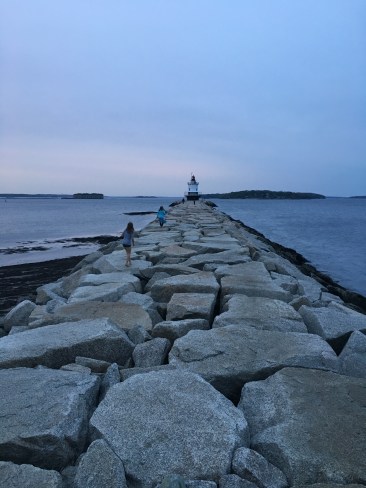
We leapt over enormous chunks of pink granite to an old lighthouse while the sun tugged the daylight over the horizon. Afterwards, all of us laughing while I drove through the dark, I told the children we would stop in Pierre, South Dakota, for gas. With our three drivers, we’d switch off until we hit the north California coast. Even when we returned to my brother’s New Hampshire house, late, the little girl tired and nearly asleep, we were still laughing, the world wide-open and full of possibilities, as if my little car with its two bright headlights could trek all around the the globe and ferry us back to home.

…where we choose to be–we have the power to determine that in our lives. We cannot reel time backward or forward, but we can take ourselves to the place that defines our being.

Sena Jeter Naslund, Ahab’s Wife, or The Star-Gazer
IMG_3134

Cape Elizabeth, Maine/Photo by Molly S.


Now, Stop & Admire the Scenery, for a Change

Yesterday, my daughters and I drove from Vermont and crossed over the White Mountains,  in a route I love and have travelled for years. This time, though, with a daughter’s friend, we stopped at a place in the mountains I’ve always rushed by, at fifty or sixty miles per hour. The point is near enough to the end (or, backtracking, to the beginning) of the trip that I’ve never wanted to pause.

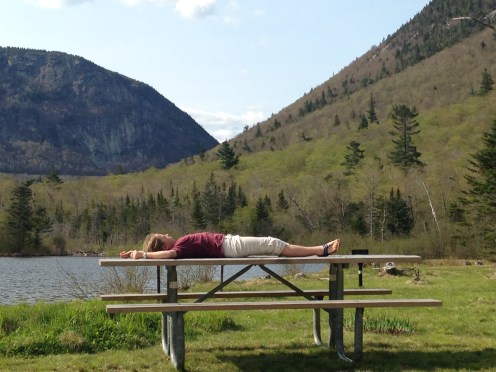
In a meadow along the Sacco River, with enormous granite mountains steeply rising on either side, the area was exquisitely beautiful. The river flowed clear, clumps of bluets bloomed in the emerald grass, and the mountains held us like a pair of immense hands. In the bitter depths of winter, hail, snow, fiercely unrelenting winds pummel these slopes, but  this spring May afternoon, I remembered my childhood infatuation with Johanna Spyri’s little orphan Heidi.

As a mother, years later, when I read the book to my first daughter, I was appalled I had missed the heavy-handed Christian urging in this novel; this book was radically different from the book I had read over and over as a ten or eleven-year-old child. But was the book really different? What sang to me in the story was an orphaned child who loved her grandfather, a bed of fresh hay, the shimmering constellations, toasted cheese sandwiches and mountain meadows of wildflowers. Through her life’s circumstances, she experiences loneliness, cruelty, abject misery, and yet love of the mountains draws her beyond her own particular unhappiness: love of beauty and the inherent goodness in people is the staff of her strength.

Sanctimonious? Need not be.


But she had to go to bed first, and all night she slept soundly on her bed of hay, dreaming of nothing but of shining mountains with red roses all over them, among which happy little Snowflake went leaping in and out.

– Johanna Spyri, Heidi


IMG_1234

White Mountain National Forest, New Hampshire

Reading, Now and Then

Back when I was in high school, I copied Salinger’s Seymour Glass and wrote quotations on index cards and thumb-tacked the cards all around my desk. Some days, it feels like veritable centuries have passed since my high school days, and I’ve long since abandoned that practice. But every now and then, reading, I come across some of those lines I favored, and I’m often struck by how much I still admire whatever I was reading then.

What’s changed is me. What’s changed is that I no longer primarily understand with my head, but all the way down to the roots of my abscessed tooth, or twined around the scars of my caesarians, or in the pronounced veins on the backs of my hands.

Isn’t that one of the beauties of literature? Some places I’ve returned to from my childhood are far smaller and paler versions in my adult life than my memory held. But books? So many are infinitely better, this time around…..

We shall not cease from exploration, and the end of all our exploring will be to arrive where we started and know the place for the first time.

– T.S. Eliot

IMG_1224

Lake Elmore, Vermont


Being a Child

Later in the summer, when the gardens are overrun with weeds, and cucumbers and string beans need to be picked from sagging vines, and the days are long with children swimming, and smoke hangs in the air from cooking outside, there’s often a point in the late afternoon when the world seems just a little much: that so-called witching hour mothers of babies know. We’ll move through that hour, through dinner and dishes, and washing up, and the cool leisure of evening comes in.

But now, in the spring, the world is yet at that new place. The weeds are nowhere near knee-high, and the warmth is as welcome as a novel in my hands I want to read.

I imagine this is how childhood should feel.

…And as I was green and carefree, famous among the barns
About the happy yard and singing as the farm was home,
In the sun that is young once only,
Time let me play and be
Golden in the mercy of his means,
And green and golden I was huntsman and herdsman, the calves
Sang to my horn, the foxes on the hills barked clear and
cold,
And the sabbath rang slowly
In the pebbles of the holy streams…

– Dylan Thomas, “Fern Hill”

FullSizeRender.jpg

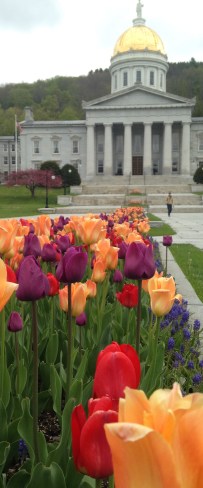
Montpelier, Vermont

New Growth

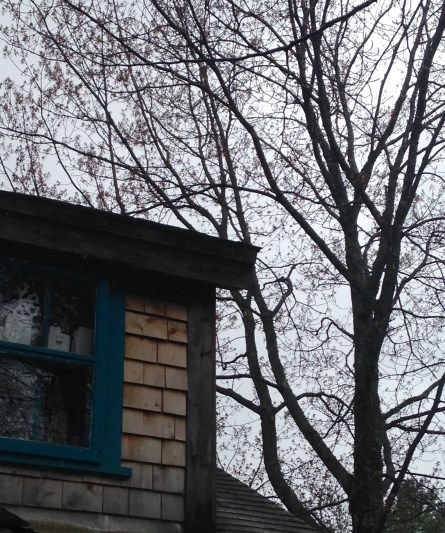
The maple tree before my house was seeded in this ragged lawn before I lived here, and it has grown steadily over these years. This beauty is likely much older than I’ve ever given her credit for. And yet here again, this May, her gnarled, lichen-covered branches are sprouting green again, with the tenderest of leaves.

I love that mystery; I love that rebirth; I love that change. One of my most favorite endings in a novel is Akhil Sharma’s Family Life, at once simple and exquisite, while throwing the reader back into the depths of the novel, the infinitely deep, living sea.

That was when I knew I had a problem.

– Akhil Sharma

FullSizeRender.jpg


Reasons to Love Vermont

Yesterday, bees and butterflies busied around the garden while I planted leeks and peas, and today it’s darn near freezing. Reasons to savor Vermont?

A bit of pink pushes through the apple blossom buds. Siberian irises have dislodged stone in our backdoor entryway, and the rose-cheeked children appear to have grown two inches overnight, rivaling the dandelions’ growth. For dinner, we’re eating pork from a friend’s pig and my tart greens and another family’s sheep cheese. We hear coyotes in the morning, waiting for the school bus, and the principal made phone calls for my daughter and her friend to get together “because I like them so much.”

The sweater I knit is sifted with garden dirt, and my hands are stained from weeding. Rain pours; walk around the house, and the sun shines brilliantly. How could you want to be anywhere else?

….Can I leave
you the vale of ten thousand trilliums
where we buried our good cat Pokey
across the lane to the quarry?
Maybe the tulips I planted under
the lilac tree? Or our red-bellied
woodpeckers who have given us so
much pleasure, and the rabbits
and the deer? And kisses? And
love-makings? All our embracings?
I know millions of these will be still
unspent when the last grain of sand
falls with its whisper, its inconsequence,
on the mountain of my love below.

– Hayden Carruth, “Testament”

FullSizeRender