More Than the Whole

This afternoon, my daughters baked a raspberry tart, gathering like any craftswomen the pieces of their creation: oats, sugar, butter, fruit. Thinking over the book I’m writing, like any writer I gather my pieces – characters in their tangible and intangible complexities (a green and gold wool vest, a port wine birthmark, the memory of driving rashly along a rainy street), story, and language – shaping this creation.

But a book is greater than the sum of its pages and cover, and I kept thinking of Akenfield, a nonfiction book about a small Suffolk village in the 1960s, told primarily in the villagers’ own voices. The village, too, of course, is more than the sum of its people: nurse, blacksmith, head mistress, gravedigger, odd-job man.

Now that the tart is half-eaten, made in merriment by two sisters, I see that sweet delight is more than the sum of its parts, too.

… I am willing to forgo a lot of the things other people now take for granted in order to keep Akenfield, by which I mean the deep country. The power of wonder is here…. It is man’s rightful place to live in Nature and to be a part of it. He has to recognize the evidence of his relationship to the great natural pattern in such things as flowers, crops, water, stones, wild creatures. Where he destroys such evidence… he gradually destroys a part of himself.

From the village poet in Ronald Blythe, Akenfield
IMG_1682

Galisteo, New Mexico

Night

When we were girls, my sister and I shared innumerable books. In elementary school we began with library books (Starring Sally J. Freedman as Herself), and by high school we were onto James Joyce and Tom Wolfe – most recently Anthony Doerr. It’s a habit that’s spanned throughout our entire lives.

One slender book has always remained in my consciousness. Even now, I remember reading this book for the first time with my sister, the two of us horrified, by happenstance of geography and time blessedly never stepping even near the peripheral edges of the profoundest human suffering. The book is Night

We must not see any person as an abstraction. Instead, we must see in every person a universe with its own secrets, with its own treasures, with its own sources of anguish, and with some measure of triumph.

– Elie Wiesel

September 30, 1928-July 2, 2016

IMG_1668

Santa Fe, New Mexico


Thorny Land

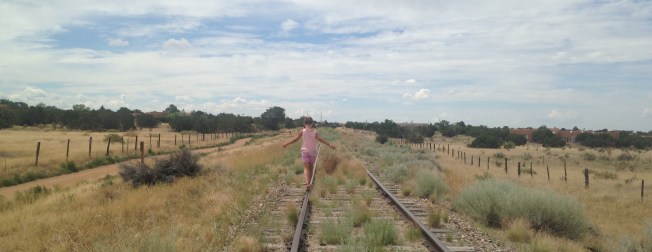
My teenage daughter fears snakes. Walking in the arroyo yesterday, this Vermont girl quizzes her grandmother about the possibility of encountering a rattlesnake. Never seen one, she’s assured. Moments later, a rattler slithers near her feet, and she screams.

She glares back at me, as if I’ve magically created what she considers a devilish creature. Between us lie spiny cholla cactus, red sand, thumbnail-sized wildflowers I don’t recognize at all. We are no longer in the lush land of the Green Mountains.

Searchingly, she peers into a cluster of tumbleweed and then back at me.

Gone, I say. She waits a moment longer and then offers, You can go first now.

The unexplainable thing in nature that makes me feel the world is big fat beyond my understanding – to understand maybe by trying to put it into form. To find the feeling of infinity on the horizon line or just over the next hill.

– Georgia O’Keeffe

FullSizeRender

Santa Fe, New Mexico

Thirst

Out of my Vermont landscape, traveling, I’m surprised to see, again, how profoundly landscape – like the desert’s grit-filled wind – shapes perception. I gauge my world through water’s motion: Have the spring beauties spread their tiny petals? Whose garden has been dealt a killing frost? Is travel impractical because of muddy roads? When will the overcast skies break?

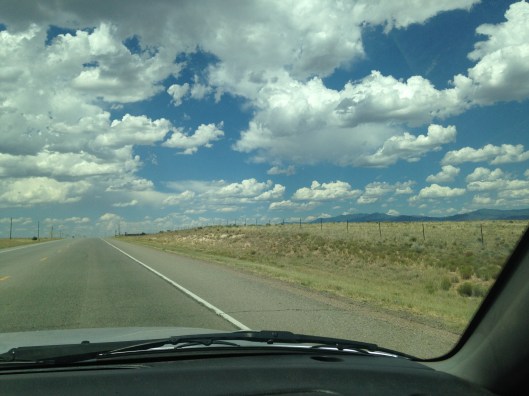
The New Mexican desert revolves around the exquisite geometry of light, shadow, wind, the near-absence of water: the same life-driving axis of knowledge, turning in an opposite direction.

This is the yin and yang of the earth, an energetic feedback. What happens below relates directly to what is happening on the surface and in the atmosphere and vice versa. Tectonics does not end at the ground beneath your feet. It is a dynamic system from the earth’s interior all the way into the sky and back.

Craig Childs, Apocalyptic Planet


FullSizeRender

Santa Fe, New Mexico

The Wild Blue Yonder

Early in her third-grade year, my daughter came home chatty about Magic E’s might, the incredibly tasty Italian salad dressing at lunch, and that her teacher jumped out of airplanes. What, she wondered, would that be like? She had never considered this a human possibility. In a poem, she wrote,  I want to fly.

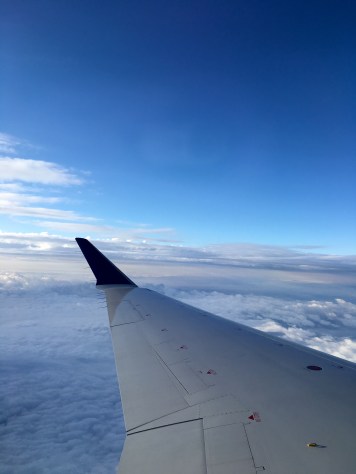
At 2:30 a.m. on a rainy night, I woke the girls and drove that familiar way to Burlington I’ve traversed so often, passing through small towns where houses were dark save for a single outside light beside the front door. A store clerk leaned against the door of Morrisville’s Cumberland Farms, smoking a cigarette, the empty parking lot illuminated. That day, we flew from Vermont’s wooded green, high over the upper midwest’s great lakes, and the enormous plains of the country’s middle. At the end of our journey, the pilot tipped the wings, and we began what always seemed to me a long and gradual descent over the northern New Mexican desert, the red and black-lava mesa land slowly rubbing into focus – pinion trees, houses, the wash of dry arroyos, the blue Sandia Mountains rising mysteriously in this open landscape.

My child pressed her face against the small window. Of everything in that day, what she loved most was lift-off, that graceful moment when the boundary between earth and sky is crossed, and, Icarus-like, she entered the realm of birds.

“Flying at Night”

Above us, stars. Beneath us, constellations.
Five billion miles away, a galaxy dies
like a snowflake falling on water. Below us,
some farmer, feeling the chill of that distant death,
snaps on his yard light, drawing his sheds and barn
back into the little system of his care.
All night, the cities, like shimmering novas,
tug with bright streets at lonely lights like his.

– Ted Kooser
FullSizeRender-13

Photo by Molly S.

Whale Bones

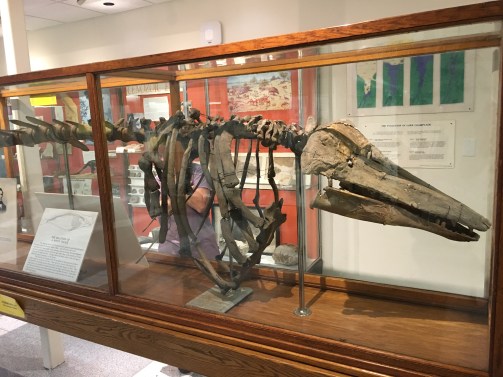
Vermont’s state fossil is the Charlotte Whale, a whale skeleton unearthed in a farmer’s field over 150 years ago. The skeleton is not Moby Dick-sized, a detail I should have researched before visiting with my 11-year-old daughter. Almost immediately, I realized I was in for Act 2 of the Hope Diamond. (That little thing is the largest diamond on the planet?)

The reality is, the whale skeleton is about as cool as cool can be, hand-wired together and displayed in UVM’s Perkins Museum; admission free. My children and I walked in, took a self-tour, and left without seeing a living soul. 11,00o years ago, these beauties were swimming right where we ate ice cream on a sunny June afternoon.

To an 11-year-old, five years spans an eternity; 11,000 years is imaginary. The number may  mean little, but the whale – enamored of or not – this child is unlikely to forget.

Consider all this; and then turn to the green, gentle, and most docile earth; consider them both, the sea and the land; and do you not find a strange analogy to something in yourself? For as this appalling ocean surrounds the verdant land, so in the soul of man there lies one insular Tahiti, full of peace and joy, but encompassed by all the horrors of the half-known life. God keep thee!

Herman Melville, Moby Dick

IMG_4826.JPG

Photo by Molly S.