Last Week of February

Our days reflect this mixed-up weather: a jumble of crystalline perfect snow, excessive heat for February, and an unraveling disorientation. Where’s everyone going? Who’s coming and when?

Maybe it’s simply the place I am in my life, solidly in my forties, when long-term marriages of so many friends are cracking – some to fail, some certainly to mend and reknit, even more tightly – and that beastly presence of cancer rears in overlapping ripples of my intimate and not-so-near circles. The upshot, perhaps, is that we’re all in the same literal journey, living our lives in an infinitude of variations, all of us making some wise and some foolish decisions, chancing into ill-fortune or light-hearted luck.

This is midwinter, season of no greenery, no blossoms, no barefoot running over lake-dampened sand. No garden to gather a basket of greens for dinner. No sun-sweet Brandywines in my hand. No stash of cucumbers the kids have quartered and sprinkled with snipped dill and coarsely ground salt.

Midwinter is the season of the moon on the snow-buried garden, the stars icy against the night sky. Midwinter is the pondering season.

A reader essentially my whole life, I return to talismans of poetry, repeatedly. I read James Joyce first as a teenager, his Dubliners filled with rooms conversely both shadowy and light-filled. Over and over, I think of the ending of “The Dead,” with steadily falling snow, that image suffused with sadness and grief, yet also with an odd acceptance – even more, perhaps, a genuine comfort in the “generalness” of snow, the transience of all our lives, how each of us will rub up against hardship. A piece of this luck, certainly, and some of the outcome simple grace in how we navigate our lives.

He watched sleepily the flakes, silver and dark, falling obliquely against the lamplight. The time had come for him to set out on his journey westward. Yes, the newspapers were right: snow was general all over Ireland. It was falling on every part of the dark central plain, on the treeless hills, falling softly upon the Bog of Allen and, farther westward, softly falling into the dark mutinous Shannon waves. It was falling, too, upon every part of the lonely churchyard on the hill where Michael Furey lay buried. It lay thickly drifted on the crooked crosses and headstones, on the spears of the little gate, on the barren thorns. His soul swooned slowly as he heard the snow falling faintly through the universe and faintly falling, like the descent of their last end, upon all the living and the dead.

James Joyce, “The Dead”
FullSizeRender.jpg

Secret Chute

House hunting with my enthusiastic contingent, us adults stood in a dim basement yesterday, so cold we kept swaying from one foot to the other, trying to stay warm. Outside, the children tromped in the snowy yard, warmer in the sunlight than we were in the house.

In the basement, someone discovered a wooden chute, carefully nailed shut from the cement floor to the under boards of the dining room above. Intently curious, my friend pried off a board, and I peered up through the darkness where I saw a gleam of daylight through an ornate floor grate.

What the heck?

It made no sense to any of us, running through our logical possibilities.

In the end, blowing on my hands, I said, But it must have made sense to whoever built it. Look at the labor.

Upstairs, the children were laughing and throwing snowballs at each other, busy in their own meaningful kids’ work.

Whether I buy the house or not, we’ve spent serious time already, running palms over pipes, fingering up loose linoleum, rapping on old plaster, getting to know just a few mysteries of this old house.

When the old way of seeing was displaced, a hollowness came into architecture. Our buildings show a constant effort to fill that void, to recapture that sense of life which was once to be found in any house or shed. Yet the sense of place is not to be recovered through any attitude, device, or style, but through the principles of pattern, spirit, and context.

Jonathan Hale, The Old Way of Seeing: How Architecture Lost Its Magic – and How to Get It Back

FullSizeRender.jpg

West Woodbury, Vermont

What the Heck is Figurative Language, Anyway?

On my drive to work, I wind through a spidery maze of dirt roads through Woodbury and Calais before I hit the paved County Road and sail into Montpelier. The drive, while long, is exquisitely lovely, changing from fall’s florescence to this winter’s sparkling white. Just after I hit the main road, I always glance at a red farmhouse to my right where whoever lives there has stacked firewood in a round pile, fanning out from a center. I always look to see if they’ve started to burn that wood yet.

So far, not yet. I’m guessing there’s a stash behind the rambling farmhouse, and those folks haven’t wanted to dig into this craftily-stacked wood.

Yesterday, driving on slushy and messy roads, a crow flew before my windshield right at that house, flying so near I could see its shiny eye, orange drape of tongue, a white chunk of breakfast in its mouth.

I once garnered those things as a sign of something, but yesterday it occurred to me that maybe the crow was merely hungry, flying in a hurry back home to eat.

Sign enough?

Surely.

I kept driving into the accumulating snowfall.

….Crow flies around the reservation
and collects empty beer bottles

but they are so heavy
he can only carry one at a time.

So, one by one, he returns them
but gets only five cents a bottle.

Damn, says Crow, redemption
is not easy….

Sherman Alexie, “Crow Testament”

fullsizerender

Where We Are Now

Falling snow is the main feature of these days, so marvelously beautiful no one complains. Usually by this time of winter, grousing is general, but we’ve had so little snow this year –almost none the winter before – and this snow is exquisitely lacy.

Tomorrow morning, with a long drive ahead of me, I might be crabbing a different song, but now, tonight, stepping out into the warm, snow-suffused twilight after work, it’s all good. Pile up; shroud this world in loveliness.

Secret truths… are the lifeblood of a writer. Your memories and your secrets… if you’re going to call yourself a writer, you need to stick your hand in the mire up to the wrist, the elbow, the shoulder, and drag out your deepest, most private truth.

Claire Fuller, Swimming Lessons

FullSizeRender.jpg

Woodbury, Vermont

Ah, Winter

Every winter, I shovel a path from the woodshed to the back entry, and another from the kitchen door to the compost pile, a hand-cut maze around my house. The snow in northern Vermont falls so amply my daughters, when toddlers, were sometimes completely concealed in these paths. I could hear a little girl laughing, running with baby steps in snow boots, invisible to my eye.

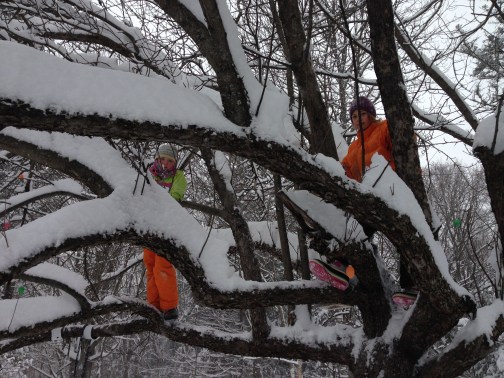
Yesterday, the 11-year-old and her friend, still wearing pajamas, opened the door and oooohhhhed at the snow. They shoveled a steep slide off the kitchen roof, and then made another from the sugarhouse roof.

In the afternoon, sun emerged and light snow drifted down outside the public library windows. The library filled with just the right amount of people, the children busy with crafts, the adults companionable, drinking coffee and working. At five, I walked outside into what must be the best of Vermont winter: drifting bits of perfect snowflake shot through with sunlight, mixed with the blueness of twilight.

But writing itself is one of the great, free human activities. There is scope for individuality, and elation, and discovery, in writing. For the person who follows with trust and forgiveness what occurs to him, the world remains always ready and deep, an inexhaustible environment….

William Stafford, Writing the Australian Crawl

img_0165

Empty Rooms

I haven’t bought a house in twenty years, and I’ve never sold one. In my teens and twenties, I lived in all kinds of places, from a tipi to a trailer to a string of apartments, but my daughters have lived in this rural house their whole lives.

House hunting in Vermont’s February means walking through empty houses with the heat off and the windows frosted: an exercise in imagination. The younger daughter sizes up where she would put her bike and trampoline, how her bunk bed might fit in a room. I crouch down and study plumbing, pick at linoleum with my car keys to see what wood lies beneath. Like approaching a piece of writing, I gnaw over mechanics – plumbing, roof, how to heat, affordability – but I’m also listening to the house. Does it sing to us beneath the layers of other people’s living? Where will the moonlight shine in? Can these rooms fill with our living?

My older daughter argues. Later, I realize she outdid me at what I was doing: she and her camera sought out beauty.

Maybe learning how to be out in the big world isn’t the epic journey everyone thinks it is. Maybe that’s actually the easy part. The hard part is what’s right in front of you. The hard part is learning how to hold the title to your very existence, to own not only property, but also your life.

Meghan Daum, Life Would Be Perfect If I Lived in That House

fullsizerender

window frost in Hardwick/photo by Molly S.