Weighty Reading

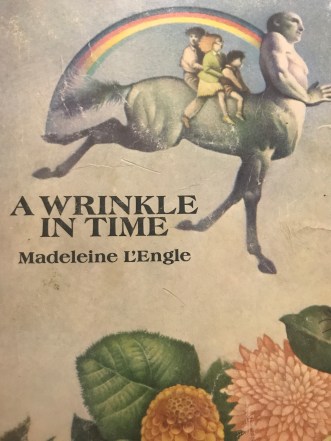
A 8-year-old boy appears in my library and asks for a copy of the wrinkle book. He’s looking for Madeline L’Engle. When I place the book in his hands, he holds it, staring at the cover. It’s an old hardback copy, the dust jacket long since disappeared, so the cover is a plain turquoise, the corners worn down.

This book’s too hard for him to read. I know it, and he knows it, too. I ask if his parents ever read to him at night, and he says, No.

I was a little younger than this boy when my father read this book to my sister and me, and even now, I have to think a little about a tesseract: what is this odd, strange wrinkle in time?

This child isn’t shy, but he stands there, holding this book in two hands. Gently, I suggest he take a second book, too, one I know he can read and will likely love, but he takes the L’Engle, too, pushing the books deep into his backpack without a word.

Life, with its rules, its obligations, and its freedoms, is like a sonnet: You’re given the form, but you have to write the sonnet yourself.

— Madeline L’Engle, A Wrinkle In Time

IMG_1007

The Worth of a Tree

After Obama as a senator had been on NPR’s Wait, Wait, Don’t Tell Me, host Peter Sagal mentioned they had to scrap the charisma off the floor. Last night, my local bookstore, The Galaxy Bookshop, asked Howard Frank Mosher’s brother Terry to read from Mosher’s posthumous collection of stories, and I’m sure the booksellers had to sweep what might be described as just plain Niceness off the floor. What a lovely family. What weeping. What laughter. What a life, Mr. Mosher.

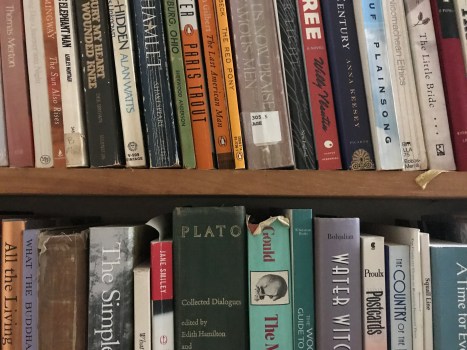
Terry Mosher spoke about a Robert Frost poem their father read to the boys when they young, and mentioned how deeply and tenaciously those lines rooted in his brother’s fiction. He quoted, “The trial by market everything must come to,” and noted that all through Mosher’s writing runs rural people fighting against measuring land in monetary terms, the worth of life in dollars and cents, which sums up one of the deepest conundrums in current Vermont — or stretch that way, way beyond my Green Mountain State borders, far into the terrain of human nature.

The city had withdrawn into itself
And left at last the country to the country…
— From Robert Frost’s “Christmas Trees”
IMG_0986.jpg

Where we are

The Foul-Mouthed

We talk a lot in our house. I mean,  a lot. The mornings I work at home, I always close my laptop when my oldest comes downstairs, generally holding a cat. This daughter works late and stays up later, while I’m awake hours before January’s dawn appears. Even if only for a few minutes — often while I making more coffee or washing a few dishes — we talk, and much of it is simply my own curiosity. What’s up with you? What’s happening in your world?

What she gets from me is possibly not much, but one thing both daughters seem to be absorbing like osmosis is the interconnectedness of everything. This leads to that which prompts this… and so on. That the past is alive and real, and the future holds a myriad of possibilities.

So when my teenager mentions Trump’s denunciation of shithole countries and asked if I could believe it, part of me said God, yes, I believe it, while another part of me is perpetually shocked by such a fatuous fool as commander-in-chief.

I forwarded her this Chris Hedges’s essay my father sent me, in hopes of widening the thinness of a public high school education. Hedges begins, “I covered the war in El Salvador for five years. It was a peasant uprising by the dispossessed against the 14 ruling families and the handful of American corporations that ran El Salvador as if it was a plantation.”

IMG_0984

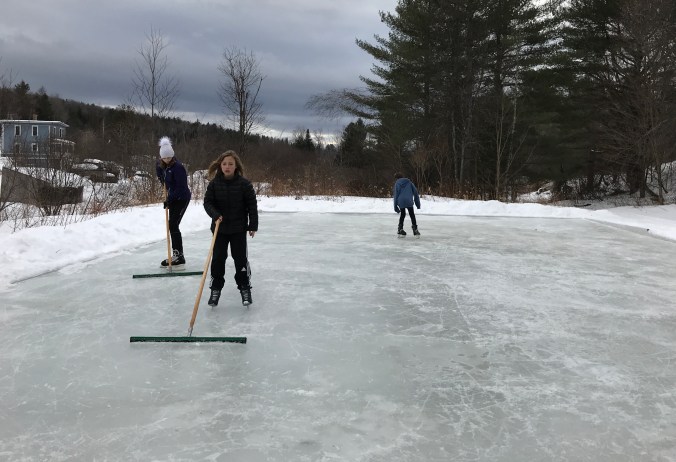
Sunday, when we’re lucky to live in Vermont.

Ladybug Table

My friend emails she’s left a stack of books in my barn on the ladybug table. The ladybug table! The children’s table my parents bought as young parents, when my sister was a toddler, long ago, when the US military was napalming Vietnam.

My friend remembers this table when her son and my daughter spent innumerable hours shaping playdough on its red-and-black surface, on breaks from tricycling around my kitchen and living room. Yes, we still have the ladybug table, worn hard from child use which might, perhaps, be the point of all this.

From one of those books…..

The cares of others can seem ridiculously small (banjo music!). And yet, maybe the small speaks to something larger. A wood beam, a hand-sewn dress, a carefully brewed coffee — each one a response to life’s uncertainty. An attempt to control what can be controlled, to make one thing as well as possible, and there’s something beautiful in that. The beauty of a slow-braised pork shoulder.

— Elisha Cooper, Falling: a Daughter, a Father, and a Journey Back

IMG_0945


Here.

Here’s where I am, on this day buried deep in gray-and-white January: I’m in a tiny Vermont village — general store with a beer cooler and sandwiches made-to-order, post office open for its afternoon hours, volunteer fire department. It’s early afternoon, and I’m walking back to my library with an armful of mail, and no one’s around, the store empty of customers, no passing cars or granite trucks on Route 14 — no one but me and my library mail and a man on the steps of an unused church. He’s pressing his phone, and he doesn’t look at me.

I stand there, on the pavement, looking at him. I know who he is, as I’m sure he knows who I am, although we’ve never exchanged a single word between us. I know he’s been at my desk, illicitly after hours in the library, sitting with his hands on the worn wood, surrounded by stacks of books, my untidy bins of yarn and crochet hooks, the hastily piled colored scraps of paper. All around are small offerings from children — tiny notes to Miss Brett, a sketch of a piglet, an orange origami box holding a clay snowman. Miniature paper airplanes folded by 7-year-old hands.

On this January day, I keep thinking back to that sunny October afternoon, the leaves turning gold and russet. Had I known that man would be dead within months, I might have stood there a little longer and then walked over to him, said, Come in through the door and not the window.

As a writer, I’ve spent years training myself to look for junctures, to know actions matter far more than thoughts — and yet, that afternoon, I kept walking. Maybe I guessed I had all the time in the world, maybe I judged some things can slide without action and the world will work its own wonders. Maybe it was simply that the day was a fine autumn one, and I believed I had things to do.

I turned left, up the dirt road, and carried on with whatever I was thinking, and that particular day passed in the great finality of the past.

I believe that there is one story in the world, and only one. . . . Humans are caught—in their lives, in their thoughts, in their hungers and ambitions, in their avarice and cruelty, and in their kindness and generosity too—in a net of good and evil… There is no other story. A man, after he has brushed off the dust and chips of his life, will have left only the hard, clean questions: Was it good or was it evil? Have I done well—or ill?

— John Steinbeck, East of Eden
IMG_0917.jpg

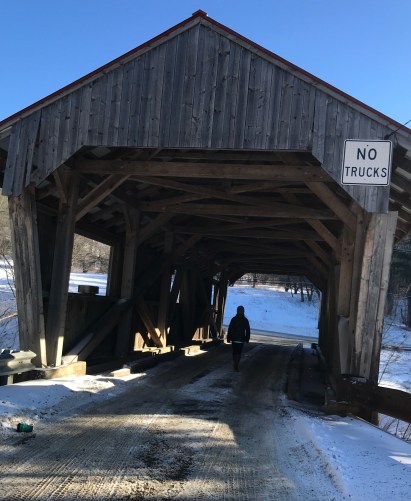
Johnson, Vermont


Winter’s Grass-Is-Greener

Driving down the Woodbury gulf in the twilight, staring at the road — snow-crusted, ice packed, with two curving black lines of asphalt worn through winter — I remember all those years of driving mountainous Route 9 in southern Vermont and wonder, What if I’d stayed in Brattleboro? What if my kids went to school there? I made soup with my publisher and used the Brooks Library with their enormous windows? What if I lived on Elliot Street again?

That’s January thinking.

My gaze lifts from the treacherous road to the gray and white mountains folding around that narrow valley, with the waterfalls and the rocky cliffs high overhead.

Trouble follows you anywhere. I know that. The last time I was in Brattleboro, itinerancy surprised me, the darker threads of our society thickening. I was glad I hadn’t stayed, that I had swapped a larger town for a smaller one. In the end maybe, it’s all Vermont roads, with those mysteriously beautiful mountains always greater than us, rising silently.

The winter wind flings pebbles
at the temple bell

— Buson

IMG_0912.jpg

Store Window Art, Hardwick, Vermont