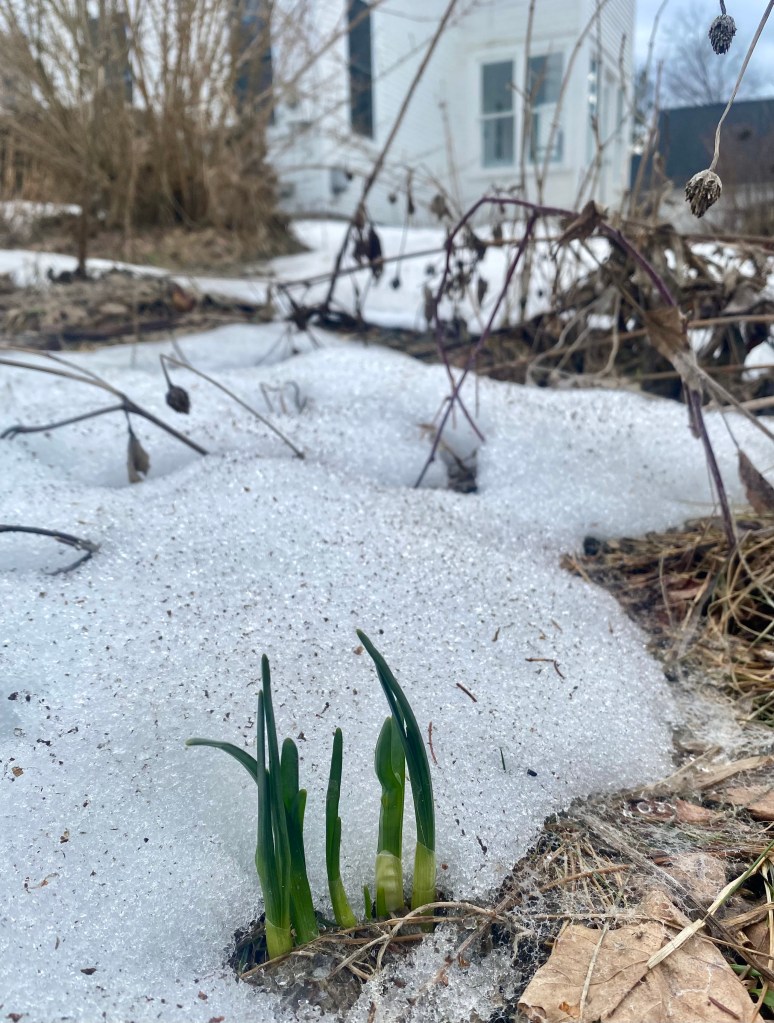
Pig farm, glass buildings, moss.

Photo by Molly S.

The man who swept and cleaned my room at Dartmouth-Hitchcock lives in a nearby farmhouse where he grew up. All this complex here, all these buildings, he says, unrolling trash bags, was once a pig farm. Marooned in bed, IV-ed with multiple lines, I ask questions. His family raised beef, milked, had sheep, their own pigs, a chicken-and-egg empire run by the family women.

We talk food – garden canning, slaughtering and freezing, how his mother’s cookstove had a can of grease they used for eggs, steaks, day-old biscuits. That stuff in a box we eat now, with too many ingredients, that’s not food.

We get to gravy recipes, boiling water and how much flour to paste in. Then we wish each other well. Done for the day, he trundles his cart down the hall.

Home, I’m less cloudy for a few morning hours. By afternoon, the cats and I retreat to lying down, reading, slipping in and out of sleep, where I dream of an enormous pig farm where those tall glass buildings now tower over the surrounding woods. I dream myself back to early girlhood, sick, sick, playing paper dolls in bed. I weld my paring knife, skinning a Chioggia beet. For one long piercing moment, I ache to pull on my jacket and boots, slip wordlessly out the door and along the brambly path – a solitary walk to clear my mind. How I’d relish stepping from frosty twilight into my warm house. Patience, patience: my lesson now.

Friends text photos of sunsets, lakes, moss, running streams. Cell phone photos once so common to me, I study these, proof of a winter day. Mail arrives. Half insurance bills, half gorgeous cards – flowers, a paper wreath, snowy mountains – and so many welcome words. Late afternoon, I cook a pot of rice, my first contribution to a meal in weeks, save setting out forks and spoons like a toddler.

I like the juicy stem of grass that grows

within the coarser leaf folded round,

and the butteryellow glow

in the narrow flute from which the morning-glory   

opens blue and cool on a hot morning.

– Denise Levertov

Snow geese and cancer and macaroni and cheese.

My friend walks into my kitchen. The windows are shrouded in the remains of last night’s darkness. She bends down and looks at my face, reminding me of those enervating conversations in ERs with doctors. After a careful moment, she pronounces, You look good. My house is warm; her sentence warms me more.

In the St. Johnsbury hospital, she drops me at the laboratory door. A receptionist sends me down the hall, in search of elevators. A woman in the waiting room follows rickety me in my winter boots, and repeats the directions. I wander down halls empty of people, interspersed with lit Christmas trees in what seem to me random corners and notches. Someone calls my name. I turn and look, and of course this is my friend, who for a fleeting moment I don’t recognize in her bundled coat, surgical mask.

Not far from the Canadian border, St.Johnsbury has a faded charm from its former heyday of logging and Fairbanks scales. This December morning, the day sputters, promising no sunlight, maybe a few rosy strands in the opening daybreak. In my strange fog, I wonder if the light mirrors Siberia. My blood is drawn and spun. Waiting for the verdict, I stare out the window, the layers of coal and washed-thin blue and last night’s pale snow. Beside me, a man introduces himself says he owns a garage and towing business. I pull down my mask and offer my name. My voice is so muted he can hardly hear me, but I ask him to tell me about his plowing so far this winter. While we wait, he obliges me. My hands, he says, will never be clean enough for hospitals.

Siberia, I think, Siberia, as the garage owner pinpoints roads. The daylight notches up a bit. Save for my friend, waiting elsewhere, I know no one here, but this winter landscape of snow and pale mountain, the livelihood of working with hands and backs and people, is familiar to me as my thumb knuckles, the loneliness of lingering over the morning’s last cup of cooling black coffee, pondering some decision that’s wormed itself in the day.

So disease, cancer, that forbidding word, burrows in. The disease is me; the blood is mine; the nurse explains numbers, says hematocrit, hemoglobin. Less than a handful of weeks into this journey, I know my blood courses with immutable facts, ragingly powerful chemistry. The blessing to leave is laid upon me.

Home again from distant Siberia — is it midmorning? afternoon’s mire? — my friend sweeps ashes from my wood stove and nourishes gleaming coals with birchbark and splinters, odd pieces of end wood. This day unfurls, somber and patient, settling into winter’s long haul. I offer a piece of my daughter’s gingerbread. For hours now, we’ve talked about migrating snow geese and cancer and macaroni and cheese. She asks if I would take her on a nighttime walk — I envision the throb of spring peepers, the redolent rotting slop of thawing earth — indeed, a pleasure I might give back, to one of my shepherds holding me steady as I wobble down my back steps.

Small Soup Bowls. Quarantine. Icicles.

My brother returns home, and I immediately slip up, ignore a morphine dose, am unable to eat. A lesson in my own laziness or foolishness learned: keep to the path.

For days, he sets small bowls of heated soup on my kitchen table – chicken and dumplings, our childhood favorite of pea soup, lentils with savory carrots. One night, my daughter bakes biscuits, opens a gift jar of raspberry jam (July!), and we revel at a nameless soup from a woman we’ve never met. Potatoes with the skins left on, chicken and maybe tarragon, celery, onion. There is nothing we could imagine adding.

Like these soup bowls, my physical life has narrowed to these warm rooms with cats, hours unfurling patiently as I stop counting days and treatments. Each day unfolds. On Saturday, I sit on the couch and return a friend’s call. Sunday, I return another call, listening to my laughter, their laughter, these friends who have been down their own stony journeys.

Quarantined, I’m connected to the world in ways I didn’t anticipate – emails and calls, books, prayers– a rosy swaddling aura. An acquaintance phones me with her cancer story and describes her year so straightforwardly she buoys me with courage. A friend offers to plow our driveway all winter; perpetually on the skimp, I’ve shoveled for years, but it’s a great gift to my people who are anyways busily feeding my wood stove and picking up morphine and antibiotics and driving me to bloodwork and The Good Doctor — not to mention, working their own jobs and walking their dogs and generally going about their lives.

So much kindness has come my way. The night the sainted nurse sat with me for an hour and a half while the final chemo infusion ebbed, ebbed, into my chest beside my heart, she counseled me to cultivate patience, that I will be able to give again, that the world spins and shifts.

In a wind gust, the robins’ nest falls from our porch beam. Icicles hang from the roof, radiant swords of sunlight.

…. A few lines from Louise Dickinson Rich, courtesy of my sister-in-law:

“All ordinary people like us, everywhere, are trying to find the same things. It makes no difference whether they are New Englanders or Texans or Malayans or Finns. They all want to be left alone to conduct their own private search for a personal peace, a reasonable security, a little love, a chance to attain happiness through achievement.”

Brutal and Brilliant Lights.

My brother drives us out of the Dartmouth-Hitchcock conglomeration of soaring windows. Somewhere in the afternoon, the gloaming sifts down through the interstate traffic. The stream of trucks bends south. We head north. Evergreen and gray, a pale blue of mountains ahead. Midwinter, I mutter, but it’s yet late fall, the solstice ahead.

All the way back home, up and down the ribboned swell of interstate, coal night tapping down, I’m jumbled in an unbroken stream of searing hospital lights, the sparklingness of The Good Doctor who sits beside me and then phones me with good news, that the lymphoma and I are parting ways, disease shedding from my unseen flesh.

Now home again, drifting in and out of this perpetual river — of appointments and results, in an unfamiliar body swollen with water that, trickle by trickle, the chemo poisons are doing their fierce work to keep me alive, thrust me towards full health — the strangeness of not being able to lift a piece of birch to feed my stove, kindle my own hearth.

Grave illness is the void. The void is always with us. I know this even as I write with my tabby purring at my knee, epitome of domestic bliss. Maybe that’s why I was compelled to write so savagely in this place about terror. Late summer, as I’d descended into this cancer, without knowing that I was sickening, I could feel myself gyrating in a sucking whirlpool of negativity — from my own particular life and in this unusual time we inhabit. On the eve of the election, the cancer word smashed into my life. A levee burst in me. For me, a woman with cancer (this is no flip joke), these are fraught days, months, more months. But even in illness I’m part of the whirling flux of this time. As we drove out of that glass complex for the first of what will certainly be many times, I was imbued with a sense of magnitude, the mightiness of the tension between life and death and the mightiness of our collective lives, each dear, each interwoven.

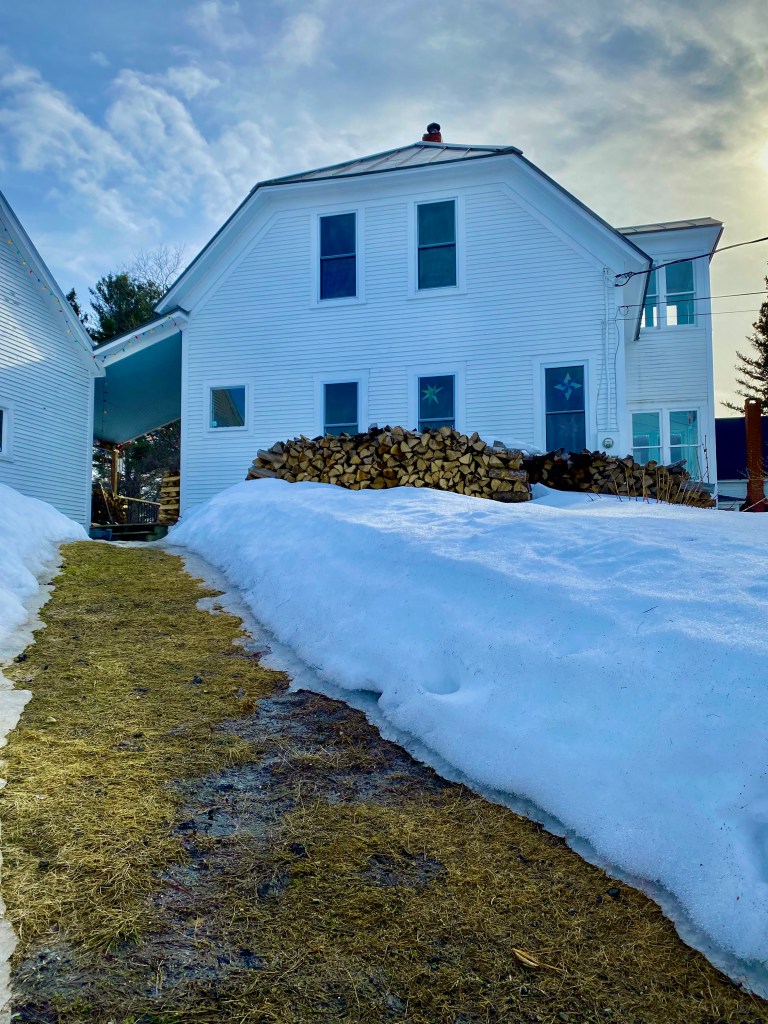
I left Dartmouth with a bright red card in my hand from a kind stranger. At home, the sky was overcast. The stars were shrouded. Our dear white clapboard house twinkled with colored and white lights. I stumbled on the top step and fell. My daughter lifted me up and helped me in.

“You have come to the shore. There are no instructions.”
― Denise Levertov

Chemo ride…

… took a bitch turn. Dreaded day 5 passed (thank goodness for the amazing anti-nausea meds), but with the last bag of this poison/healing fluid, a fist immediately grabbed my chest and squeezed my breath. My cheeks coursed with blood.Terror, say the word, terror. So much back and forth, oxygen and treatments and more liquids through this purple spaghetti plastic that drip, drip, drips near my heart. I shook fiercely – rigors – the nurses said. I was stuck on the word as my molars hammered, rigors!, where is this hard ride taking me? The fluid was stopped with a promise not to start again until I knew.

In and out of a fog, a dream of a herringbone jacket with a pleated flair my youngest wore as a two-year-old. In the evening, a nurse sits with me. As the drip-drops begin again, she talks, right beside me, watching me, close eye, about this disease, about infection and rest, about what I will need to do and avoid – do not knick your fingers with a knife, no dirt, no cat litter, no flowers, no illness. I ease from tension and realize, yes, yes, I am still breathing, I am still taking in this toxin that quite possibly will save my life. I glance up at the round analog clock on the wall that reminds me and my brother of school days. These are the moments Burlington’s Phoenix Books is hosting the Almanac intro in an online event. In my haze, I imagine the Almanac editors and reading and answering questions, this book filled with farm dirt and blooming flowers, hay chaff and sneezing, insects and sheep, and stories – so many stories – of people working on this northern place on the globe. In my half-dream, exchanging novels to read with this steady stranger, I feel my place in the world opening up, both descending into the long trek of illness and healing and, miraculously, an upward course, too, as this illness strips me down. Your bone marrow, the stranger says, marrow, a word I love and have been content to let lie, bone marrow doing its bone marrow thing. All this is changing, too, from nature, from medicine, from my fierce intent to reclaim my body.

All of you who have traveled or will travel this journey, bone marrow and rigors and fear, how simultaneously far and yet close this feels, all of us.

….. Everyday, a dear friend texts me a poem read in her clear strong voice. Here’s Rilke’s “Let Darkness Be a Bell Tower”

Quiet friend who has come so far,

feel how your breathing makes more space around you.
Let this darkness be a bell tower
and you the bell. As you ring,

what batters you becomes your strength.
Move back and forth into the change.
What is it like, such intensity of pain?
If the drink is bitter, turn yourself to wine.

In this uncontainable night,
be the mystery at the crossroads of your senses,
the meaning discovered there.

And if the world has ceased to hear you,
say to the silent earth: I flow.
To the rushing water, speak: I am.

Sonnets to Orpheus II, 29

December, Holy/Unholy/Holy Season

Anyone who lives in a northern climate must inevitably come to some reckoning with the descent into this month’s darkness, the steady whittling away of daylight at either end, noontime oftentimes scrubbed to a soapy haze.

To my surprise, this month began on an ascent for me, an elevator rise at the end of November, crammed into a silver metal box on a gurney with my weeping daughters and brother, and an anesthesiologist who might have drawn the short straw to collect the patient in the otherwise sleeping hospital. He was actually assured me he was a much better anesthesiologist than a gurney driver. Bring me back safely to these people, I pleaded.

Here at Dartmouth, I’m in a major medical facility (of which I’ll someday write much more). There’s no illusion that this is giant Health Care. Within this, my tiny 4’8″ body and the fraughtness of grave disease and uncertainty, and so so many patients. Yet all these interwoven days and nights, I’m surrounded by an arch of kindness, by skilled and unskilled staff who labor so patiently. I’m humbled by this secular holiness. The respect is repeated among colleagues here, aiding each other (and all us needy patients) with their own thank you, thank you as they work together.

A friend, driving home to Vermont from family Thanksgiving, leaves me Time of the Child by Niall Williams. Late into the night I read, taking these hours to relearn the slow joy of novel immersion. Sleep, sleep, I urge myself, and yet Williams’ world entrances me. Here’s line from this novel that an elderly Irish country doctor remembers from his doctor father: “The sick are ourselves, was a thing his father had said. When you stop understanding that, take your name off the wall and throw your bag in the river.

…. Whatever way this month transpires — for rise or for misery — and it’s all holy, isn’t it, this sacred and profane mixture of spirit and blood and bowel. The journey itself we take together is the gem.

Although I will say, I was ineffably joyous to return from that dismal night and see my curved-to-exhaustion people. After all, I am in the only one in our household who devours the cold leftover French fries with gusto. Why would we waste cold potatoes?

Thank you again, all.