Wild and Tame Creatures

On his favorite perch on the dining room windowsill, my daughter’s cat suddenly stiffens his back and presses his nose near the November-cool glass. Beside him, I’m typing, and I rub his back. He mews an inquiry, looking at me.

Through the window, I see eight wild turkeys, nosing through my young asparagus bed, planted just last spring. The turkey nearest us steps toward the window, raising its long odd legs. The cat and the bird stare at each other, the turkey’s head tipped slightly to one side, so its eye gazes at this little furry tiger cat.

The bird’s bigger than you, I murmur.

For the longest time, these two creatures stare at each other. Then the turkey goosesteps on its way, and the cat, true to his nature, curls up on the table beside my laptop and takes a nap.

Midterm elections, 2018.

I always feel the movement is a sort of mosaic. Each of us puts in one little stone, and then you get a great mosaic at the end.

— Suffragette Alice Paul

IMG_3839.jpg

When In Doubt, Do Handwork

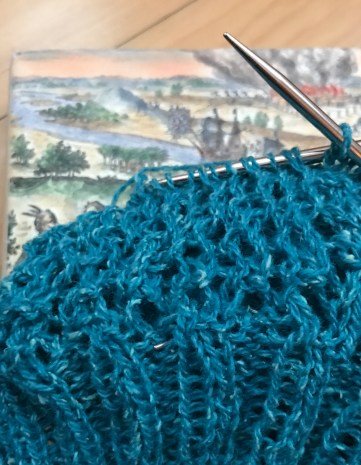
My 19-year-old, pondering what to do with her life, buys fat skeins of yarn and begins knitting a blanket. The metaphor of comfort consoles me, too.

I just read David Grann’s The White Darkness, about Henry Worsley, descendant of Frank Worsley, of the Shackleton Endurance expedition. It’s hard to imagine a more manly man than Henry Worsley, who ultimately perished from complications of his solo South Pole trek. Yet Worsley sewed to calm his nerves. He was skilled at needlepoint. He volunteered to teach tatting — yes, tatting — to London prison inmates. How cool is that?

Shackleton… sought recruits with the qualities that he deemed essential for polar exploration: “First, optimism; second, patience; third, physical endurance; fourth, idealism; fifth and last, courage.”

State 14 ran the first of my monthly Postcards From Hardwick. Check out terrific Vermont voices here.

IMG_3837

#10 Pond

Why Love Cats

My daughters’ cat and I are listening to Chris Hedges lecture about the collapse of the American Empire — extremely serious and unfunny — when the cat falls off the hutch and splashes into my pan of lemon-yellow paint.

The cat probably yowled; I certainly shouted. The creature scrambled through the dining room to living room, through my study, into the kitchen, where my daughter grabbed the paint-soaked cat. While she cleaned paint from the cat in the basement, I washed wet paint from our floors on my hands and knees.

We’ve lived in this house not much more than a year. While I love the maple floors, I generally don’t spend much time mopping.

While Hedges kept talking, I realized some of the narrow boards were birdseye maple. Through the closed basement door, I heard my daughter murmuring, comforting her beloved cat.

Whoever laid the floors in this house passed from this life decades ago. I thought of these slender, hard boards in a carpenter’s hand, his sight appraising the grain.

The decision by the ruling elites in ancient Rome—dominated by a bloated military and a corrupt oligarchy, much like the United States—to strangle the vain and idiotic Emperor Commodus in his bath in the year 192 did not halt the growing chaos and precipitous decline of the Roman Empire…. Trump and our decaying empire have ominous historical precedents.

— Chris Hedges, America: The Farewell Tour

IMG_3819.jpg

The Larch Season, November, Vermont


My Long-Ago Mentor

The children’s librarian in the town where I grew up — Goffstown, New Hampshire — not only offered me first dibs on brand-new books (I began reading Judy Blume’s Deenie while walking home), she also came to my wedding. Every summer, I fill the glass purple vase she gave me for a wedding present.

So, when we were talking about the Giving Back issue at Kids VT — the magazine where I’m on staff — I wanted to write about Betsy Elliott. We aspired to write particularly about a few of the many people who give so generously, so meaningfully, without any expectation of return — maybe a kind of antidote to our troubled world. Here’s my short essay.


uyw

Vocab Lesson

I’m reading The New York Times on the couch when I look over at my middle school daughter on the couch who’s reading. She’s in her athletic pants, her hair carefully up in a bun like her friends, her face still tawny from a summer mostly outside. When she’s finished with her chapter, she tosses the library book on the couch, and I ask if she knows what the word anti-Semitic means.

She doesn’t.

The word is so terrible, I’m not sure what to say. In our house, we sometimes joke about language. This week, the girls have been tossing voluminous around playfully, like a half-deflated, helium-filled balloon.

I glance into the dining room I’ve spent all weekend painting a color described as lemon custard, my motivation simply love of color and warmth.

And then I look back at my daughter who’s waiting, patiently, on the couch.

It did not really matter what we expected from life, but rather what life expected from us. We needed to stop asking about the meaning of life, and instead to think of ourselves as those who were being questioned by life — daily and hourly… Life ultimately means taking the responsibility to find the right answer to its problems and to fulfill the tasks which it constantly sets for each individual.

Viktor E. Frankl, Man’s Search for Meaning

IMG_3811.jpg

Happy Arkhipov Day

Two mothers relax on the floor of my library with their babies when my dad sends me an email reminding me that October 27 is Arkhipov Day. Not yet a year old, the babies haven’t begun to walk. Their smiles rise so radiantly joyous you instinctively smile back. Sleet drills against the library windows.

On October 27, 1962, Vasili Arkhipov refused to agree with his fellow Soviet submarine officers and fire a nuclear-tipped torpedo at the USS Randolph, preventing the nuclear holocaust that would have World War III.

The mothers check out children’s books, bundle up their babies again, and head out into the sleet that’s turned to wet snowflakes: everyday Vermont.

World War III was averted not by decisions in the White House or in the Kremlin, but in the sweltering control room of a Soviet submarine. Vasili Arkhipov saved the world. We should celebrate his obedience to humankind, not to the Nation-State, on October 27, Arkhipov Day, a proposed international holiday by students of the Cuban Missile Crisis.

— George Stanciu. For more about Vasili Arkhipov and my dad, read here.

IMG_3759.jpg