Emerging From Quarantine

When my youngest was just over a year old and not yet walking, I was at a child’s birthday party around a pond. I sat her to play on a blanket. Her back was to me, and, after a while, a little girl ran over to me and said something was wrong with my baby.

My baby’s eyes were watering terribly. Before long, she seemed to have trouble breathing. A woman I had just met drove me and the baby to the ER. I sat in the backseat, talking to my littlest, hearing my voice speaking quietly, as if I was dividing in two. I knew I was terribly afraid, because I wasn’t panicking.

By the time we had reached the ER, whatever bothered her had passed. Although I had her tested for multiple allergies, this event never occurred. But for the rest of the summer, I felt as though a knife had sliced over me, shearing off some essential part of me.

The pandemic has changed all of us — both over a year, and in smaller, sharper pieces, as in my family’s recent case. The New York Times shares stories today of new lives emerging, reshaping and reforming. Of lives going on.

Hardwick, Vermont

Mysterious Visitors

When my youngest daughter was four, she and one of her best four-year-old friends were playing outside and called me to come from the kitchen and, “See the bunnies, mama!”

This was right around Easter, when the yard was worn-down snowbanks interspersed with wet earth. Two enormous hares were hopping around the yard, their white winter fur turning brown in patches. Or maybe the hares looked so large because the girls in their boots were so small.

Our house was surrounded by thousands of wild acres. We had seen moose and deer and bear wander through, but never hares that came to visit for a morning. The girls had made an open air house beneath the branches of a spruce tree. All morning, the hares came and went, hopping through on their powerful legs, then disappeared and never returned to play.

This Easter arrives in a strange and disorienting period in our family life, of tests and quarantining, of worry and waiting, of days of eating take-out Japanese food sent from my parents and coconut birthday cake. We’ve abandoned the dining room for the living room, surrounded by piles of library books, cats sleeping on blankets, and my two knitting projects. I’ve begun to wonder if I might ever brush my hair again.

My youngster asks what’s this holiday about anyway, with the rock rolling away and the ascension? On the phone, my brother offers his own explanation that I’ll keep unrepeated, although I woke wondering if Jesus himself wouldn’t have objected. Jesus walked in the most profane of the human world and perhaps embodied the most holy, too.

On this spring morning, with the robins singing in the box elder outside our kitchen, I’m grateful for both the ineffable mystery of spring — thaw and crocuses — and the mundane chores of dish washing and a kitchen floor badly in need of a sweep. Or, maybe, as so often before, I’m utterly wrong, and there’s not two things, not a both, but one.

April

The wind chimes on our back porch tingle and clang all day and all night long. Spring pushes in not just with purple and pearl and gold crocuses, but with birdsong. 5 a.m., when I step out with a bucket of hot stove ashes, the robins are at it already, mating and nesting, busy with robin family-life.

I lie awake thinking of that window of time when my daughter contracted Covid, imagining when she might have let her mask slip, rubbed an eye with her fingers, the slightest of gestures she’ll never recall. Then I imagine the hours when she was contagious, before this gorgeous healthy teen said, My back hurts. I’m tired, and I closed my laptop, looked at her carefully, and began to worry suddenly, in earnest.

With my own two negative tests, the virus has (at the moment) passed over my body.

Snow falls, all day, on April first. We sleep with the windows cracked open, and I smell the particular damp scent of snow in the night. I lie there, thinking of the practical, mundane things of my world (as a single parent, could I get with it and write a will?) and the visible and invisible mysteries of this world. How I’ve tarnished and sullied the prayer of my everyday life, distracted by things that mean very little, while all along our days are unfolding, one after another, in their finite number.

The cats insist on breakfast. I stand at the back door, drinking coffee, watching snowflakes drift in a gray dawn, listening to NPR and a courtroom in Minnesota.

It’s another month. Despite the snow, spring edges in.

You’d better get busy, though, buddy. The goddamn sands run out on you every time you turn around. I know what I’m talking about. You’re lucky if you get time to sneeze in this goddamn phenomenal world.

— J. D. Salinger

Quarantining

Every morning when I wake in the dark, I think, I’m not sick, a revelation that begins the day. Although I’m not headed out of the house, for any number of days, I’m up especially early these days, thinking of Salinger’s Zooey telling Franny not to fritter away the best part of the day, buddy.

It’s all jumbled up here, even more than the past year. I am so grateful my daughter isn’t sick, that she’s counting down her quarantine days not with pleasure, but with her trademark resolution, her will do, but I’m plotting my summer plans….

For me, it’s wait and watch, a negative test followed by another test, results in 36-72 hours. Over us hovers the thought: which way will this go?

I set up work on the kitchen table, then move to the back porch in the afternoon. My daughter disappears on a long walk through the woods. At the tail end of winter, we haven’t pulled any outdoor furniture from the barn yet, so I sweep the boards and lean against what remains of the railing broken by falling ice.

In the late afternoon, I’m painting the interior windows of my upstairs office when I see the town librarian walking up my road with two books she’s leaving for me. I holler down, Thank you! We talk for a moment through my screen, and then she’s on her way again.

Like the rest of the world, I keep listening to the trial in Minnesota. My daughter appears and leans in the doorway, watching me. I tell her I’m going to savor this quarantine with her, that we’ll be talking about it someday, years hence, when she has twins and a baby and I show up to change diapers.

That’s wonderful, she tells me, and you have paint on your elbow.

Thank you so much, my readers, for writing in. It means the world to me.

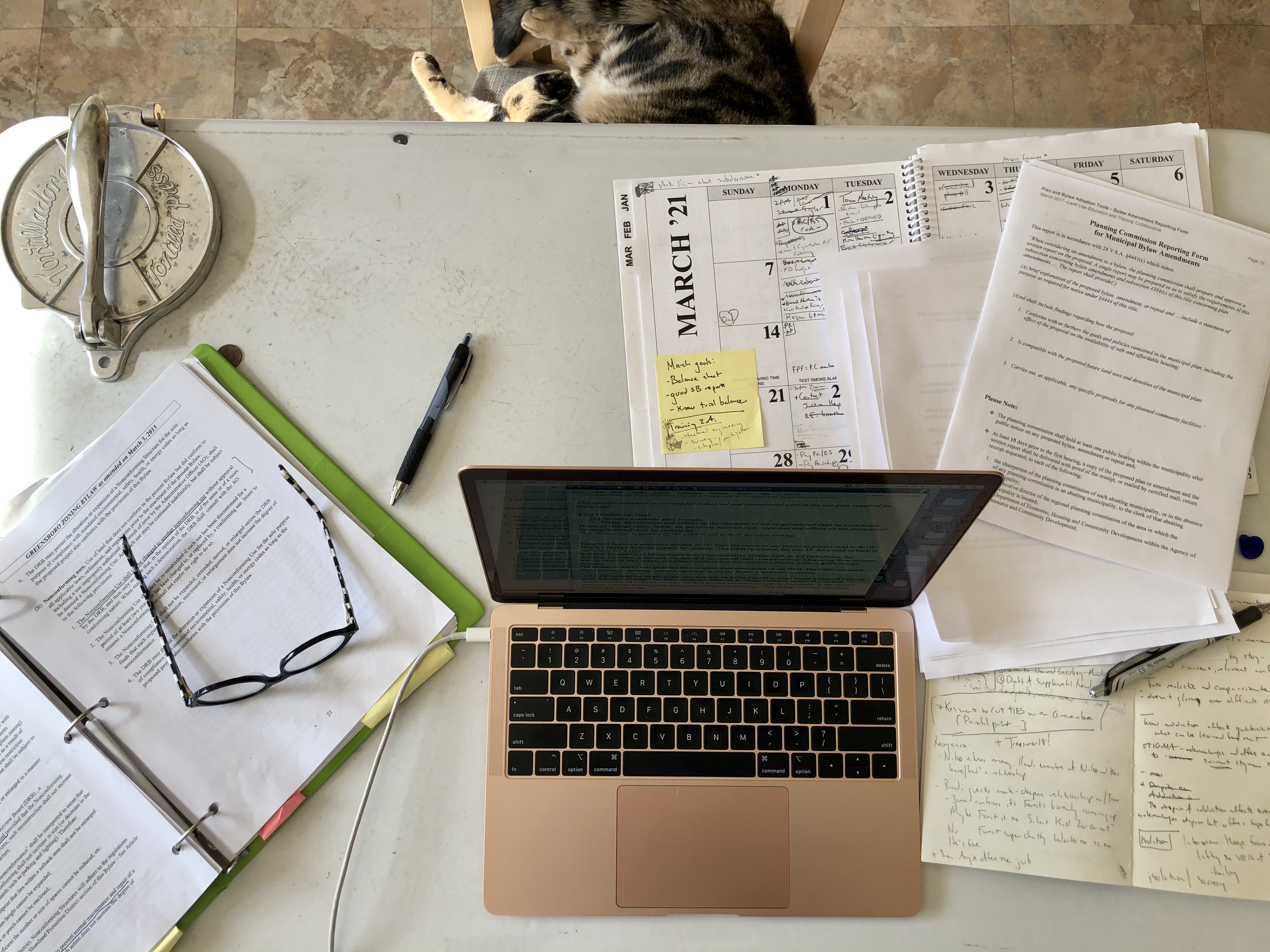
Kitchen office, complete with (working) cat and borrowed tortilla press.

Phone Conversation

Sunday afternoon finds me talking to the Vermont Department of Health contact tracer about my daughter’s positive Covid test. My results, he determines, haven’t rolled in yet.

I’m at the dining room table, chipping wax off a candlestick, doodling on a piece of paper. He asks where she’s been, and I answer honestly, school, home, and the woods.

Through the window, I see a cold rain falling. He tells me about the potential for what seems to me an incredibly long quarantine period for myself, if I don’t test positive. If I do, well, that’s a different kettle of fish so to speak, he says.

What you’re saying, I clarify, is that there’s no good options here.

He pauses.

I apologize immediately. The good thing has already happened. Covid has washed right over my daughter with the lightest touch. My other daughter is vaccinated.

I answer all his questions. Then I ask, Wait and watch?

It’s maddening, he says, but yes. That’s where you are.

The wind bends the pear tree in our front yard. We’ve endured plenty. Our house is warm, stocked with firewood and food. And so it goes.

Sing, Robins

I lingered on our porch yesterday evening, gathering a few pieces of firewood. It’s warm enough now that the fire could stay out, but somehow letting the hearth go cold in March just doesn’t seem right.

There’s that worn-out cliche that the laughter of babies is one of the best sounds on this planet — and it’s not a cliche, because baby laughter is really dear.

But so is the songs of robins.

We’re back again in these melodies. Around us, mud and thaw pushing up the debris that’s hidden under the snow all winter. Pieces of cardboard and empty yogurt containers, the runny mess of my ash pile, my youngest’s holey (or is that holy) pink socks where she tossed them over the porch railings in a burst of spring enthusiasm.

Oh, robins, mud your nests, lay your eggs, raise your newborns. We need you!

Open a window. Rain falling
on good land is good for melancholy.

Jody Gladding

Hardwick, Vermont