A retired man shows up at my job, looking for a little info and then stays to talk, sitting in a chair while I lean against one of the cement posts that hold up the ceiling, and the building overhead.
A former landscaper, he’s survived numerous joint replacements, an overseas war as a young man, and he’s holding cancer at bay, for now. He’ll succumb to the cancer, he says, at some point. But for now, he tells me how much he savors that first slurp of hot tea every morning.
I have plenty to do, but for that time, I might as well, really, have nothing else to do. He tells me about a double blossom primrose flowering in his garden. Another spring, he says.
Blue squill reappears in our front yard and over the hill behind our house, in the thickets of wild raspberry canes — tiny flowers that sprinkle color in our landscape that is otherwise brown dirt and gray mountain.
In the rough patches of roadsides and rocky ditches, coltsfoot springs up. Along the brick school gymnasium, I discover blooming dandelions.
These tiny flowers, some no larger than my thumbnail, are mighty tough. There’s a lesson here, I know, as I crouch in that tangle of thorny vines, admiring a clump of starflowers. That lesson might be as simple as the determination of the world’s beauty. Who planted these flowers, I don’t know. But every spring I’m grateful for that gardener who lived here and who so loved these spring gems.
On a sunny spring Friday afternoon, I’m outside a St. Johnsbury car dealership, waiting for a recalled part to be replaced on my car.
A warm breeze blows up and drifts dust over my keyboard.
90 minutes later, I’m finished, and stop in the downtown. The doors of all the businesses are open. I wander into the bookstore, lift a book, and read — a casual gesture in a public space that I may not have done for a year, or more.
I open a book of poetry randomly and read:
You may have to break your heart, but it isn’t nothing to know even one moment alive. The sound of an oar in an oarlock or a ruminant animal tearing grass. The smell of grated ginger. The ruby neon of the liquor store sign
I have the strangest rush through my body, a tingling all the way down to my fingers.
On my way home, I stop in at a store and buy mayonnaise and two avocados at my daughter’s request. I walk out holding these things, blinking in the hot sunlight.
In the parking lot, a woman driving a pickup rolls down her window and remarks about the lovely weather, saying how happy she will be to get home. I nod, and we talk for a moment.
When she’s left, I stand with those things in my hands, on this ordinary afternoon, doing this ordinary errand. Someday, not too far off, this daughter will be out sourcing her own mayonnaise.
Our quarantine with Covid has likely turned my hair irretrievably to gray. So be it. Our lives were never meant to stay burnished and unblemished. I stand there, suddenly amazed at my good fortune, and then I head home for BLTs.
The temperature weirdly shoots up to 70 degrees. 70 degrees in Vermont in early April! For anyone who doesn’t live here, know that this warm, daffodil-growing weather makes our world a communally happy place.
While my daughter plays soccer, I take a walk, then spread out my work on a picnic table. Three geese fly overhead, making a honking racket. On the other side of a school building, I hear the kids laugh. Two dads roll up on bikes and stand in the parking lot, chatting.
Another parent I haven’t seen for a long time appears and stands at a distance. We talk and talk, about how our work has changed, and what’s happening with our kids, and even more, about each of us might want this summer — happiness, in some small way. Listening, I think, of all the many things we’ve learned this year, surely valuing the connection between us rises high. How little that might seem, and how infinitely valuable.
My daughter returns with a blister. At home, the carpenter has just finished repairing the porch railings broken by falling ice. We stand for a bit, talking and waving at early mosquitoes. He admires the view of the village below us and asks how I like living beside a cemetery. I like it just fine, I tell him.
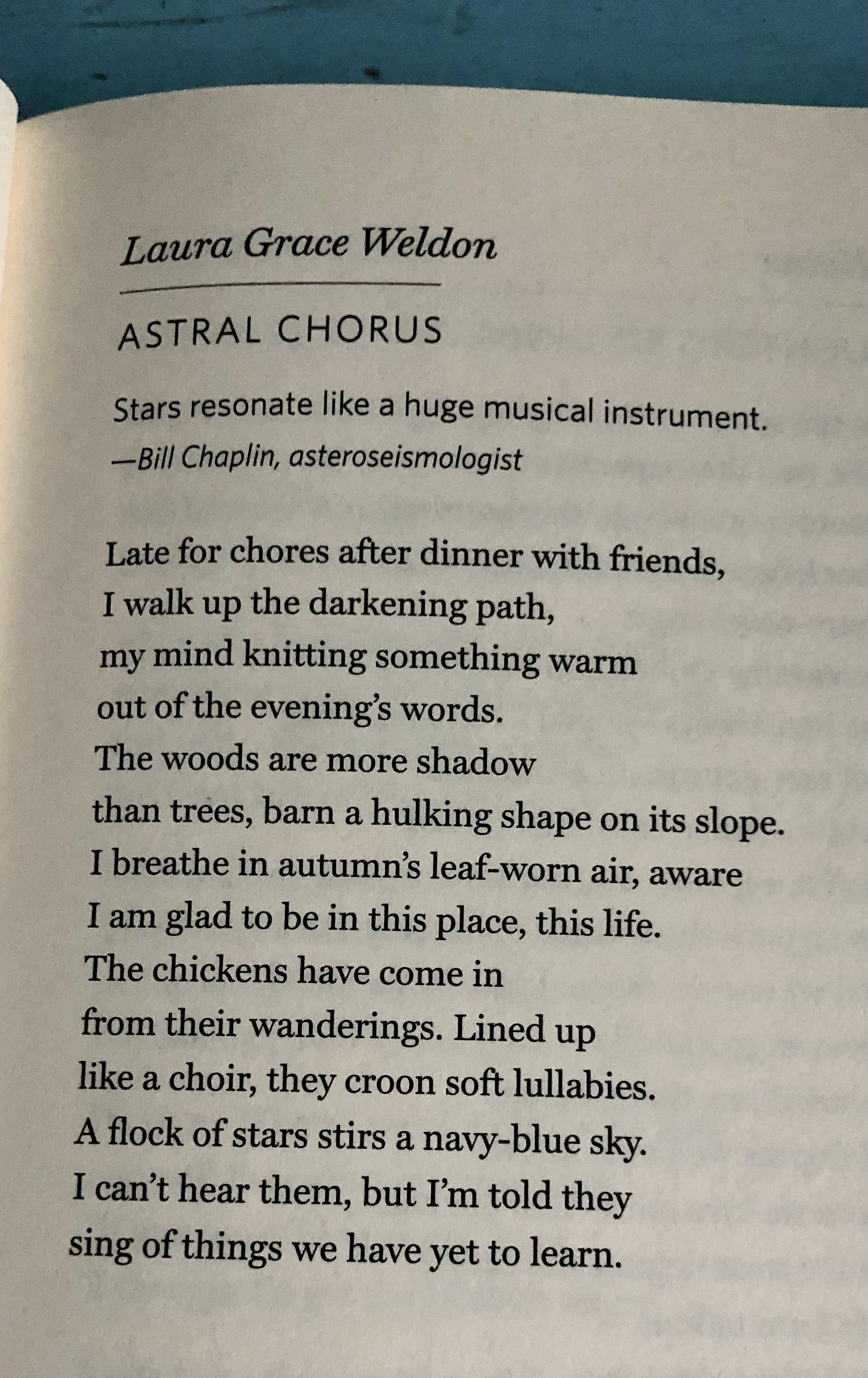
Don’t talk to me about the stars, about how cold and indifferent they are, about the unimaginable distances. There are millions of stars within us that are just as far, and people like me sometimes burn up a whole life trying to reach them.
When my youngest was just over a year old and not yet walking, I was at a child’s birthday party around a pond. I sat her to play on a blanket. Her back was to me, and, after a while, a little girl ran over to me and said something was wrong with my baby.
My baby’s eyes were watering terribly. Before long, she seemed to have trouble breathing. A woman I had just met drove me and the baby to the ER. I sat in the backseat, talking to my littlest, hearing my voice speaking quietly, as if I was dividing in two. I knew I was terribly afraid, because I wasn’t panicking.
By the time we had reached the ER, whatever bothered her had passed. Although I had her tested for multiple allergies, this event never occurred. But for the rest of the summer, I felt as though a knife had sliced over me, shearing off some essential part of me.
The pandemic has changed all of us — both over a year, and in smaller, sharper pieces, as in my family’s recent case. The New York Times shares stories today of new lives emerging, reshaping and reforming. Of lives going on.
When my youngest daughter was four, she and one of her best four-year-old friends were playing outside and called me to come from the kitchen and, “See the bunnies, mama!”
This was right around Easter, when the yard was worn-down snowbanks interspersed with wet earth. Two enormous hares were hopping around the yard, their white winter fur turning brown in patches. Or maybe the hares looked so large because the girls in their boots were so small.
Our house was surrounded by thousands of wild acres. We had seen moose and deer and bear wander through, but never hares that came to visit for a morning. The girls had made an open air house beneath the branches of a spruce tree. All morning, the hares came and went, hopping through on their powerful legs, then disappeared and never returned to play.
This Easter arrives in a strange and disorienting period in our family life, of tests and quarantining, of worry and waiting, of days of eating take-out Japanese food sent from my parents and coconut birthday cake. We’ve abandoned the dining room for the living room, surrounded by piles of library books, cats sleeping on blankets, and my two knitting projects. I’ve begun to wonder if I might ever brush my hair again.
My youngster asks what’s this holiday about anyway, with the rock rolling away and the ascension? On the phone, my brother offers his own explanation that I’ll keep unrepeated, although I woke wondering if Jesus himself wouldn’t have objected. Jesus walked in the most profane of the human world and perhaps embodied the most holy, too.
On this spring morning, with the robins singing in the box elder outside our kitchen, I’m grateful for both the ineffable mystery of spring — thaw and crocuses — and the mundane chores of dish washing and a kitchen floor badly in need of a sweep. Or, maybe, as so often before, I’m utterly wrong, and there’s not two things, not a both, but one.



 Stony Soil Vermont