A Little Green.

An acquaintance stops into work. I’m jammed to the point of frazzled with a list of what needs to be done, but I quit for a bit and shoot the breeze, ask what’s up in his world, and how his very large (by Vermont standards) business is faring.

We’re Vermonters, so our conversation naturally bends towards the weather. We’re dry — not New Mexico dry, where my parents live — but so dry in Vermont wells are going dry. Listening, I think how much of the summer is yet to come. Then he heads off to his day, and I head back into mine.

In the evening, I’m in a meeting at the town offices when the rain begins. The town offices are in a 100-year-old schoolhouse. It’s a well-made building of wood and walls of pressed-tin over, now shabby in places and in need of TLC, but endearing with history and craft. By then, the day has stretched out quite long for me, but I’m happy to be in this building, with jovial people who are doing their community part.

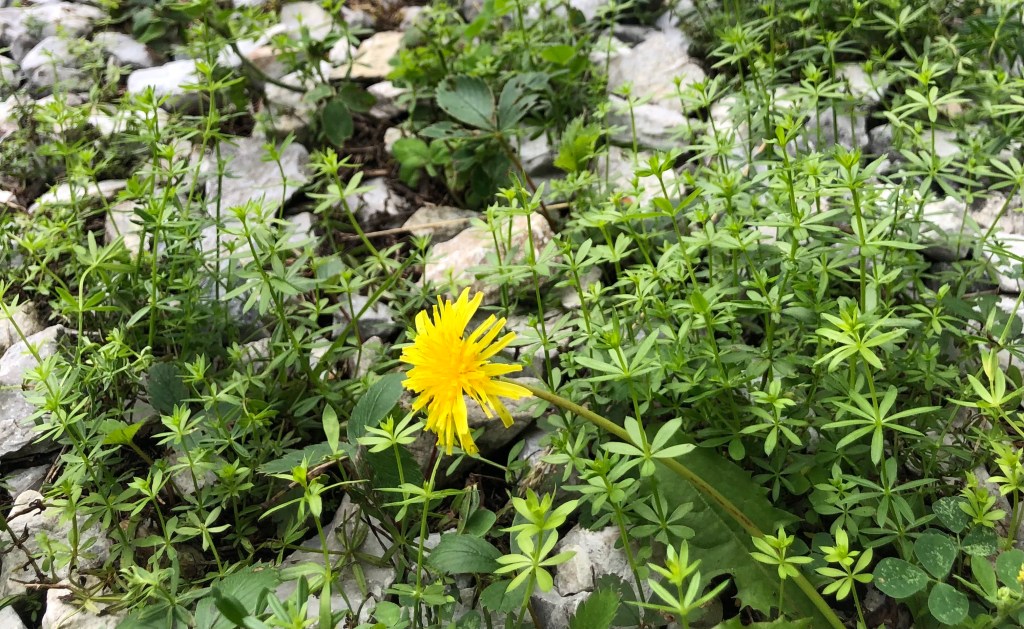
When I step outside in the dark, cold has moved in with the rain. But the rain falls steadily, at least for some amount of time. The next morning, the hillsides are vibrant green in a way I haven’t seen for some time.

We’re dry, but not as dry as we were before.
A Little Meal

A 13-year-old or so boy is fishing at the edge of the pond when my friend and I walk down in the evening to swim. He nicely shuffles to one side, and then we’re off.

The evening sky this summer has been especially enchanting — muted in color, pale peach sky with gentle blue.When we’re finished swimming and laughing, we stand for a moment on the weedy shore, and I point out a luna moth dipping and rising — part of the evening charm, like an Impressionist painting. Suddenly, a bird pursues the moth, then swallows it. A ragged wing falls.

And so much for the make-believe world.

Poem for America.

I was pruning the rose bushes along our house, pressed up against the clapboards, when I had the strangest feeling that I had stepped into a snapshot collage of my life: thorn, blood, house, half-hidden, wet moss under my knees, a cat bird screeching in the lilacs. This morning, I’m wearing a bulky sweater. Oh, Vermont July, how I love you.

Every year, my daughters and I end up in some lengthy discussion about the Fourth of July. This year, as if jointly agreeing to avoid words, we ate ice cream and lit sparklers after dark. The fireflies blinked, in their own particular journeys.

Here’s a poem in its entirety from Tony Hoagland’s Twenty Poems That Could Save America:

Even if the geraniums are artificial

Just the same,

In the rear of the Italian café

Under the nimbus of electric light

They are red; no less red

For how they were made. Above

The mirror and the napkins

In the little white pots . . .

. . . In the semi-clean café

Where they have good

Lasagna . . . The red is a wonderful joy

Really, and so are the people

Who like and ignore it. In this place

They also have good bread.”

“The Geraniums” by Genevieve Taggard

Hardwick, Vermont

The Giving Closet

In the town building where I work, there’s a room upstairs called The Giving Closet, jammed with the town’s cast-offs and free for the taking. Clothing, dishes, puzzles, books (from self-help to Isabelle Wilkinson’s brand-new Caste that I snapped up.

The space is infinitely fascinating — who gives, who gives what, and who takes. The wealthy who donate boxes of never-worn clothes. A widow who wept when she dropped off her husband’s suits. Those who leave handmade quilts or winter boots, to empty their house, but also hope that someone else might use these things. One woman handed over a pair of child’s boots, saying, But there’s so much use left in these…

The takers (mostly women) form an unending stream. In an unintentional way, The Giving Closet bucks capitalism. Need a coffee pot? A packet of seeds? A child’s snowsuit? This is the place.

It’s a place without policies, cobbled together, that moves along the uniquely local story of humanity — a solid plan.

July 1.

This photo snapshots summer for me.

I snapped this photo of my beloved daughter’s bare feet at a gas station, just before I had a conversation with a couple who had left Tennessee (brutally hot, they repeated) for the romantic life in Vermont. I kept thinking, but you haven’t meet Vermont’s January yet….

After so long, we finally had a full dinner table on our back porch yesterday, myself and the daughters and the boyfriend and my brother and his partner, all of us together with summer’s greenery pressing in — the domesticity of my potted plants and the wildness of box elder and cardinals interwoven.

Rain sprinkled, and we grilled steak and vegetables. Our conversation wound through drought, the pandemic and the Delta variant, QAnon, and my teenager’s job in a general store this summer.

Over the valley, I saw clouds darken, and rain broke again. Plate by chair by glass we carried in what needed to be covered, and kept talking.

Somewhere in Summer.

Vermont’s summer mugginess settles in, and I lie awake at night, remembering the much stickier summers of my childhood in southern New Hampshire, a thousand days of no school and bike riding and eating salted cucumber and playing Acquire with my brother and the neighbor — the ultimate game of capitalism.

But those were likely much less than a thousand days.

My youngest texts me at work. She and her friend explore different swimming holes and go hiking. Together, as new drivers, they match route numbers with roads, beginning to master maps. I worry about her — my youngest navigating the world on her own — this place of such ineffable beauty and real badness. This is the summer she’s learning the price of a tank of gas — a transaction between labor and coin. But it’s also the summer she’s beginning to realize the phrase girls travel in packs has much more meaning than looking for the women’s room.

This is the summer of phenomenal sunsets and sunsets, of studying the sky, wondering if rain might move in.

Quit counting, I counsel myself. The hot days unwind into hotter nights, but the dawn is cool, the dew lush over my toes.